
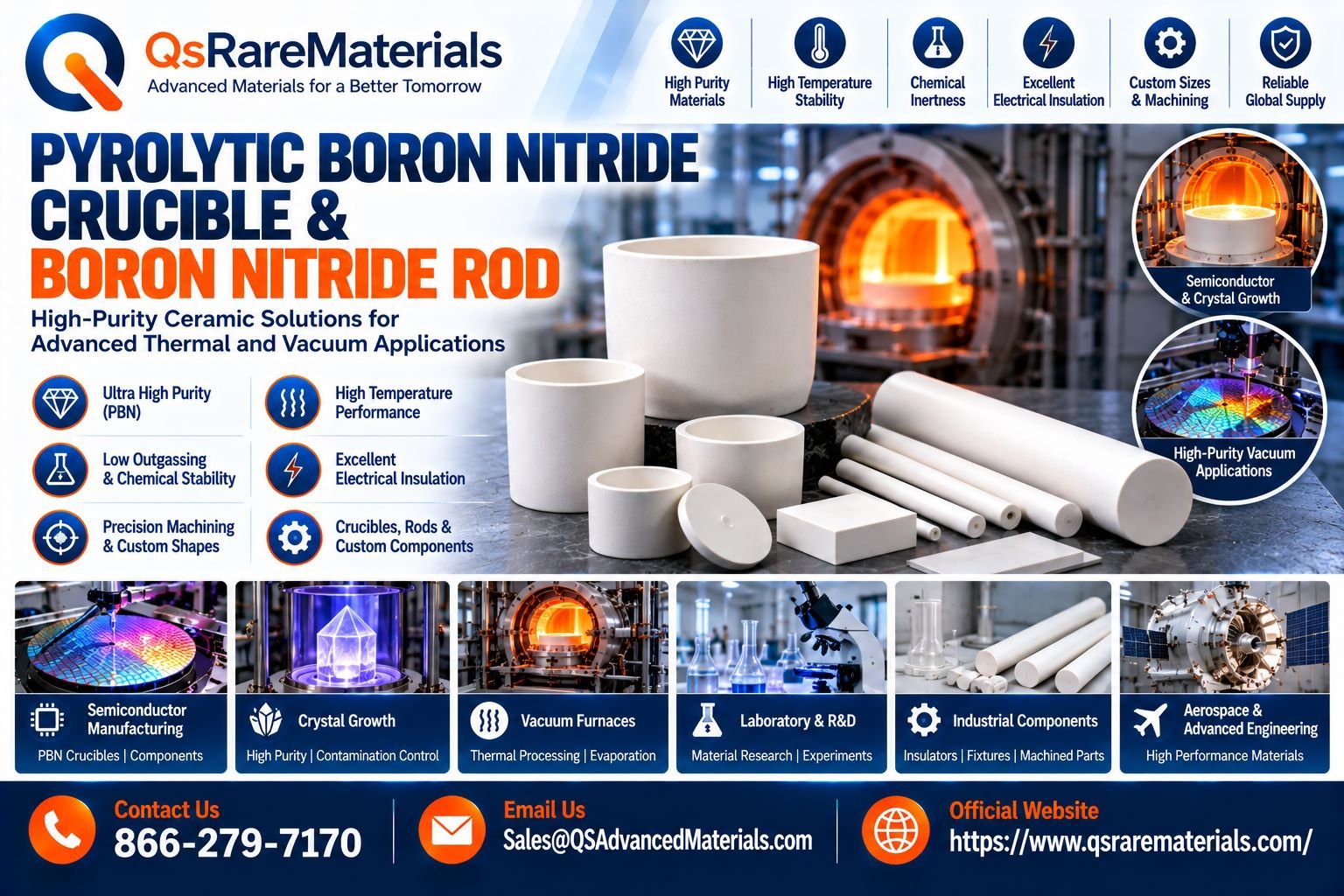
In specialised furnaces, the performance of a heating system depends not only on temperature settings but also on the materials and structures used inside the processing chamber.
A Pyrolytic Boron Nitride Crucible can serve as a specialised container for compatible materials under carefully controlled thermal conditions.
Meanwhile, a Boron Nitride Rod can be used to manufacture selected insulating supports, spacers, and positioning components for technical equipment.
Although these ceramic products serve different purposes, their appropriate application can support precise furnace assembly design.
For materials scientists, furnace manufacturers, and laboratory engineers, understanding how processing vessels and supporting components interact is essential for reliable thermal operations.
Why Furnace Fixture Design Matters
A thermal processing system contains multiple components that influence how materials are positioned and exposed to heat.
Crucibles, supports, insulating elements, and measurement instruments all contribute to the overall processing arrangement.
Improper component positioning can introduce unwanted temperature differences or mechanical stresses.
Similarly, unsuitable fixture materials may affect process cleanliness or component stability.
A well-designed furnace fixture should support the intended material without introducing unnecessary interference.
What Is a Pyrolytic Boron Nitride Crucible?
A Pyrolytic Boron Nitride Crucible is a specialised ceramic container manufactured from pyrolytic boron nitride, typically produced through chemical vapour deposition.
The material is recognised for its high purity, electrical insulation characteristics, and distinctive thermal properties.
Depending on operating conditions, these crucibles may be suitable for selected vacuum processing, high-purity material research, and controlled-atmosphere applications.
However, temperature capability and chemical compatibility depend on the processing environment.
Oxidising conditions, reactive materials, and mechanical stresses can limit performance.
Engineers should therefore evaluate the actual application rather than relying on general material descriptions.
Understanding the Function of a Boron Nitride Rod
A Boron Nitride Rod is a solid ceramic component that may be used directly or machined into specialised engineering parts.
Depending on its grade and construction, it can support the production of electrical insulators, spacers, locating features, and other technical components.
Hot-pressed boron nitride rods and pyrolytic boron nitride components may differ significantly in structure and material properties.
These differences are important when selecting components for furnace applications.
Rod dimensions, mechanical loading, temperature exposure, and chemical compatibility should be considered before installation.
Boron nitride ceramics are relatively brittle, so suitable handling and support arrangements are essential.
Controlling Component Position Inside Furnaces
Precise positioning can influence the repeatability of thermal experiments.
A crucible placed in an unsuitable location may experience a different thermal environment from one positioned within the intended processing zone.
Support components can help maintain a consistent arrangement between experiments.
Machined ceramic rods or spacers may be useful when their material properties and mechanical strength are appropriate.
However, their design should avoid concentrated loading or unnecessary restraint.
Engineers should document fixture dimensions and approved component positions when consistent experimental conditions are required.
Comparing Crucibles and Ceramic Support Rods
| Engineering Factor | Pyrolytic Boron Nitride Crucible | Boron Nitride Rod |
| Main Function | Containing compatible processing materials | Supporting or positioning components |
| Typical Construction | Deposited ceramic structure | Grade-dependent ceramic stock |
| Design Priority | Cavity dimensions and wall geometry | Diameter, length, and machined features |
| Key Consideration | Chemical and thermal compatibility | Mechanical and thermal suitability |
| Handling Concern | Cracking and surface damage | Brittle fracture and edge damage |
| Typical Evaluation | Container performance | Fixture stability and insulation |
Both products require separate technical evaluation before being incorporated into the same assembly.
Why Thermal Gradients Require Attention
Temperature is not always distributed uniformly throughout a furnace chamber.
Differences in heater arrangement, component position, insulation, and surrounding surfaces can influence local thermal conditions.
A ceramic crucible may therefore experience different temperatures across its structure.
Fixture geometry can also affect local heat transfer.
Pyrolytic boron nitride exhibits anisotropic properties, meaning certain characteristics vary with material direction.
This behaviour can be relevant when evaluating thermal response.
Engineers should consider component orientation and furnace geometry rather than assuming uniform heating.
Suitable temperature measurement and process validation can help identify significant variations.
Mechanical Compatibility During Thermal Processing
Ceramics and surrounding furnace components may expand differently as temperature changes.
If a crucible or supporting structure is constrained too tightly, mechanical stress may develop.
This can contribute to cracking or component damage.
Fixture designers should consider appropriate clearances, support locations, and contact surfaces.
Boron nitride rods used as positioning elements must also have sufficient mechanical strength for the intended arrangement.
Complex fixtures should be assessed using suitable engineering calculations or representative testing.
A reliable design should support the components without introducing unnecessary mechanical loads.
Avoiding Contamination From Furnace Components
In high-purity applications, every material inside the processing chamber may influence experimental results.
Potential contamination sources include handling residues, fixture materials, loose particles, and chemical reactions.
Selected boron nitride ceramics may offer useful properties for controlled processing.
However, grades containing additives or binders can behave differently from high-purity pyrolytic material.
Suppliers should therefore provide appropriate material specifications.
Cleaning procedures must also be compatible with the ceramic components.
No material should be assumed completely contamination-free under every processing condition.
Custom Ceramic Geometry for Specialised Equipment
Standard crucible and rod dimensions may not satisfy every laboratory requirement.
A research system may need a container with a particular diameter or cavity shape.
Likewise, a furnace fixture may require a machined support with specific positioning features.
Custom ceramic components can address these requirements where manufacturing capabilities permit.
However, narrow sections, sharp corners, and complex geometries may create structural or fabrication challenges.
Early discussion with a technical materials supplier can help establish practical dimensions and tolerances.
Quality Inspection Before Furnace Installation
Ceramic components should be inspected before being introduced into critical processing equipment.
Relevant checks may include:
- Dimensional accuracy and approved geometry.
- Visible cracks, chips, or surface damage.
- Material identification and relevant purity specifications.
- Compatibility with the intended temperature and atmosphere.
- Suitable fit within the supporting fixture.
Representative testing may be necessary for demanding applications.
Documented inspection procedures can support more consistent component selection and installation.
Frequently Asked Questions (FAQs)
1. What is a Pyrolytic Boron Nitride Crucible?
It is a high-purity ceramic container made from pyrolytic boron nitride for specialised material processing under suitable operating conditions.
2. What is a Boron Nitride Rod used for?
It may be used to manufacture ceramic spacers, electrical insulators, supports, and customised technical components.
3. Can boron nitride components be used in vacuum furnaces?
Certain grades are suitable for selected vacuum applications, depending on temperature, chemistry, and equipment requirements.
4. Why is component positioning important in thermal processing?
Consistent positioning helps maintain comparable exposure to the intended furnace conditions and supports experimental repeatability.
5. How should buyers choose boron nitride ceramic components?
They should evaluate material grade, purity, geometry, operating atmosphere, chemical compatibility, mechanical requirements, and inspection documentation.
Media Contact
Department: Advanced Ceramic Materials and Technical Product Enquiries
Phone: 866-279-7170
Email: Sales@QSAdvancedMaterials.com
Official Website: https://www.qsrarematerials.com/