Modern product engineering depends on components that perform reliably under different mechanical, environmental, and operational conditions. While metal and plastic parts often receive significant design attention, flexible rubber components are equally important for product functionality.
From electronic enclosures and automotive assemblies to industrial equipment and consumer products, custom silicone rubber parts provide specialised solutions for sealing, cushioning, insulation, and protection.
Similarly, silicone rubber molded parts allow manufacturers to incorporate flexible components into products with complex shapes and specific performance requirements.
The challenge is not simply producing a rubber component. It is ensuring that the material, geometry, and surrounding assembly work together effectively.
This engineering-focused approach can help manufacturers improve product integration, reduce assembly difficulties, and achieve more consistent performance.
Why Silicone Components Matter in Product Engineering
Silicone rubber is widely recognised for its flexibility, thermal stability, and electrical insulation properties.
However, these characteristics vary according to the selected formulation.
In a finished product, silicone components may serve as interfaces between rigid materials, helping accommodate movement, vibration, or dimensional differences.
For example, a flexible gasket can create a seal between two enclosure surfaces when designed and compressed appropriately.
This makes silicone component design an important part of overall product development.
What Are Custom Silicone Rubber Parts?
Custom silicone rubber parts are components developed according to specific dimensions, material requirements, and functional objectives.
Unlike standard catalogue products, customised components are designed to fit particular equipment or product assemblies.
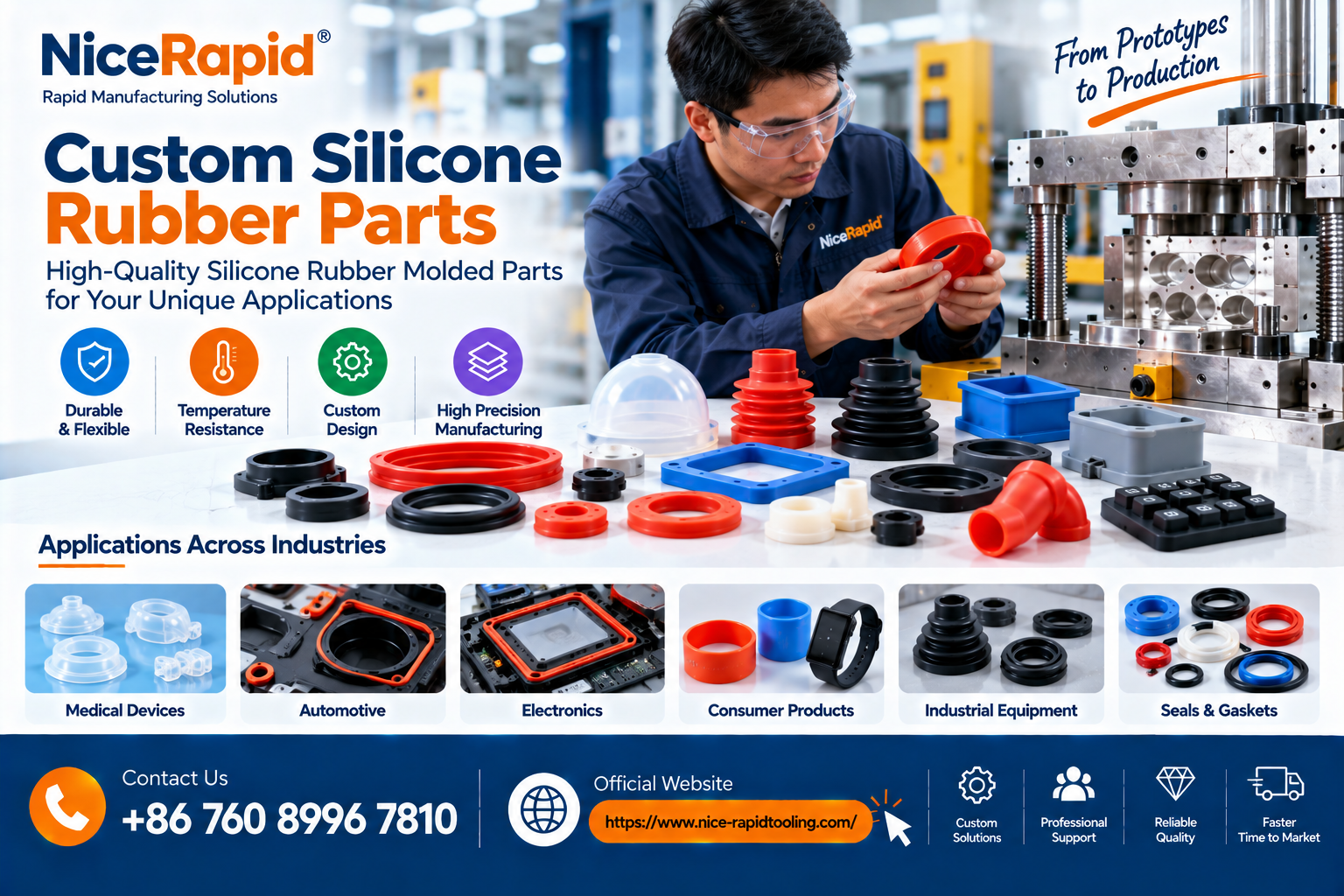
Common examples include gaskets, protective boots, sealing rings, keypad membranes, flexible connectors, and cushioning elements.
Their design may involve unusual profiles, integrated features, or specialised material characteristics.
Customisation allows engineers to address application requirements that standard components may not satisfy.
However, the design must remain compatible with the selected manufacturing process and realistic production tolerances.
Understanding Silicone Rubber Molded Parts
Silicone rubber molded parts are manufactured by shaping silicone material inside suitable mould tooling.
Depending on the application, manufacturers may use compression molding, transfer molding, or silicone injection molding.
The appropriate process depends on material type, part geometry, production requirements, and manufacturing economics.
Molded silicone components can incorporate functional shapes such as grooves, flanges, flexible lips, and mounting features.
These details may help simplify assembly or support product performance.
Nevertheless, complex geometry requires careful assessment to ensure consistent manufacturing and reliable component removal from the mould.
Designing Silicone Components for Assembly Compatibility
One of the most important engineering considerations is how a silicone part interacts with neighbouring components.
A gasket must fit the intended housing, while a protective boot must accommodate movement without unwanted interference.
Designers need to evaluate dimensions, available space, attachment methods, and expected mechanical forces.
Incorrect geometry can cause installation difficulties or inconsistent performance.
Reviewing silicone interfaces alongside surrounding metal and plastic components can help identify potential design conflicts before production.
How Different Applications Influence Design Requirements
Custom silicone components serve different functions across industrial and commercial products.
| Application | Typical Silicone Component | Important Design Consideration |
| Electronic Enclosures | Sealing gasket | Compression and enclosure fit |
| Consumer Electronics | Flexible button membrane | Tactile response |
| Industrial Machinery | Protective boot | Movement and environmental exposure |
| Automotive Assemblies | Flexible seal | Temperature and fluid compatibility |
| Electrical Products | Insulating component | Required dielectric properties |
| Medical Devices | Specialised silicone component | Biocompatibility and regulatory requirements |
Material and design specifications should reflect the actual operating environment.
The Importance of Material Properties
Selecting silicone rubber involves evaluating more than appearance or softness.
Material hardness, tensile strength, elongation, compression set, and environmental resistance may influence component performance.
For sealing applications, the ability to maintain appropriate contact pressure is particularly important.
For flexible buttons or protective covers, repeated deformation may be a greater concern.
Chemical compatibility must also be evaluated because silicone rubber is not suitable for every fluid or substance.
Engineers should select materials using documented performance requirements rather than relying on general descriptions of silicone durability.
Why Dimensional Tolerances Require Attention
Silicone rubber behaves differently from rigid engineering materials.
Its flexibility, curing behaviour, and potential shrinkage can influence manufactured dimensions.
Very tight tolerances may increase tooling complexity and inspection requirements without improving functional performance.
Designers should therefore distinguish between dimensions essential to product function and those that allow greater variation.
For example, a sealing surface may require more careful dimensional control than a noncritical decorative feature.
Appropriate tolerance planning supports manufacturability and helps prevent unnecessary production costs.
Design for Manufacturing and Tooling Efficiency
Design for manufacturing, commonly called DFM, involves adapting a component design to support practical production.
For molded silicone parts, this may include reviewing wall thickness, parting lines, draft requirements, undercuts, and flash-sensitive surfaces.
Features that appear straightforward in a digital model may create difficulties during mould construction or demoulding.
Early cooperation between product designers and manufacturing engineers can help identify these concerns.
A suitable design balances component function, tooling practicality, material behaviour, and required production quality.
DFM reviews can also reduce the likelihood of expensive design modifications after tooling has been completed.
Validating Silicone Components Before Production Approval
A silicone component should be evaluated within its intended assembly whenever practical.
Dimensional inspection confirms whether selected measurements meet specifications, but it does not necessarily establish functional suitability.
Application-specific testing may involve compression behaviour, sealing performance, repeated movement, or exposure to relevant environmental conditions.
The appropriate testing programme depends on the consequences of component failure.
For specialised products, manufacturers may evaluate prototypes before approving final tooling or production arrangements.
Testing results can reveal opportunities to improve geometry, material selection, or assembly procedures.
Quality Control and Component Consistency
Consistent quality is essential for silicone components used in functional assemblies.
Manufacturers may establish checks for appearance, dimensions, material identity, and relevant performance characteristics.
Quality requirements should reflect the component’s intended use.
For example, an electrical insulating component may require different verification from a decorative silicone grip.
Production documentation and appropriate inspection records can support traceability and corrective action when problems occur.
A clear agreement between the customer and manufacturer helps establish which characteristics are essential for acceptance.
Choosing the Right Custom Silicone Manufacturing Partner
Businesses evaluating silicone manufacturing services should consider technical capabilities and communication quality.
Important factors include:
- Engineering Support: Ability to review design requirements and manufacturability.
- Material Knowledge: Understanding of relevant silicone formulations.
- Tooling Capability: Suitable precision and mould construction expertise.
- Production Flexibility: Support for appropriate manufacturing quantities.
- Quality Assurance: Defined inspection procedures and acceptance criteria.
- Technical Communication: Clear handling of drawings, revisions, and specifications.
A capable manufacturer should explain the practical implications of design decisions before production begins.
Frequently Asked Questions (FAQs)
1. What are custom silicone rubber parts?
They are specially designed silicone components manufactured according to specific dimensions, material properties, and functional requirements.
2. What are silicone rubber molded parts used for?
They are used in applications involving sealing, insulation, cushioning, vibration management, flexible controls, and equipment protection.
3. Can silicone rubber components be manufactured in complex shapes?
Yes. Molding processes can produce various geometries, although design complexity must be evaluated against tooling and manufacturing requirements.
4. What affects the cost of custom silicone components?
Tooling complexity, component dimensions, material selection, production quantity, tolerances, and inspection requirements can influence cost.
5. Why is prototype testing important for silicone parts?
Prototype testing helps engineers evaluate component fit, material behaviour, and functional performance before approving manufacturing arrangements.
Media Contact
Department: Custom Silicone Components and Precision Manufacturing Enquiries
Enquiry Categories: Custom Silicone Rubber Parts, Silicone Rubber Molded Parts, Precision Tooling, Rubber Component Design, Prototype Development, and Industrial Manufacturing.
Contact: +86 760 8996 7810
Email: enquiry@nice-rapidtooling.com
Official Website: https://www.nice-rapidtooling.com/