
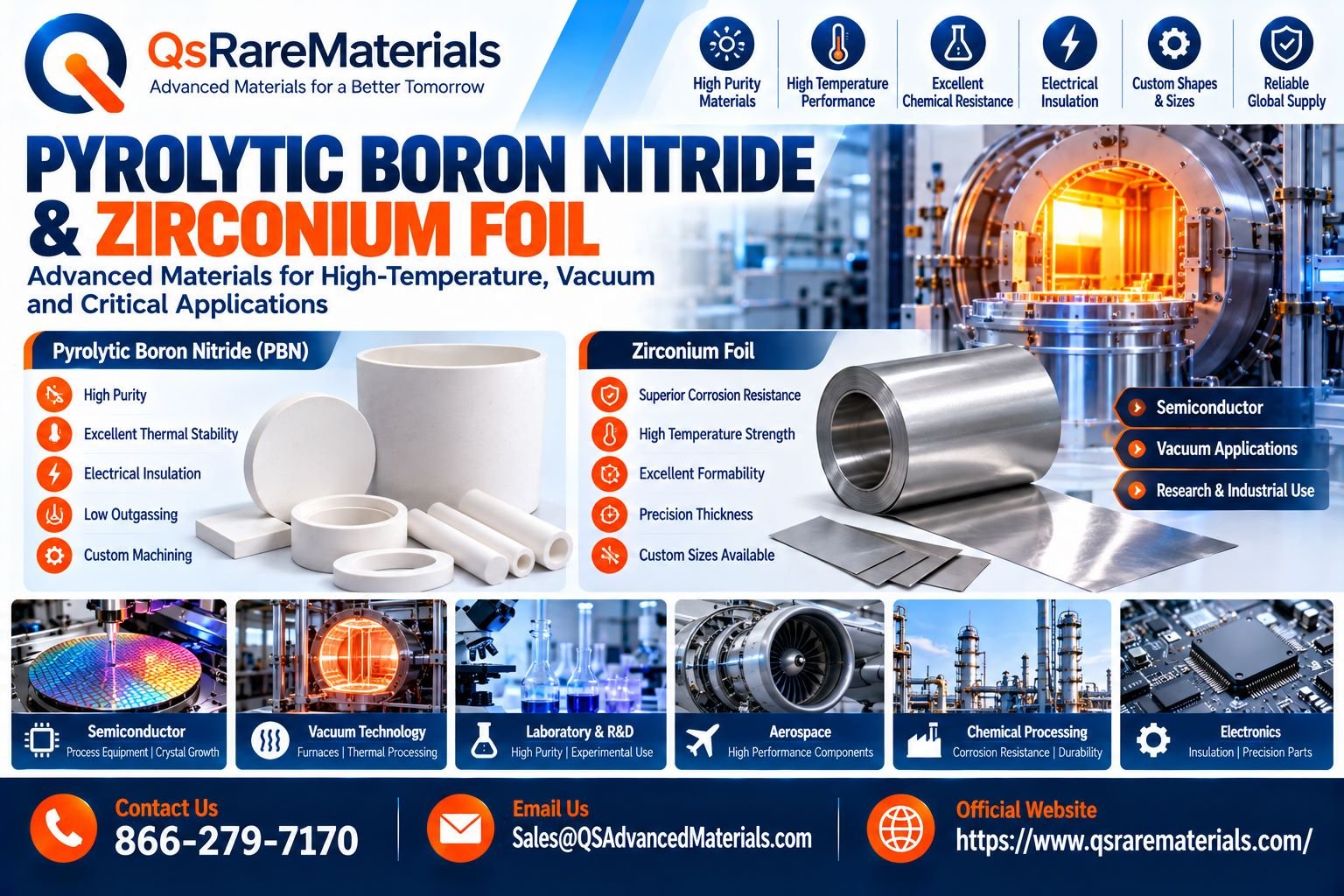
Specialised materials laboratories are examining how component selection influences the reliability of vacuum experiments, thermal measurements, and surface engineering processes.
In precision research equipment, even small differences in material behaviour can affect experimental results. Engineers must consider electrical insulation, surface reactions, thermal characteristics, and the way individual components interact inside controlled environments.
Pyrolytic Boron Nitride provides distinctive ceramic properties suitable for selected electrical insulation and high-temperature vacuum applications.
Meanwhile, Zirconium Foil offers a thin metallic material that researchers can investigate in surface chemistry, oxidation studies, and specialised experimental assemblies.
Although these materials serve different purposes, understanding their characteristics can help engineers design reliable research systems.
The focus is on selecting appropriate materials for specific functions rather than assuming that one material can meet every engineering requirement.
Why Material Selection Matters in Vacuum Engineering
Vacuum systems are used in semiconductor research, surface analysis, materials science, and specialised thermal processing.
These systems require components compatible with their intended pressure, temperature, and chemical environments.
An unsuitable material may release contaminants, react with surrounding substances, or introduce unwanted electrical effects.
Consequently, researchers must evaluate each material according to its role.
Careful selection helps engineers establish consistent experimental environments and investigate unexpected results.
What Is Pyrolytic Boron Nitride?
Pyrolytic Boron Nitride, commonly abbreviated as PBN, is a technical ceramic generally manufactured through chemical vapour deposition.
Its layered structure gives the material direction-dependent thermal characteristics.
PBN also provides electrical insulation and can be manufactured with high purity.
These properties make it useful for selected specialised research equipment and thermal processing applications.
Depending on component design, PBN may be used for insulating elements, crucibles, or compatible processing fixtures.
However, performance depends on the operating atmosphere, temperature, geometry, and material quality.
High-temperature exposure to oxidising conditions can limit its suitability.
Understanding Zirconium Foil
Zirconium Foil is a thin sheet of zirconium metal manufactured to specified thickness and dimensional requirements.
Zirconium exhibits distinctive chemical behaviour, including a strong affinity for oxygen under suitable conditions.
This makes it relevant to selected investigations involving oxidation, surface reactions, and metallic materials.
Researchers may use foil specimens to examine how environmental conditions affect zirconium surfaces.
However, zirconium foil must not automatically be treated as a ready-to-use vacuum getter.
Its behaviour depends on surface condition, temperature, atmosphere, and the engineering arrangement.
Suitable technical assessment is necessary before considering any reactive-metal application.
Electrical Insulation Versus Metallic Conductivity
PBN and zirconium have fundamentally different electrical properties.
PBN generally functions as an electrical insulator, while zirconium is an electrically conductive metal.
This distinction is important when researchers design experimental fixtures containing heating elements, electrodes, or metallic test specimens.
An insulating component may help separate electrically active parts within an appropriately engineered assembly.
A metallic foil may serve as a specimen or functional material where conductivity is required.
However, both materials must be positioned to avoid unintended contact, short circuits, or mechanical damage.
The complete electrical design should be evaluated before operation.
Comparing Important Engineering Characteristics
| Material Property | Pyrolytic Boron Nitride | Zirconium Foil |
| Material Type | Technical ceramic | Thin metallic sheet |
| Electrical Behaviour | Generally insulating | Conductive |
| Key Engineering Interest | Insulation and thermal characteristics | Surface chemistry and metallic properties |
| Common Form | Crucibles and specialised ceramic shapes | Thin foil specimens |
| Mechanical Consideration | Brittle behaviour | Deformation and surface damage |
| Critical Limitation | Atmosphere-dependent performance | Oxidation and chemical reactivity |
These differences demonstrate why materials should be selected according to their intended functions.
Surface Reactions and Experimental Accuracy
Surface conditions can significantly influence specialised materials experiments.
Zirconium naturally develops an oxide layer under ordinary environmental exposure.
That surface condition may affect subsequent experiments involving chemical reactions, electrical contact, or thermal processing.
Researchers should therefore document specimen preparation and relevant exposure conditions.
PBN components also require suitable handling to minimise contamination and mechanical damage.
Appropriate cleaning, inspection, and specimen documentation support reliable comparisons.
Thermal Gradients and Fixture Design
Thermal gradients occur when different areas of an experimental assembly experience different temperatures.
These gradients can influence measurements, material reactions, and mechanical behaviour.
PBN’s anisotropic thermal characteristics should be considered when designing compatible ceramic components.
Zirconium foil may respond differently to heating because of its metallic structure, thickness, and surface condition.
When materials operate near one another, engineers must evaluate thermal expansion and contact arrangements.
Poorly designed restraints may introduce stress or distort thin specimens.
Representative testing helps establish whether the fixture performs as intended.
Handling Thin Foil and Technical Ceramics
Material handling is an important part of laboratory quality control.
Thin zirconium foil can become scratched, bent, or contaminated during preparation.
PBN components can experience chipping or fracture under unsuitable mechanical loads.
Researchers should use appropriate handling tools and clean storage arrangements.
Zirconium dust and fine particles can introduce significant ignition hazards, especially during machining or abrasive processing.
Safety procedures should reflect the material’s physical form and the work being performed.
Relevant supplier safety documentation should be reviewed before processing.
Designing Repeatable Research Experiments
Reliable experiments require clearly defined operating conditions.
Researchers should document material grades, dimensions, surface preparation, and component positioning.
For thermal or vacuum experiments, relevant parameters may include chamber conditions, specimen placement, and measurement arrangements.
Using consistent procedures helps researchers determine whether observed differences reflect genuine material behaviour.
However, repeatability does not establish accuracy by itself.
Measurement equipment must also be appropriately calibrated and suitable for the intended application.
Selecting Materials for Custom Research Equipment
Custom laboratory equipment may require specialised ceramic components or thin metallic specimens.
Before procurement, engineers should establish:
- Material Composition: Confirm the required grade and purity.
- Dimensions: Specify thickness, geometry, and tolerances.
- Operating Conditions: Define temperature and atmosphere.
- Electrical Requirements: Evaluate insulation or conductivity.
- Mechanical Suitability: Review handling and loading conditions.
- Quality Documentation: Request relevant inspection information.
Clear specifications support better communication between research teams and material suppliers.
Frequently Asked Questions (FAQs)
1. What is Pyrolytic Boron Nitride?
Pyrolytic boron nitride is a high-purity technical ceramic generally produced through chemical vapour deposition and used in selected specialised thermal and electrical applications.
2. What is Zirconium Foil used for?
Zirconium foil can be used in materials research, metallic specimen preparation, and selected experiments involving surface chemistry or thermal behaviour.
3. Is pyrolytic boron nitride electrically insulating?
Yes. PBN generally provides electrical insulation, although its suitability must be evaluated under the intended operating conditions.
4. Can zirconium foil be used in vacuum experiments?
It may be suitable for selected experiments, but surface oxidation, chemical reactivity, temperature, and safety considerations require evaluation.
5. How should researchers select specialised ceramic and metallic materials?
They should compare verified material properties, purity, dimensions, operating conditions, safety requirements, and supplier documentation.
Media Contact
Department: Advanced Ceramics and Specialty Materials Enquiries
Phone: 866-279-7170
Email: Sales@QSAdvancedMaterials.com
Official Website: https://www.qsrarematerials.com/