The global specialty chemical landscape is becoming increasingly application-driven as manufacturers seek raw materials capable of solving precise technical challenges. Within this changing environment, 2,3-dimethyl-2,3-diphenylbutane and 1,2-octanediol illustrate how highly specific chemical structures can deliver value across very different industrial sectors.
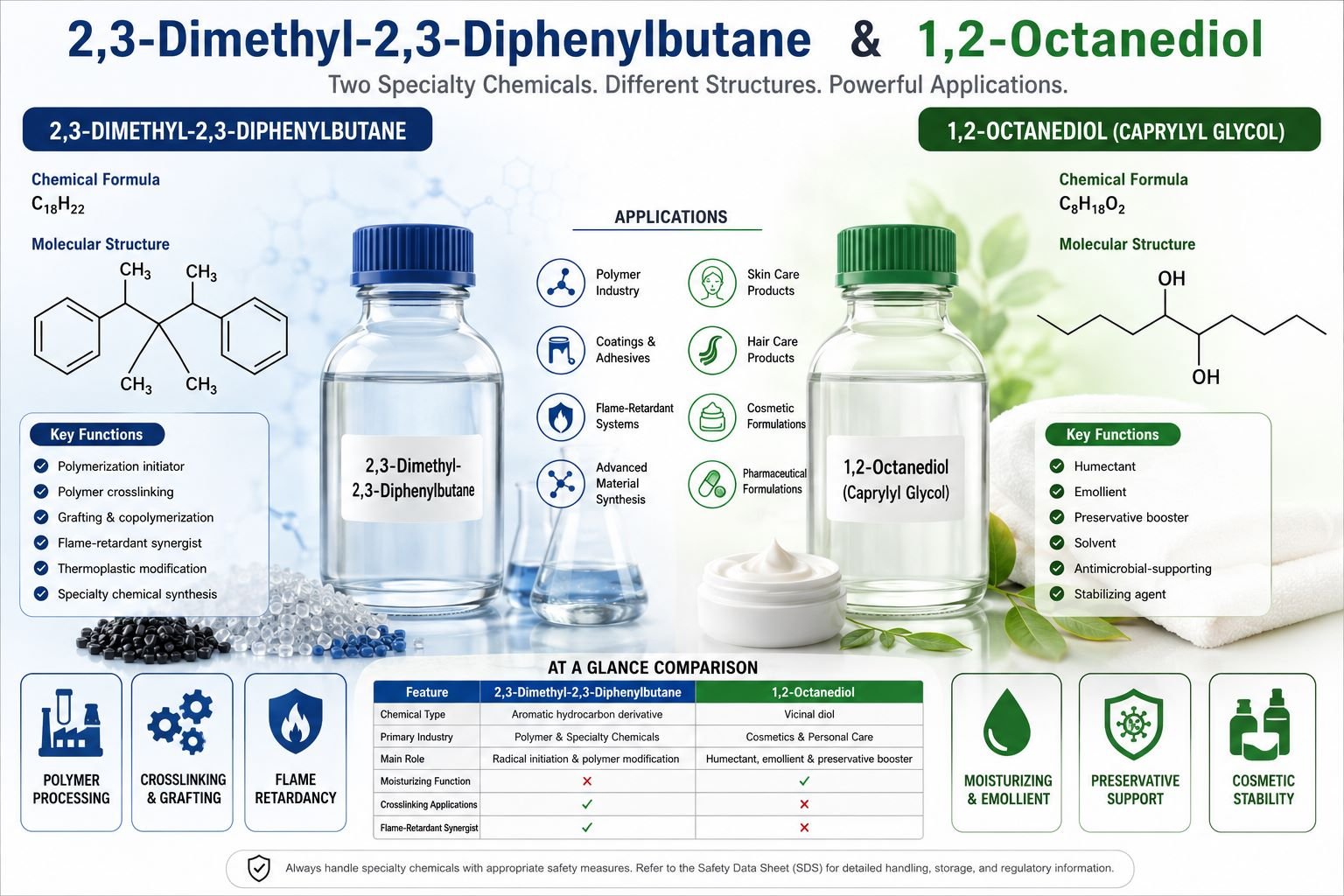
Rather than competing for the same applications, these two compounds address separate manufacturing requirements. 2,3-dimethyl-2,3-diphenylbutane is associated primarily with polymer chemistry, radical reactions, crosslinking, and specialized additive systems. 1,2-octanediol, also known as caprylyl glycol in cosmetic applications, has become important for personal-care formulations requiring moisturization, emolliency, and preservation support.
Manufacturers Look Beyond Conventional Raw Materials
Today’s manufacturers are under pressure to improve product performance while maintaining consistent processing and quality.
As a result, chemical selection is increasingly based on functional contribution. A specialty ingredient may be chosen because it initiates a particular reaction, improves material properties, supports stability, enhances sensory characteristics, or contributes multiple functions simultaneously.
Major considerations now include:
- Chemical purity and consistency
- Processing compatibility
- Functional efficiency
- Thermal characteristics
- Formulation stability
- Regulatory suitability
- Storage requirements
- Reliable supply
This performance-focused approach is strengthening the role of technically specialized compounds.
2,3-Dimethyl-2,3-Diphenylbutane Offers Distinctive Molecular Behavior
The structure of 2,3-dimethyl-2,3-diphenylbutane gives the compound particular relevance in radical chemistry.
Its molecular framework contains two phenyl groups together with highly substituted central carbon atoms. Under appropriate thermal conditions, the central carbon-carbon bond can undergo homolytic cleavage.
The resulting radical species can participate in reactions that are useful for selected polymer-processing applications.
This characteristic separates the compound from additives that function only as passive fillers or modifiers.
Polymer Processing Emerges as a Core Application Area
The properties of a polymer depend substantially on the organization and interaction of its molecular chains.
Manufacturers may modify these chains to achieve specific processing or performance characteristics. Radical chemistry provides one route for producing such changes.
Potential functions associated with 2,3-dimethyl-2,3-diphenylbutane include:
- Initiating radical reactions
- Supporting polymer crosslinking
- Facilitating grafting processes
- Assisting polymer modification
- Supporting selected copolymerization processes
- Contributing to specialty additive systems
Each application requires careful optimization because polymer chemistry, temperature, concentration, and processing time can influence results.
Crosslinking Helps Engineers Tailor Material Properties
Crosslinking connects separate polymer chains and can change the physical behavior of the resulting material.
Depending on the polymer and crosslinking level, manufacturers may achieve changes in heat resistance, mechanical behavior, dimensional stability, and durability.
2,3-dimethyl-2,3-diphenylbutane can be relevant in selected applications where radical generation is required to facilitate controlled polymer modification.
Application Testing Determines Practical Performance
There is no universal concentration or processing condition suitable for every polymer.
Manufacturers should conduct laboratory and pilot-scale trials to determine how the compound behaves with specific resins, additives, temperatures, and manufacturing processes.
Flame-Retardant Synergy Adds Another Technical Dimension
The need for materials with improved fire-performance characteristics continues across transportation, electrical, construction, industrial equipment, and engineered plastics.
In selected formulations, 2,3-dimethyl-2,3-diphenylbutane can have relevance as a flame-retardant synergist.
Instead of functioning exclusively as the principal flame retardant, a synergistic component is designed to enhance the performance of another flame-retardant system.
Possible formulation objectives include:
- Improving overall flame-retardant efficiency
- Optimizing additive concentrations
- Maintaining processing characteristics
- Balancing physical properties
- Supporting specialized polymer development
Final fire performance must be verified using testing appropriate to the intended product and market.
1,2-Octanediol Reflects the Rise of Multifunctional Formulation Ingredients
At the opposite end of the specialty chemical spectrum, 1,2-octanediol demonstrates the growing importance of multifunctionality.
The molecule consists of an eight-carbon chain containing two adjacent hydroxyl groups. This structure gives it characteristics useful in formulations containing both aqueous and oil-related components.
Known commonly as caprylyl glycol within cosmetic ingredient systems, the compound is widely relevant to modern personal-care development.
Personal Care Creates Demand for Smarter Ingredient Systems
Today’s cosmetics are expected to provide much more than basic appearance or cleansing.
Consumers seek hydration, smooth texture, comfortable application, pleasant skin feel, and reliable product quality. Formulators must deliver these characteristics while also addressing stability and microbial protection.
1,2-octanediol can be incorporated into products including:
- Moisturizing creams
- Facial lotions
- Body-care products
- Cosmetic serums
- Cleansing systems
- Hair-care formulations
- Emulsions
- Specialized skin-care products
Its multifunctionality gives formulation scientists flexibility when designing sophisticated ingredient systems.
Moisturizing and Emollient Characteristics Strengthen Its Position
One of the principal formulation benefits of 1,2-octanediol is its contribution to skin conditioning.
Its humectant characteristics can support moisture management, while its emollient function can help improve softness and sensory properties.
Cosmetic Performance Extends Beyond Hydration
Modern formulation development considers several interconnected characteristics:
- Moisture retention
- Product texture
- Skin softness
- Spreadability
- Application experience
- After-feel
A multifunctional ingredient can therefore contribute to both technical formulation objectives and the consumer’s experience of the finished product.
Preservation Support Addresses a Critical Formulation Challenge
Water-containing personal-care products require careful microbial management.
1,2-octanediol can contribute antimicrobial-supporting properties, making it useful as part of broader preservation strategies.
Its performance can depend on:
- Product pH
- Ingredient concentration
- Water activity
- Other preservatives
- Surfactants and emulsifiers
- Packaging design
- Manufacturing hygiene
Preservative Systems Require Verification
No formulation should be considered adequately protected simply because it contains a preservative-supporting ingredient.
Microbial challenge testing, stability studies, and appropriate quality-control procedures are essential before commercial introduction.
Industrial Comparison Highlights Different Functions
| Area | 2,3-Dimethyl-2,3-Diphenylbutane | 1,2-Octanediol |
| Primary industry | Polymers | Personal care |
| Main chemistry | Radical chemistry | Formulation chemistry |
| Polymer modification | Significant | Limited |
| Crosslinking | Relevant | Not primary |
| Flame-retardant synergy | Potential use | Not typical |
| Cosmetic applications | Limited | Extensive |
| Moisturizing function | Not typical | Relevant |
| Emollient properties | Not typical | Relevant |
| Preservation support | Not typical | Relevant |
| Technical formulation value | High | High |
The compounds demonstrate how specialty chemicals can create value through entirely different mechanisms.
Supply Quality Becomes Essential for Commercial Manufacturing
Technical performance depends not only on chemical identity but also on consistent material quality.
Manufacturers should evaluate purity, impurity levels, batch consistency, packaging, storage conditions, and traceability when sourcing either compound.
Documents such as Certificates of Analysis, Safety Data Sheets, product specifications, and regulatory information provide important support for procurement and quality-control decisions.
Frequently Asked Questions
What makes 2,3-dimethyl-2,3-diphenylbutane technically important?
Its ability to generate radicals under suitable conditions makes it relevant to specialized polymer chemistry.
What industries may use this compound?
Its primary applications are associated with polymers, engineered materials, and specialty chemical processing.
Can it be used for polymer crosslinking?
Yes. It can support selected radical-driven crosslinking and polymer-modification processes.
What is its role in flame-retardant systems?
It may function as a synergist that supports the effectiveness of selected flame-retardant formulations.
What is 1,2-octanediol commonly known as?
It is commonly known as caprylyl glycol in cosmetic and personal-care applications.
Why do cosmetic formulators use 1,2-octanediol?
It can provide moisturizing, emollient, conditioning, and preservation-supporting functionality.
Does 1,2-octanediol support hydration?
Yes. Its humectant characteristics can contribute to moisture management in suitable formulations.
Can it replace conventional preservatives?
Not automatically. Preservation performance depends on the entire formulation and requires appropriate testing.
Are both chemicals used for the same purpose?
No. One primarily serves polymer-related applications, while the other is strongly associated with cosmetic formulation.
Why does supplier quality matter?
Reliable purity and batch consistency help manufacturers maintain predictable processing and finished-product performance.
https://newsgrow.blogspot.com/2026/08/ethylhexylglycerin-emerges-as-key.html
https://newsgrow.blogspot.com/2026/08/inside-modern-formulations-science-and.html