
Every time a construction machine raises a heavy load, a tractor operates an attachment, or a production machine performs a powerful controlled movement, a hydraulic system may be doing the hard work. Hydraulic power is valued because it can transfer substantial force efficiently while giving machinery precise control.
But the performance of these systems depends on something surprisingly simple: keeping hydraulic fluid moving safely between components. This is where Hydraulic Hose and Hydraulic Fittings become essential.
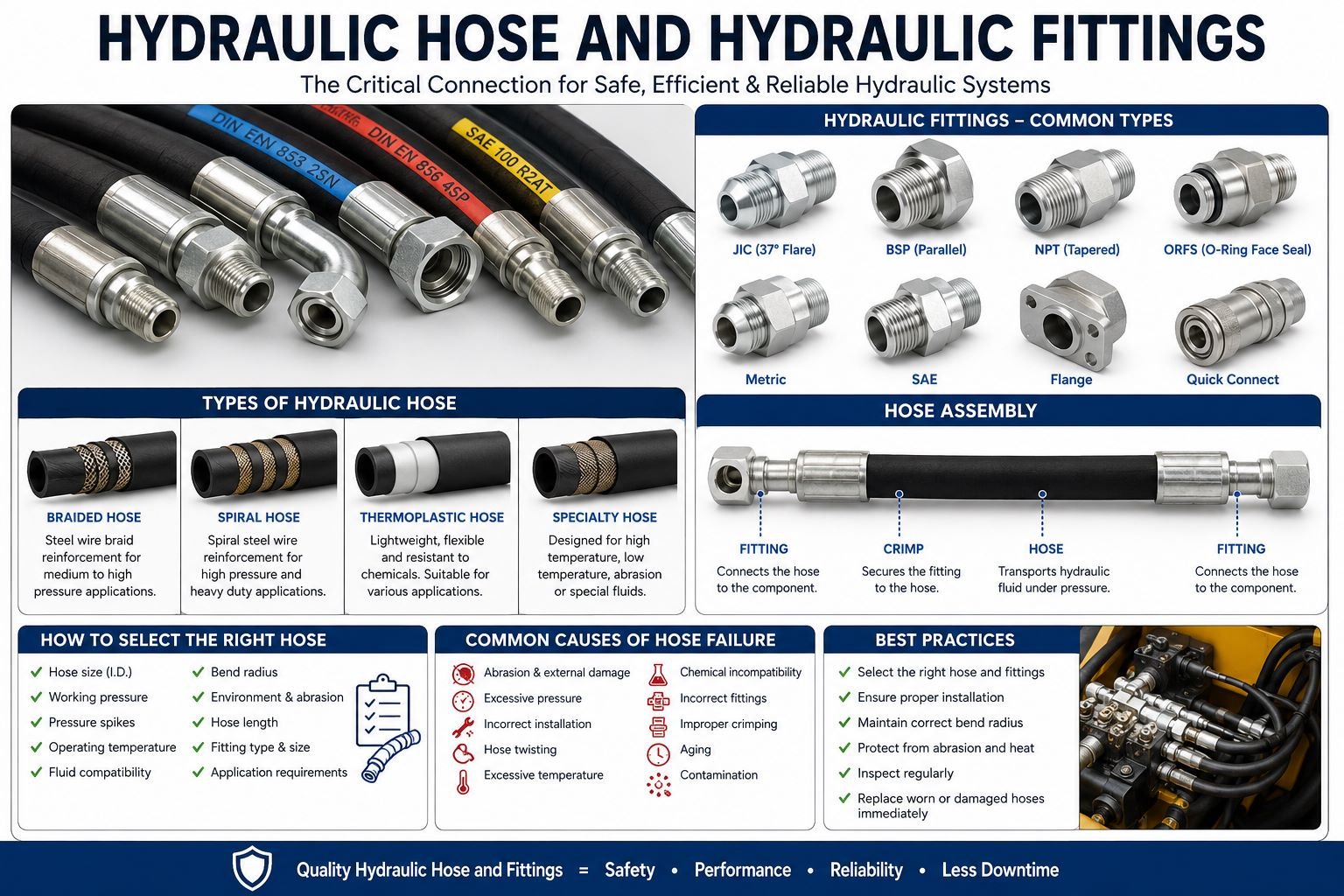
A hose carries the pressurized fluid, while fittings create secure connection points. Together, they form an important part of the hydraulic circuit. Understanding how to choose, install, and maintain them can help businesses reduce leakage, unexpected breakdowns, and unnecessary maintenance costs.
Inside a Hydraulic Hose: What Makes It Strong?
A Hydraulic Hose may appear to be an ordinary flexible tube, but its internal construction is designed to cope with pressure, movement, vibration, and demanding operating environments.
Most hydraulic hoses contain three fundamental layers.
The innermost tube provides the passage through which hydraulic fluid travels. It must be compatible with the fluid being used.
Around this is reinforcement, which gives the hose strength and helps it withstand internal pressure. Reinforcement may use textile materials, steel-wire braid, spiral steel wire, or other engineered materials.
Finally, the outer cover protects the internal structure against abrasion, moisture, oil, weather exposure, and environmental damage.
The combination of these layers determines where a particular hose can safely be used.
Why Hydraulic Fittings Deserve Equal Attention
It makes little sense to invest in a high-quality hose while ignoring its connection points.
Hydraulic Fittings connect flexible hoses to pumps, valves, cylinders, hydraulic motors, filters, manifolds, and other components.
Their job is simple in principle: maintain a secure connection while preventing hydraulic fluid from escaping.
In reality, achieving this under high pressure, repeated vibration, machine movement, and changing temperatures requires accurate component selection.
Common fitting standards include JIC, BSP, NPT, ORFS, SAE, metric connections, hydraulic flanges, and quick couplings.
Each design can use different threads and sealing principles.
Why Matching Hose and Fittings Is Critical
A hydraulic hose assembly should be viewed as one engineered unit.
You cannot determine assembly performance simply by looking at the pressure rating of the Hydraulic Hose. The fittings, connection method, seals, and other components also have operating limitations.
A correctly designed assembly considers:
- Hose size
- Working pressure
- Fluid temperature
- Ambient temperature
- Fluid compatibility
- Fitting standard
- End orientation
- Bend requirements
- Environmental exposure
- Manufacturer specifications
Using compatible components is essential for maintaining the intended performance of the complete assembly.
Choosing Between Different Hydraulic Hose Designs
Hydraulic applications differ enormously, so manufacturers produce hoses with different reinforcement constructions.
Braided Hose
Steel-wire braided hoses are widely used for general hydraulic applications because they can combine useful flexibility with pressure resistance.
They are commonly found in agricultural equipment, industrial machines, forklifts, mobile equipment, and material-handling systems.
Spiral Hose
Spiral-wire hoses are designed for demanding applications involving high pressure and repeated pressure impulses.
They are frequently associated with heavy construction, mining, drilling, earthmoving, and similar equipment.
Thermoplastic Hose
Thermoplastic constructions can offer advantages such as lighter weight, chemical resistance, and compact dimensions.
Some specialized versions are also developed for applications requiring electrical non-conductivity.
The correct option depends on the actual application—not simply which hose appears strongest.
What Happens When Hydraulic Hose Size Is Wrong?
One of the easiest mistakes to make is selecting a hose according to fitting size without considering flow requirements.
Imagine a busy motorway suddenly narrowing to one lane. Traffic must squeeze through a smaller area, creating congestion.
A similar concept can apply to hydraulic fluid.
When a Hydraulic Hose is undersized, fluid velocity can become excessive. This may contribute to pressure drop, increased temperature, noise, and inefficient system performance.
An unnecessarily oversized hose may add weight, cost, and routing difficulties.
| Consideration | Why It Matters |
| Flow rate | Determines fluid volume requirements |
| Inside diameter | Influences fluid velocity |
| Hose length | Can affect pressure losses |
| Pressure | Determines required hose capability |
| Routing | Influences practical hose dimensions |
| Connection size | Must match system requirements |
Proper sizing therefore supports both reliability and efficiency.
Pressure Spikes Can Be More Important Than Expected
Hydraulic pressure is not always perfectly constant.
When valves change position, cylinders reach the end of their travel, or loads change suddenly, the system may experience pressure fluctuations.
Repeated pressure impulses can place stress on the hose reinforcement and fittings.
The working-pressure rating should therefore be suitable for the application, and the complete assembly must remain within its specified operating limits.
Burst pressure should never be considered an acceptable normal operating pressure.
Heat Is a Silent Enemy of Hydraulic Components
High temperature can gradually shorten hose life without producing an obvious immediate failure.
Excessive hydraulic-fluid temperature may affect the inner tube, while external heat sources can deteriorate the outer cover.
Engines, exhaust components, furnaces, hot process equipment, and confined machinery spaces can all create challenging conditions.
Cold temperatures can also influence flexibility.
Selecting Hydraulic Hose should therefore involve evaluating both fluid temperature and the surrounding environment.
Fluid Compatibility Cannot Be Assumed
Hydraulic systems do not always use the same type of fluid.
Depending on the equipment and industry, fluids may include petroleum-based oils, synthetic formulations, biodegradable hydraulic fluids, or water-based media.
Hose materials and seals need to remain compatible with the selected fluid.
Incompatibility can contribute to:
- Inner-tube swelling
- Material softening
- Hardening
- Cracking
- Seal deterioration
- Leakage
Always verify compatibility through the component manufacturer’s technical information rather than relying only on appearance or previous experience with another fluid.
The Biggest Everyday Threat May Be Abrasion
Many hydraulic hoses operate in environments filled with moving components, metal frames, brackets, debris, and vibration.
If a hose continuously rubs against another surface, its protective outer cover can gradually wear away.
Eventually, reinforcement may become exposed.
Good routing helps prevent this problem. The hose should have sufficient length for normal movement without excessive slack, twisting, tension, or tight bends.
Protective sleeves and guards can also help where contact cannot be completely eliminated.
A Failed Hose Can Reveal the Real Problem
Replacing a damaged Hydraulic Hose without investigating why it failed may only provide a temporary solution.
Different damage patterns can provide useful clues.
Damage in one concentrated external area may indicate abrasion. Failure close to the fitting may suggest excessive bending or mechanical stress. A hardened or cracked hose could indicate temperature or compatibility problems.
Maintenance should therefore involve both replacement and root-cause investigation.
This approach can prevent repeated failures in the same location.
Why Hydraulic Fittings Sometimes Leak After Installation
Leakage around Hydraulic Fittings does not necessarily indicate that the connection is loose.
Possible reasons include:
- Incorrect fitting selection
- Damaged sealing surfaces
- Contaminated connections
- Worn O-rings
- Incorrect thread combinations
- Corrosion
- Improper installation
- Excessive vibration
Simply tightening the fitting further may not solve these problems.
In fact, overtightening can damage certain threads, seals, or sealing surfaces.
Correct identification and inspection should come first.
Building a Better Preventive Maintenance Routine
Hydraulic maintenance does not have to begin when a machine stops working.
Regular inspections can help identify developing problems much earlier.
Look for:
- Oil around fitting connections
- Cracks in the hose cover
- Abrasion marks
- Exposed reinforcement
- Blisters
- Flattened sections
- Damaged protective sleeves
- Corroded fittings
- Unusual hose movement
- Heat damage
Inspection frequency should reflect the severity of the application, operating environment, machine usage, and manufacturer recommendations.
Never Ignore Hydraulic Safety
A hydraulic leak may appear harmless, particularly when only a tiny amount of fluid is visible.
However, high-pressure fluid can escape through extremely small openings at considerable velocity.
Never search for a pinhole leak with your bare hand. Pressurized hydraulic fluid can penetrate skin and cause a serious injection injury.
Before performing maintenance, machinery should be isolated, secured, and depressurized according to appropriate procedures.
Qualified technicians should handle critical hydraulic repairs.
Frequently Asked Questions
1. What is Hydraulic Hose?
Hydraulic Hose is a flexible reinforced component designed to transport hydraulic fluid between different parts of a hydraulic system.
2. What are Hydraulic Fittings?
Hydraulic Fittings are connectors used to join hoses with pumps, valves, cylinders, motors, manifolds, and other components.
3. Why does hydraulic hose have reinforcement?
Reinforcement provides mechanical strength and helps the hose withstand internal hydraulic pressure.
4. Which hydraulic hose should I choose?
Selection should consider size, pressure, temperature, fluid compatibility, application, routing, and manufacturer requirements.
5. Are BSP and NPT fittings the same?
No. They have different thread characteristics and should not be treated as interchangeable connections.
6. Why does my hydraulic hose keep failing?
Repeated failure may indicate abrasion, incorrect routing, excessive pressure, heat exposure, improper assembly, or another underlying problem.
7. How can hydraulic hose abrasion be prevented?
Improve routing, eliminate unnecessary contact, secure hoses correctly, and use appropriate protective sleeves where required.
8. Why do hydraulic fittings leak?
Leaks can result from incorrect connections, damaged seals, contamination, corrosion, improper installation, or damaged sealing surfaces.
9. Can I use a higher-pressure hose as a replacement?
Pressure capability alone is insufficient. Size, fittings, temperature, fluid, construction, and application compatibility must also be verified.
10. When should a damaged hydraulic hose be replaced?
Hoses showing significant leakage, exposed reinforcement, severe abrasion, cracking, blistering, or structural damage require prompt professional evaluation.
https://newsgrow.blogspot.com/2026/08/industrial-hose-technology-evolves-as.html