
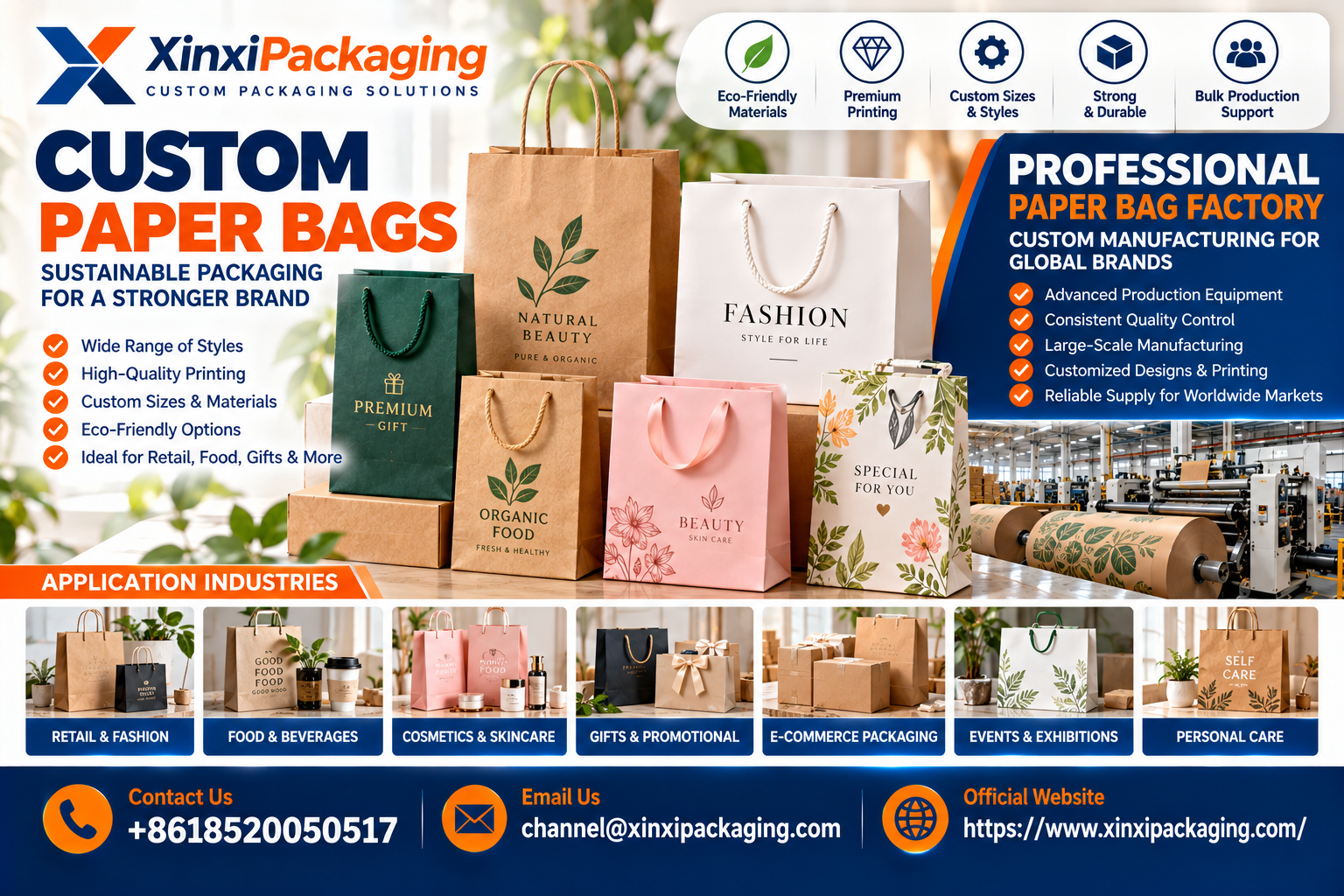
Retail packaging is becoming an important consideration for businesses seeking practical carrying solutions, consistent brand presentation, and responsible material use. From fashion outlets and grocery stores to restaurants and promotional businesses, paper bags serve a wide range of commercial applications.
Choosing a reliable Paper Bag Supplier involves evaluating product quality, carrying capacity, customisation options, and supply consistency.
Meanwhile, a professional Paper Bag Factory plays an important role in converting paper materials into functional bags through cutting, printing, folding, gluing, and handle attachment.
As businesses balance packaging expenses with customer expectations, the focus is expanding beyond appearance to include manufacturing quality, functional performance, and efficient procurement.
For retailers, distributors, and brand owners, understanding paper bag construction can support more informed packaging decisions.
Why Paper Bags Remain Important in Retail Packaging
Shopping bags are among the most visible packaging products used by retail businesses.
Customers may carry branded bags outside stores, making them a practical extension of the retail experience.
However, appearance alone cannot determine packaging quality.
A suitable paper bag must accommodate the intended product weight while remaining comfortable and convenient to carry.
Businesses should consider dimensions, paper strength, handle construction, and expected handling conditions.
This combination of usability and presentation makes paper bag selection an important operational decision.
What Does a Paper Bag Supplier Provide?
A Paper Bag Supplier provides businesses with suitable paper bag products according to specified commercial requirements.
These may include kraft paper shopping bags, printed retail bags, takeaway bags, gift bags, and other customised designs.
Suppliers may manufacture bags directly or source them from specialised producers.
Their responsibilities can include coordinating product specifications, packaging quantities, artwork requirements, and delivery arrangements.
For businesses placing repeat orders, consistency is especially important.
Differences in bag dimensions, paper quality, or printing colours can affect retail presentation.
Buyers should therefore establish clear product specifications before purchasing.
Understanding How a Paper Bag Factory Operates
A Paper Bag Factory converts suitable paper materials into finished packaging products using different manufacturing processes.
The production sequence depends on the bag design and equipment configuration.
Typical operations include paper preparation, printing, cutting, folding, adhesive application, and bag formation.
Some products also require handle attachment or additional finishing.
Quality-control checks may examine dimensions, bonding performance, printing accuracy, and overall construction.
The manufacturing process should be designed around the intended bag type.
A lightweight takeaway bag and a premium retail shopping bag may require different construction methods.
Kraft Paper and Other Material Considerations
Paper selection influences bag strength, appearance, printability, and handling performance.
Kraft paper is commonly considered for retail and carrying applications because suitable grades provide useful strength characteristics.
Other paper types may offer smoother surfaces or different decorative possibilities.
However, material thickness alone does not establish carrying capacity.
Fibre quality, construction, folding geometry, adhesive performance, and handle design also influence strength.
For food-related uses, businesses must verify relevant food-contact material requirements.
Paper bags should not automatically be considered suitable for direct food contact without appropriate material evaluation.
Why Bag Handles Deserve Special Attention
Handles are an essential component of many shopping bags.
Common designs include twisted paper handles, flat paper handles, rope handles, and die-cut openings.
Each option has different construction requirements.
The connection between the handle and the bag body is particularly important because it experiences stress during carrying.
Poorly attached handles may fail even when the paper body remains intact.
Manufacturers should evaluate handle attachment and carrying performance under representative loading conditions.
Comparing Common Paper Bag Types
| Paper Bag Type | Typical Application | Important Consideration |
| Kraft Shopping Bag | Retail merchandise | Strength and carrying comfort |
| Printed Paper Bag | Fashion and branded stores | Colour accuracy and branding |
| Flat Handle Bag | Grocery and takeaway uses | Handle attachment |
| Twisted Handle Bag | Retail shopping | Load suitability |
| Gift Paper Bag | Promotional and gift products | Presentation and finishing |
| SOS Paper Bag | Suitable grocery and foodservice uses | Base construction and product fit |
Selecting a bag according to the intended application can reduce unnecessary packaging expenses.
Custom Printing and Retail Brand Identity
Custom printing allows businesses to transform a functional carrying bag into recognisable branded packaging.
Logos, brand colours, slogans, and graphic designs can contribute to a consistent retail identity.
However, the printing method should match the paper surface, artwork complexity, and required production volume.
Large solid-colour areas may present different printing considerations from simple one-colour logos.
Businesses should review artwork proofs and physical samples before commercial production.
Print registration, colour variation, and readable text are important quality considerations.
Consistent printing helps maintain a professional appearance across different store locations.
How Packaging Specifications Support Bulk Purchasing
Businesses purchasing paper bags in large quantities benefit from establishing standard specifications.
These may include bag width, height, gusset dimensions, paper grade, handle style, and acceptable printing tolerances.
Standardisation can simplify repeat orders and reduce misunderstandings.
For retailers with several product categories, a limited range of practical bag sizes may support efficient inventory management.
However, unsuitable standardisation can create waste if bags are consistently much larger than the products they carry.
Procurement teams should balance flexibility with realistic product requirements.
Responsible Paper Packaging and Recycling
Environmental considerations are influencing retail packaging decisions.
Paper bags may be compatible with recycling systems where the materials and local collection arrangements permit.
However, coatings, decorative components, adhesives, and contamination can affect recyclability.
Paper packaging also involves raw material consumption and manufacturing impacts.
Businesses should therefore avoid assuming that every paper bag is automatically environmentally preferable.
Reusable designs, suitable material selection, and responsible sourcing can be evaluated according to actual conditions.
Claims involving recycled content or sustainable sourcing should be supported by appropriate documentation.
Choosing the Right Paper Bag Manufacturing Partner
Businesses evaluating manufacturers should examine both production quality and commercial capabilities.
Important considerations include:
- Material Specifications: Confirm suitable paper grades and construction.
- Carrying Performance: Evaluate bag strength and handle attachment.
- Custom Printing: Review artwork and finishing capabilities.
- Manufacturing Consistency: Assess dimensional and visual quality.
- Order Planning: Confirm suitable quantities and delivery arrangements.
- Sample Approval: Evaluate physical products before bulk purchasing.
A clear supplier agreement helps establish expectations and supports reliable purchasing relationships.
Frequently Asked Questions (FAQs)
1. What does a Paper Bag Supplier offer?
A paper bag supplier provides suitable retail, shopping, gift, and commercial paper bags according to specified dimensions, materials, printing, and quantity requirements.
2. What does a Paper Bag Factory manufacture?
A paper bag factory produces paper bags through processes such as paper conversion, cutting, printing, folding, gluing, and handle attachment.
3. Are kraft paper bags suitable for retail businesses?
Yes. Suitable kraft paper bags are commonly used in retail applications, provided their construction and carrying capacity match the intended products.
4. Can paper shopping bags be customised?
Yes. Businesses can customise bag dimensions, paper grades, handle designs, printed artwork, colours, and appropriate finishing options.
5. How can businesses select a reliable paper bag manufacturer?
Buyers should assess material quality, carrying strength, printing accuracy, sample performance, production consistency, and supplier communication.
Media Contact
Department: Paper Bag Manufacturing and Custom Packaging Enquiries
Contact: +86 185 2005 0517
Email: channel@xinxipackaging.com
Official Website: https://www.xinxipackaging.com/
Read More:-