
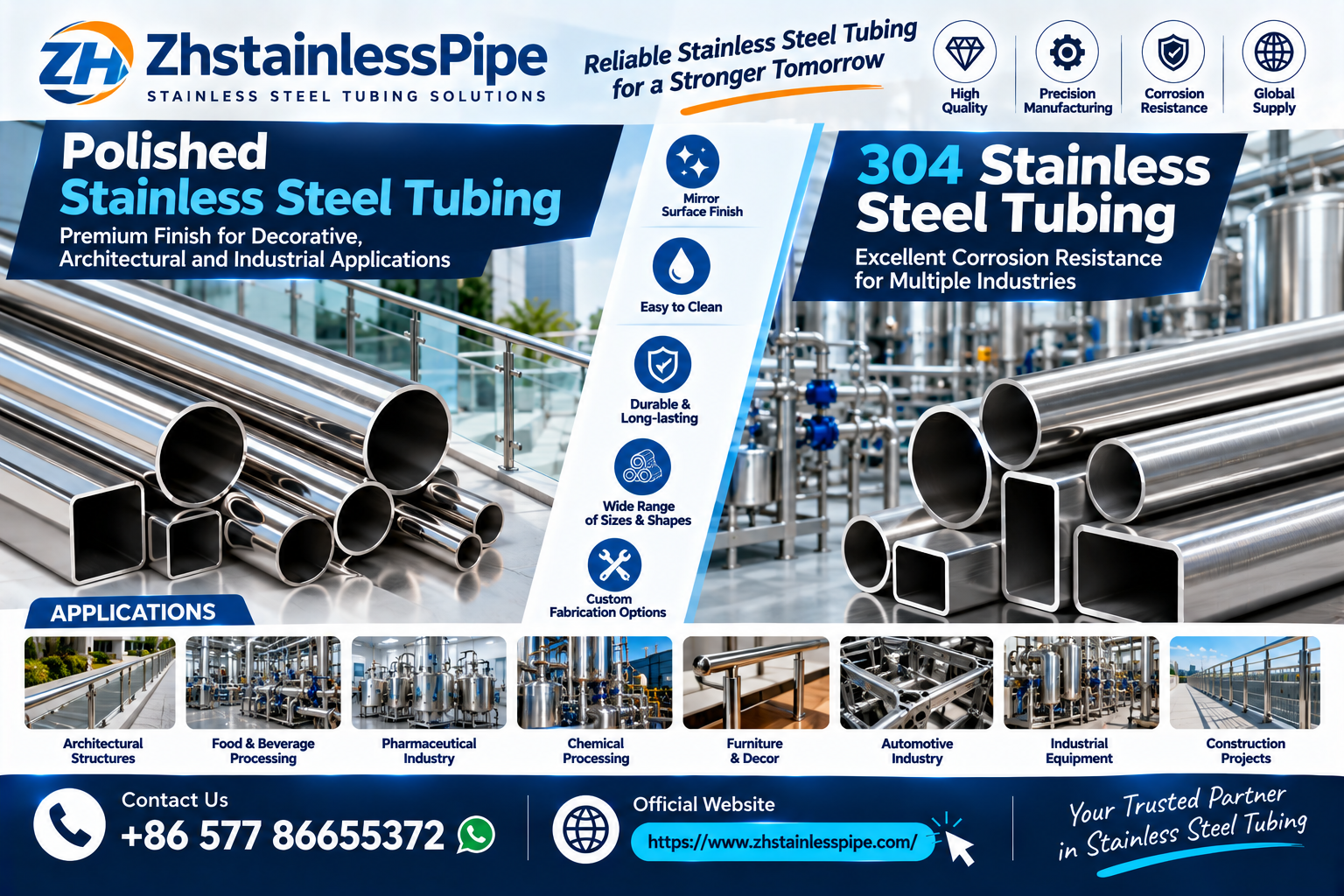
As manufacturing industries increasingly emphasize material durability, surface quality, corrosion resistance, and operational efficiency, stainless steel tubing continues to play an important role in modern industrial applications. Polished Stainless Steel Tubing is widely considered for applications requiring smooth surfaces, attractive finishes, and convenient cleaning, while 304 Stainless Steel Tubing remains a practical material choice for manufacturing, construction, food processing, and engineering projects.
From industrial machinery to architectural installations, selecting suitable stainless steel tubing requires an understanding of material grades, surface finishes, dimensional accuracy, and application requirements.
Industrial buyers and project engineers are therefore placing greater importance on product specifications, manufacturing quality, and long-term material performance.
Growing Importance of Polished Stainless Steel Tubing
Polished Stainless Steel Tubing refers to stainless steel tubes that undergo mechanical polishing or other suitable finishing processes to achieve specified surface characteristics.
Polishing can improve surface smoothness, enhance appearance, and make certain cleaning procedures easier when the finish is appropriate for the application.
These tubes are used across industries where hygiene, appearance, and surface consistency are important.
Common applications include:
- Food Processing: Equipment and suitable fluid handling components.
- Pharmaceutical Manufacturing: Selected processing equipment and hygienic installations.
- Architectural Projects: Railings, decorative structures, and modern interiors.
- Automotive Manufacturing: Decorative and functional tubing components.
- Industrial Machinery: Equipment frames and compatible mechanical assemblies.
- Commercial Facilities: Stainless steel structures requiring attractive surface finishes.
Understanding 304 Stainless Steel Tubing and Its Properties
304 Stainless Steel Tubing is manufactured from a widely used austenitic stainless steel grade containing chromium and nickel as important alloying elements.
Grade 304 is recognized for its general corrosion resistance, formability, and suitability for numerous industrial applications.
It offers useful performance in many atmospheric and moderately corrosive environments.
Important properties include:
Corrosion Resistance: Suitable resistance to many common environmental conditions, depending on chemical exposure.
Mechanical Performance: A combination of strength and ductility appropriate for various structural and industrial uses.
Formability: Suitable for manufacturing components requiring bending and shaping.
Weldability: Can be welded using appropriate procedures and fabrication practices.
Surface Finishing: Can be supplied with different surface conditions, including polished finishes.
However, grade 304 is not suitable for every corrosive environment. Applications involving significant chloride exposure may require evaluation of alternative materials.
Polished Stainless Steel Tubing vs. 304 Stainless Steel Tubing
Although these terms are frequently associated with similar products, they describe different characteristics.
| Feature | Polished Stainless Steel Tubing | 304 Stainless Steel Tubing |
| Main characteristic | Specified surface finish | Stainless steel material grade |
| Primary consideration | Smoothness and appearance | Chemical composition and performance |
| Applications | Decorative and hygienic uses | Industrial and general engineering |
| Available grades | May include 304, 316, and others | Specifically grade 304 |
| Selection requirement | Surface finish specification | Material and mechanical specifications |
A polished tube can also be manufactured from grade 304 stainless steel.
Therefore, buyers should evaluate both material grade and finishing requirements rather than treating them as competing product categories.
Industrial Applications of 304 Stainless Steel Tubing
The versatility of 304 Stainless Steel Tubing makes it relevant to different industrial sectors.
Food and Beverage Processing: Suitable tubing may be used in processing equipment, provided the complete installation meets applicable hygiene requirements.
Chemical Processing: Selected applications involving chemicals compatible with grade 304.
Construction and Architecture: Structural components, railings, decorative installations, and building fixtures.
Automotive Industry: Suitable exhaust components, mechanical assemblies, and tubing applications.
Industrial Equipment: Fabricated machinery, equipment supports, and compatible fluid handling systems.
The actual suitability of a tube depends on its dimensions, manufacturing specification, operating conditions, and intended function.
Why Surface Finish Matters in Stainless Steel Tubing
Surface finishing influences the appearance, cleanability, and performance of stainless steel components.
Polished Stainless Steel Tubing may feature satin, brushed, or mirror-like finishes, depending on manufacturing requirements.
For hygienic processing applications, surface roughness is particularly important.
Manufacturers may specify surface roughness using parameters such as Ra, which measures average surface roughness.
A polished appearance alone does not establish suitability for sanitary applications. Surface finish, weld quality, cleaning procedures, and applicable standards must also be considered.
Key Factors to Consider When Selecting Stainless Steel Tubing
Industrial buyers should examine technical specifications before purchasing tubing for demanding applications.
Important selection factors include:
- Material Grade: Confirm whether grade 304 or another stainless steel grade is suitable.
- Tube Dimensions: Check outside diameter, wall thickness, and required length.
- Surface Finish: Determine polishing and roughness requirements.
- Manufacturing Method: Evaluate seamless or welded tubing according to the application.
- Operating Conditions: Consider pressure, temperature, chemical exposure, and environmental conditions.
- Dimensional Tolerances: Confirm consistency with engineering requirements.
- Quality Documentation: Request appropriate material certificates and inspection records.
- Applicable Standards: Verify specifications such as ASTM A269, ASTM A270, or ASTM A554 where relevant.
These standards cover different types of tubing and should not be considered interchangeable.
Manufacturing Quality and Long-Term Performance
Reliable stainless steel tubing production requires appropriate raw materials, controlled manufacturing processes, and consistent inspection.
Quality evaluation may involve dimensional testing, surface inspection, chemical composition verification, and mechanical testing.
For 304 Stainless Steel Tubing, buyers should confirm material traceability and suitability for the intended environment.
Similarly, polished tubing should be examined for surface consistency, scratches, and finishing defects.
Proper installation, suitable cleaning methods, and routine inspection can also help maintain long-term performance.
Frequently Asked Questions (FAQs)
1. What is Polished Stainless Steel Tubing?
It is stainless steel tubing processed to achieve specified surface smoothness and appearance through polishing or related finishing methods.
2. What is 304 Stainless Steel Tubing?
It is tubing manufactured from grade 304 austenitic stainless steel, commonly used in industrial, architectural, and manufacturing applications.
3. What is the difference between polished tubing and 304 tubing?
Polished tubing describes a surface finish, while 304 identifies the stainless steel grade. A product may have both characteristics.
4. Is 304 stainless steel resistant to corrosion?
Yes. It provides good resistance in many environments, although aggressive chloride exposure and certain chemicals may cause corrosion.
5. Can 304 stainless steel tubing be polished?
Yes. Grade 304 tubing can be supplied with different polished finishes according to manufacturing specifications.
6. Is polished stainless steel tubing suitable for food processing?
It may be suitable when the material, surface finish, fabrication, and complete installation meet relevant hygiene and application requirements.
7. What industries use stainless steel tubing?
Common industries include food processing, pharmaceuticals, construction, automotive manufacturing, chemical processing, and industrial engineering.
8. What factors affect stainless steel tubing prices?
Material grade, dimensions, wall thickness, surface finish, manufacturing method, order quantity, and market conditions can influence pricing.
9. Is stainless steel 304 better than 316?
Neither grade is universally better. Grade 316 generally offers improved resistance in some chloride-containing environments, while 304 is suitable for many general applications.
10. How can buyers choose a reliable stainless steel tubing supplier?
Buyers should evaluate material specifications, manufacturing capabilities, inspection documentation, dimensional accuracy, and supplier support.
Media Contact
Department: Stainless Steel Products and Business Communications
Email: sales@zhehengsteel.com
Contact: +86 577 86655372
Official Website: https://www.zhstainlesspipe.com/