As biotechnology companies, pharmaceutical researchers, and academic laboratories pursue increasingly complex genetic investigations, reliable synthetic DNA materials remain essential to scientific progress. DNA oligo synthesis provides precisely designed short nucleotide sequences for molecular experiments, while plasmid synthesis supports the development of customized circular DNA constructs for genetic engineering, protein expression, and synthetic biology.
Both technologies contribute to laboratory workflows involving gene analysis, molecular cloning, diagnostic research, and biological system development.
For research organizations, selecting appropriate DNA products requires careful attention to sequence accuracy, molecular quality, construct design, and experimental compatibility.
Growing Importance of DNA Oligo Synthesis in Biotechnology
DNA oligo synthesis is a chemical manufacturing process used to produce short DNA sequences, known as oligonucleotides, according to specific nucleotide requirements.
These synthetic molecules serve as essential components in molecular biology research because their sequences can be designed for particular experimental targets.
Unlike naturally isolated DNA fragments, customized oligonucleotides allow researchers to specify nucleotide composition, length, and selected modifications.
Major Applications of DNA Oligo Synthesis
- PCR Amplification: Producing sequence-specific primers for selected DNA targets.
- DNA Sequencing: Preparing primers for genetic characterization.
- Molecular Diagnostics: Developing experimental probes for detecting genetic sequences.
- Genetic Engineering: Supporting molecular cloning and DNA assembly.
- Mutation Studies: Investigating selected nucleotide changes.
- Synthetic Biology: Preparing defined genetic components for research projects.
Understanding Plasmid Synthesis and Its Research Applications
Plasmid synthesis refers to the design and production of plasmid DNA constructs containing selected genetic elements.
Plasmids are typically circular, double-stranded DNA molecules that can replicate independently in suitable host cells.
Researchers use engineered plasmids to introduce genetic sequences into compatible experimental systems.
Plasmid construction generally involves combining designed or synthesized DNA fragments with suitable vector components, followed by assembly and verification.
Important Applications
Recombinant Protein Research: Preparing expression constructs that encode selected proteins.
Gene Function Studies: Investigating the activity of specific genes and regulatory elements.
Synthetic Biology: Developing designed genetic systems for controlled experiments.
Vaccine Research: Supporting investigations involving DNA-based expression constructs.
Cell Biology: Studying cellular responses to introduced genetic material.
Molecular Cloning: Preparing customized vectors for research applications.
The suitability of a plasmid depends on its sequence, vector architecture, host compatibility, and intended biological function.
How DNA Oligo Synthesis Works
Most conventional DNA oligonucleotides are manufactured using automated solid-phase phosphoramidite chemistry.
This method allows nucleotides to be added sequentially according to a defined sequence.
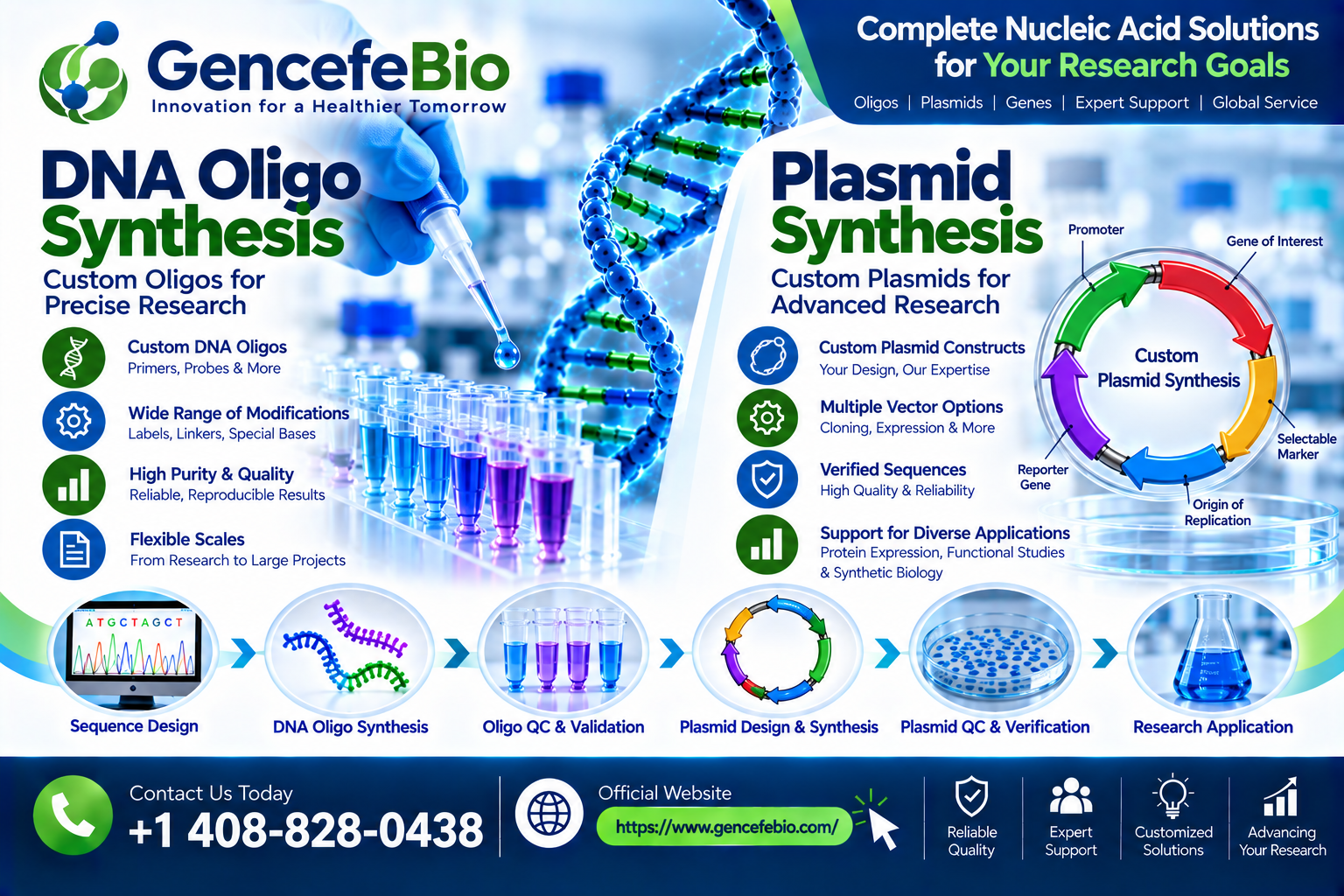
A typical service workflow includes:
- Sequence Design: Defining the required nucleotide arrangement.
- Technical Review: Evaluating synthesis feasibility and modification requirements.
- Chemical Synthesis: Assembling the oligonucleotide using appropriate chemistry.
- Product Recovery: Removing protecting groups and recovering the synthesized DNA.
- Purification: Separating selected impurities when required.
- Quality Assessment: Evaluating molecular identity and product purity.
- Final Preparation: Supplying the DNA according to research specifications.
Depending on the application, customized oligonucleotides may include fluorescent labels, biotin, or selected chemical modifications.
Plasmid Synthesis: From Genetic Design to Verified Constructs
A plasmid synthesis project begins with defining the required genetic elements and their intended functions.
Researchers may specify a coding sequence, regulatory components, vector backbone, or other application-relevant features.
The construct is then prepared using suitable DNA assembly methods.
Depending on the production approach, the completed plasmid may be propagated in a compatible biological host and subsequently purified.
Quality assessment may include sequence confirmation, DNA concentration, molecular integrity, and purity testing.
DNA Oligo Synthesis vs. Plasmid Synthesis
Although both technologies support genetic research, their products and applications differ.
| Feature | DNA Oligo Synthesis | Plasmid Synthesis |
| Primary product | Short DNA oligonucleotides | Typically circular DNA constructs |
| Production approach | Chemical nucleotide synthesis | DNA assembly and plasmid production |
| Common applications | PCR, sequencing, probes | Cloning, gene expression |
| Customization | Sequence, labels, modifications | Vector elements, inserted sequences |
| Quality focus | Identity and purity | Sequence accuracy and construct integrity |
These technologies are complementary rather than competing.
For example, synthetic oligonucleotides can support the preparation or verification of plasmid constructs through appropriate molecular biology workflows.
Why Quality Control Matters in Synthetic DNA Research
Accurate molecular materials are essential for dependable scientific experiments.
For DNA oligo synthesis, analytical methods such as mass spectrometry and high-performance liquid chromatography may help evaluate product identity and purity.
For plasmid DNA, sequencing can confirm that the construct matches the intended design.
Additional quality considerations include:
- DNA concentration and purity
- Sequence verification
- Molecular integrity
- Residual impurities
- Appropriate storage conditions
- Product documentation and traceability
For sensitive cellular applications, researchers may also require specific endotoxin limits or additional quality testing.
Quality requirements should reflect the intended experimental use.
Selecting Reliable DNA Synthesis Services
Biotechnology organizations should evaluate synthesis providers according to technical capabilities rather than purchasing cost alone.
For oligonucleotide projects, important considerations include supported sequence lengths, purification options, chemical modifications, and analytical documentation.
For plasmid projects, researchers should assess construct design support, assembly capabilities, sequence verification, DNA preparation quality, and delivery formats.
Professional providers should also maintain suitable confidentiality and responsible sequence-screening procedures.
Clear project specifications help establish appropriate expectations for molecular quality and research compatibility.
Frequently Asked Questions (FAQs)
1. What is DNA oligo synthesis?
It is the chemical production of short DNA sequences according to specified nucleotide requirements for molecular research applications.
2. What is plasmid synthesis?
It is the design and production of customized plasmid DNA constructs used in genetic engineering, cloning, and biological research.
3. What is the difference between oligonucleotides and plasmids?
Oligonucleotides are generally short nucleotide sequences, while plasmids are typically longer, circular DNA molecules containing functional genetic elements.
4. What are DNA oligonucleotides used for?
They are commonly used as PCR primers, sequencing primers, molecular probes, and research reagents.
5. Can synthetic oligonucleotides support plasmid construction?
Yes. Appropriately designed oligonucleotides can contribute to DNA assembly, cloning, and construct verification workflows.
6. Why is plasmid sequence verification important?
It helps confirm that the completed construct contains the intended DNA sequence and reduces uncertainty in subsequent experiments.
7. Can DNA oligonucleotides be chemically modified?
Yes. Depending on feasibility, they may incorporate fluorescent labels, biotin, and selected nucleotide modifications.
8. Are plasmids used in recombinant protein research?
Yes. Suitable expression plasmids can carry genetic instructions required for protein production in compatible host systems.
9. What affects DNA synthesis pricing?
Sequence length, complexity, modifications, purification, construct assembly, production quantity, and quality testing influence costs.
10. How can researchers select a reliable synthesis provider?
Researchers should evaluate synthesis capabilities, technical documentation, sequence verification, quality-control procedures, and research support.
Media Contact
Department: Biotechnology Research and Business Communications
Email: gene@gencefebio.com
Contact: +1 408-828-0438
Official Website: https://www.gencefebio.com/