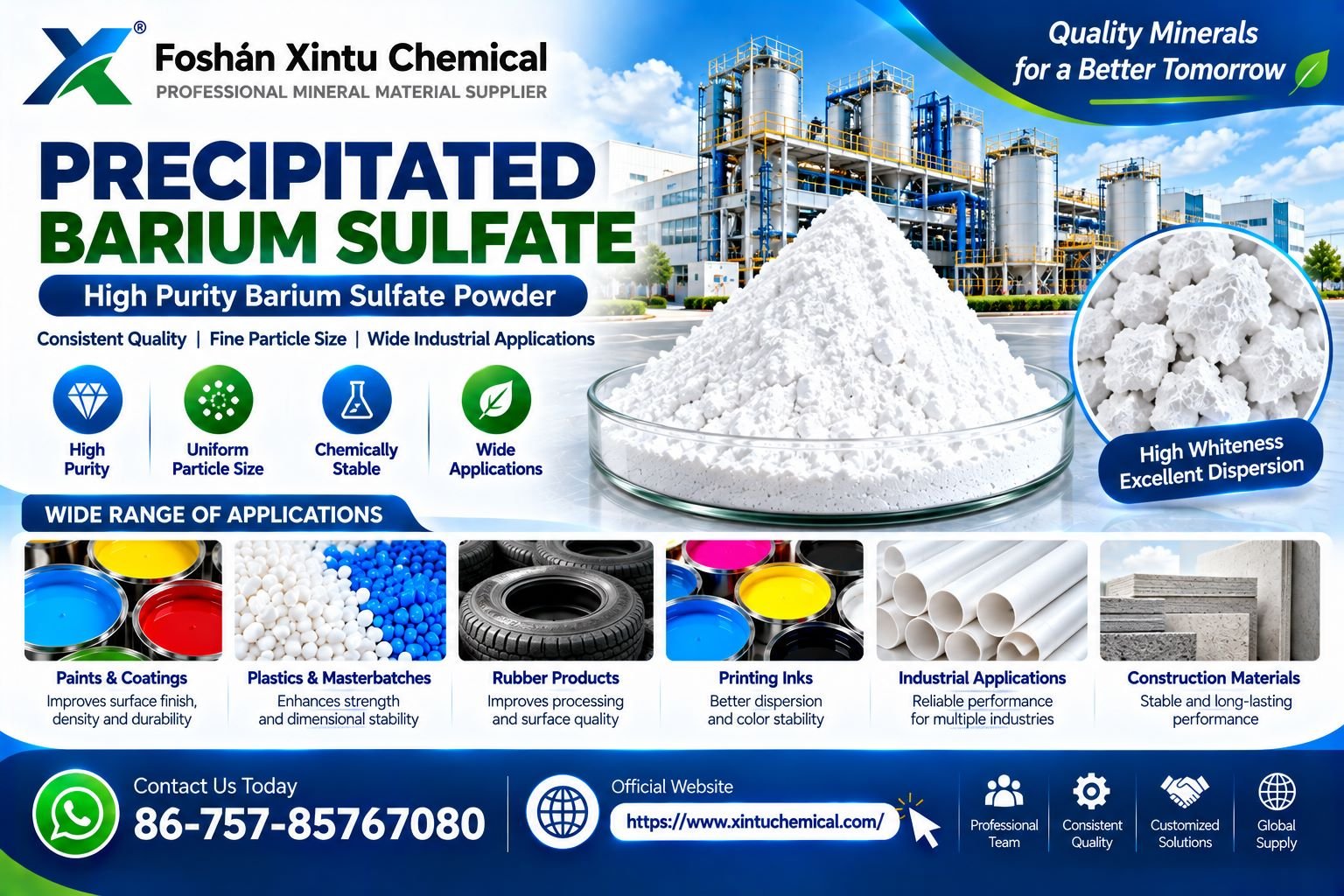
Industrial manufacturers are placing greater emphasis on high-performance raw materials, consistent product quality, and efficient formulation development. Among the inorganic materials supporting these requirements, Precipitated Barium Sulfate has become an important consideration for industries seeking controlled particle characteristics, chemical stability, and reliable manufacturing performance.
Meanwhile, Barium Sulfate Powder continues to serve as a functional filler in paints, powder coatings, plastics, printing inks, rubber products, and specialty industrial materials.
With its chemical formula BaSO₄, barium sulfate is recognized for its high density, low water solubility, and compatibility with numerous industrial formulations.
For manufacturers and chemical distributors, understanding product grades, technical specifications, and application requirements is essential for selecting suitable materials.
Understanding Precipitated Barium Sulfate in Modern Manufacturing
Precipitated Barium Sulfate is a synthetic inorganic material manufactured through controlled chemical precipitation.
Unlike natural barite, which is extracted from mineral deposits and processed mechanically, precipitated barium sulfate is produced through chemical reactions that form relatively insoluble barium sulfate particles.
This manufacturing approach allows producers to control certain material characteristics, depending on processing conditions.
Important Material Properties
- High Whiteness: Suitable grades contribute to the appearance of white and light-colored products.
- Controlled Particle Size: Supports defined formulation requirements.
- Chemical Resistance: Offers stability in many industrial environments.
- High Density: Useful for selected technical applications.
- Low Water Solubility: Helps maintain material integrity in compatible systems.
- Consistent Quality: Controlled processing can support more uniform material specifications.
Why Barium Sulfate Powder Is Important for Industrial Applications
Barium Sulfate Powder is a finely divided inorganic compound used to modify selected physical and processing properties of manufactured products.
Industrial grades may be produced from natural barite or through synthetic manufacturing processes.
The material’s suitability depends on purity, particle-size distribution, whiteness, surface characteristics, and other technical parameters.
Common Industrial Applications
Paints and Coatings: Used as a functional extender to adjust selected coating properties.
Plastic Compounds: Incorporated into suitable polymers to modify density and other formulation characteristics.
Powder Coatings: Supports specific coating compositions and surface requirements.
Printing Inks: Used in selected formulations requiring controlled pigment and filler performance.
Rubber Manufacturing: Provides mineral filler options for suitable rubber products.
Specialty Materials: Supports application-specific industrial formulations requiring controlled mineral characteristics.
Precipitated vs. Natural Barium Sulfate: What Manufacturers Should Know
Although both products contain barium sulfate, their production methods and technical characteristics may differ.
| Parameter | Precipitated Barium Sulfate | Natural Barium Sulfate |
| Origin | Synthetic chemical production | Processed barite mineral |
| Particle characteristics | Controlled through precipitation and finishing | Determined by grinding and classification |
| Purity | Depends on manufacturing and purification | Depends on mineral source and processing |
| Typical applications | Specialty coatings, plastics, inks | Coatings, plastics, rubber, general fillers |
| Selection priority | Defined particle and formulation properties | Suitable grade, performance, and cost |
Manufacturers should evaluate actual product specifications rather than assuming one manufacturing method is always superior.
How Precipitated Barium Sulfate Supports Coating Performance
The paint and coatings industry uses mineral fillers to achieve targeted appearance, processing behavior, and mechanical properties.
Precipitated Barium Sulfate may help formulators adjust surface smoothness, gloss characteristics, pigment distribution, and coating density.
Its performance depends on the binder system, pigment composition, dispersion process, and filler concentration.
For example, fine-particle grades may be considered when surface quality is important. Other grades may be more appropriate for different production requirements.
Before commercial production, manufacturers should conduct laboratory trials to confirm compatibility and finished-product performance.
Role of Barium Sulfate Powder in Plastic Compounds
Plastic manufacturers incorporate inorganic fillers to achieve selected material properties and manage formulation requirements.
Barium Sulfate Powder can be used in suitable polypropylene, polyethylene, PVC, and other compatible polymer formulations.
Potential applications include molded plastic components, industrial sheets, masterbatches, and specialty plastic products.
However, filler concentration must be carefully evaluated.
Excessive loading may reduce impact strength, alter processing behavior, or affect other mechanical properties.
Proper dispersion and suitable material selection are therefore essential for maintaining consistent finished products.
Key Quality Parameters for Industrial Buyers
Before purchasing barium sulfate materials, manufacturers should review the relevant technical data.
Important specifications include:
- BaSO₄ Content: Indicates the material’s chemical composition.
- Particle-Size Distribution: Helps determine suitability for the intended formulation.
- Whiteness: Important for selected coatings and light-colored polymer products.
- Moisture Content: Can influence storage and processing performance.
- Oil Absorption: Relevant to certain coating and ink formulations.
- Dispersibility: Supports uniform distribution throughout the product.
- Batch Consistency: Helps maintain predictable manufacturing results.
Suppliers should provide appropriate technical data sheets and safety documentation.
How to Select the Right Barium Sulfate Grade
Choosing an industrial barium sulfate grade requires evaluating the finished product’s intended function.
Manufacturers should consider processing temperatures, mixing methods, appearance requirements, and compatibility with other raw materials.
Price comparisons should also account for product consistency and actual performance rather than purchase cost alone.
For critical applications, buyers should request representative samples and conduct formulation trials before approving large-volume orders.
Industrial-grade barium sulfate should not be assumed suitable for pharmaceutical, medical, or food-contact applications without the relevant specifications and regulatory requirements.
Frequently Asked Questions (FAQs)
1. What is Precipitated Barium Sulfate?
It is a synthetic form of barium sulfate manufactured through controlled chemical precipitation for industrial applications.
2. What is Barium Sulfate Powder?
It is a finely divided inorganic material used as a functional filler in coatings, plastics, rubber, and other manufactured products.
3. What is the chemical formula of barium sulfate?
Its chemical formula is BaSO₄.
4. What is the difference between precipitated and natural barium sulfate?
Precipitated grades are chemically manufactured, while natural grades are obtained through mineral extraction and processing.
5. Why is barium sulfate used in paints?
Suitable grades help modify coating appearance, density, and selected physical or processing characteristics.
6. Can barium sulfate be used in plastics?
Yes. It is incorporated into selected polymer compounds and masterbatch formulations.
7. Is barium sulfate soluble in water?
Barium sulfate has very low water solubility under ordinary conditions.
8. Does particle size affect product performance?
Yes. Particle-size distribution can influence dispersion, surface characteristics, and formulation behavior.
9. What factors affect barium sulfate prices?
Purity, particle characteristics, manufacturing method, packaging, order quantity, and supply conditions may affect prices.
10. How can manufacturers choose a reliable supplier?
They should evaluate material specifications, quality documentation, sample performance, technical support, and supply consistency.
Media Contact
Department: Industrial Chemicals and Business Communications
Email: sales@xintuchemical.com
Contact: +86-757-85767080
Official Website: https://www.xintuchemical.com/