
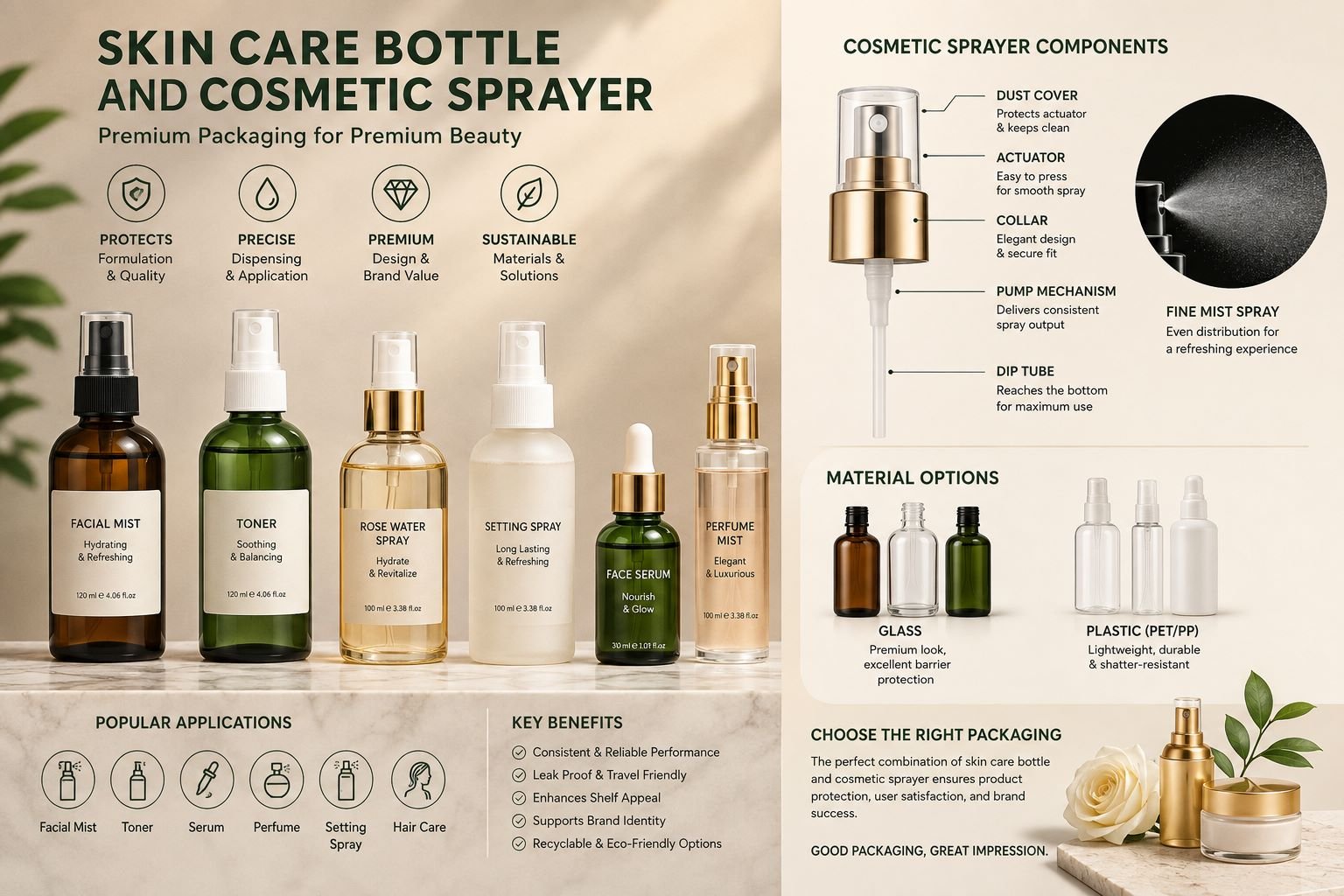
A skincare formula can take months or even years to develop, yet consumers often form their first opinion of it within seconds. Before they experience the texture, fragrance, absorption, or results, they interact with the packaging. That first interaction explains why the skin care bottle and cosmetic sprayer deserve far more attention during cosmetic product development.
Packaging has become a bridge between formulation science and consumer experience. It must protect ingredients, survive transportation, dispense the right amount, look appealing, and remain convenient until the final use. For modern beauty brands, packaging is no longer simply something placed around a formula—it is part of the product itself.
Start With the Formula, Not the Bottle Design
One of the easiest mistakes for a new cosmetic brand is choosing packaging based on appearance before considering the formulation.
A beautifully designed skin care bottle is of little value if its material reacts with the product or fails to provide sufficient protection.
Water-based toners, facial oils, active serums, alcohol-containing products, and botanical formulations can have very different packaging requirements.
Brands should evaluate factors such as:
- Formula viscosity
- Ingredient composition
- Light sensitivity
- Oxygen sensitivity
- Intended shelf life
- Application method
- Storage conditions
- Transportation environment
Packaging selection becomes much easier once these requirements are clearly defined.
Glass and Plastic Serve Different Packaging Needs
Glass remains a popular option for premium cosmetic products. Its weight and appearance can create a luxurious impression, while colored glass may provide useful light protection for certain formulations.
Plastic offers different benefits.
PET, PETG, PP, PE, and HDPE can provide lightweight construction, durability, design flexibility, and reduced breakage risk.
There Is No Universal Best Material
The best skin care bottle is not necessarily the most expensive one.
Instead, it is the bottle that performs appropriately with the intended formulation and usage conditions.
For example, a travel-focused skincare product may benefit from lightweight and impact-resistant packaging, while a premium facial oil may be positioned more effectively in glass.
Compatibility Testing Provides the Answer
Testing the final formula inside proposed packaging over time can reveal changes such as swelling, cracking, discoloration, leakage, odor alteration, or loss of structural integrity.
These issues are difficult to predict from appearance alone.
Spraying Is More Technical Than It Looks
Pressing a sprayer appears simple from the consumer’s perspective, but considerable engineering can sit behind that single action.
A cosmetic sprayer must draw liquid through a dip tube, move it through the pump chamber, and release it through a nozzle in a controlled pattern.
The interaction between nozzle design, pressure, liquid characteristics, and output volume determines the quality of the spray.
A well-designed system can create a soft mist. An unsuitable system may release large droplets, narrow streams, or inconsistent quantities.
The User Experience Is Defined in Milliseconds
Imagine applying a premium facial mist.
The first press produces a smooth cloud that spreads comfortably across the face. The second delivers approximately the same experience. There is no dripping and no need to repeatedly pump the actuator.
That consistency builds confidence.
Now imagine the opposite: the first press does nothing, the second produces a stream, and the third releases excessive liquid.
Even if the formulation is excellent, the packaging can reduce perceived product quality.
This is why choosing the right cosmetic sprayer is an experience-design decision as much as a technical one.
What Brands Should Expect From a Good Sprayer
Reliable spray packaging should offer consistent performance throughout normal product use.
Important characteristics include:
- Smooth actuation
- Reliable priming
- Controlled output
- Appropriate droplet size
- Consistent spray coverage
- Low dripping
- Secure sealing
- Reliable repeated operation
For facial applications, spray distribution deserves particular attention because uneven droplets can affect comfort and coverage.
Bottle and Sprayer Compatibility Cannot Be Assumed
A bottle and sprayer may look compatible while still having dimensional or functional differences.
The neck finish of the skin care bottle must correctly correspond with the closure of the cosmetic sprayer.
| Area | What to Check | Why It Matters |
| Bottle neck | Diameter and thread | Closure fit |
| Gasket | Material and dimensions | Leak prevention |
| Dip tube | Length and shape | Product access |
| Pump | Formula suitability | Consistent dispensing |
| Nozzle | Spray characteristics | Application quality |
| Closure | Torque and fit | Transport security |
A small mismatch can create leakage that becomes visible only after temperature changes or transportation.
Packaging Should Be Tested Beyond the Bathroom Shelf
Cosmetic products experience a complicated journey before reaching consumers.
They may move from a manufacturing facility to a warehouse, distributor, retail outlet, fulfillment center, delivery vehicle, and finally the customer’s home.
During that journey, the skin care bottle may experience vibration, impact, temperature variation, horizontal storage, and pressure.
Testing Should Simulate Real Conditions
Useful evaluations can include:
- Leakage testing
- Drop testing
- Temperature cycling
- Closure torque measurement
- Pump endurance testing
- Spray-output testing
- Compatibility studies
- Transportation simulation
- Decoration adhesion assessment
Testing the complete package helps brands identify weaknesses before committing to large production quantities.
Packaging Design Can Communicate Without Words
Consumers can often identify a product’s positioning without reading the label.
Heavy glass, metallic detailing, subtle typography, and restrained colors may suggest luxury. Lightweight colorful packaging may communicate accessibility, youthfulness, or everyday convenience.
A skin care bottle therefore functions as a visual language for the brand.
Decoration techniques can include frosting, printing, labeling, hot stamping, coating, metallization, embossing, debossing, and customized colors.
Small Packaging Details Can Create Big Differences
Premium packaging does not always require an entirely custom bottle mold.
A standard bottle can look distinctive when several details are coordinated properly.
For example, a brand might combine a stock bottle with:
- Custom color coating
- Branded printing
- A metallic collar
- Coordinated cap
- Premium label material
- Customized actuator finish
Matching the cosmetic sprayer to the overall bottle design can create a more cohesive appearance without requiring a completely new packaging structure.
Sustainability Is Moving From Trend to Design Requirement
Environmental concerns are encouraging cosmetic brands to reconsider how much packaging they use and what happens after disposal.
PCR plastics, lightweight packaging, refill systems, reusable bottles, simplified structures, and recyclable materials are increasingly considered during product development.
Less Material Does Not Automatically Mean Better Packaging
Reducing material can provide environmental advantages, but packaging must remain durable enough to protect the product.
An extremely lightweight skin care bottle that frequently breaks or leaks could ultimately create additional product and packaging waste.
Sustainability should therefore consider the entire packaging lifecycle rather than one characteristic alone.
E-Commerce Makes Leak Resistance Even More Important
Beauty products sold online can experience tougher individual handling than products transported primarily in retail cartons.
Packages may be turned upside down, dropped, compressed, or exposed to changing temperatures.
A dependable closure and cosmetic sprayer can help prevent accidental leakage during delivery.
Protective caps or locking mechanisms may also be appropriate depending on the product and distribution method.
How to Make a Smarter Packaging Decision
Before placing a bulk packaging order, brands should follow a structured process.
First, define the formulation’s technical requirements. Next, shortlist compatible bottle materials and dispensing systems. Then obtain samples and fill them with the actual formula.
Observe packaging performance over time and under different storage conditions.
Only after technical approval should decoration and large-scale production be finalized.
This approach can prevent expensive redesigns later.
Frequently Asked Questions
Why is a skin care bottle important?
A skin care bottle protects the formula while supporting convenient use, transportation, shelf presentation, and brand identity.
Which skincare products can use bottles?
Toners, oils, serums, cleansers, essences, lotions, mists, and various liquid treatments can use bottle packaging.
What does a cosmetic sprayer do?
A cosmetic sprayer converts suitable liquid formulations into controlled droplets or mist for convenient application.
What creates a fine spray?
Pump design, nozzle geometry, liquid viscosity, pressure, and output volume influence the resulting spray.
Why do sprayers sometimes produce large droplets?
An unsuitable nozzle, formula viscosity, blockage, or pump-design limitations may affect atomization.
Can oil-based cosmetics use sprayers?
Some can, but the formulation and sprayer must be tested together to confirm reliable performance.
Is glass safer than plastic?
Both can be suitable when properly selected and tested for the specific cosmetic formulation.
Why does bottle-neck size matter?
The neck determines closure compatibility and directly affects sealing, leakage resistance, and dispensing-system fit.
What packaging tests are important?
Compatibility, leakage, drop, temperature, dispensing, transportation, closure, and decoration tests can all provide useful information.
Can small brands customize packaging?
Yes. Stock bottles can often be personalized using colors, printing, labels, coatings, caps, collars, and other decorative options.
Is recyclable packaging always sustainable?
Not necessarily. Durability, material use, transportation, actual recyclability, product protection, and reuse should also be considered.
https://newsgrow.blogspot.com/2026/08/cream-jar-and-cosmetic-jar.html
https://gosarkarijobs.com/disc-cap-and-cosmetic-pump-a-deep-guide-to-modern-cosmetic-packaging/
https://newsgrow.blogspot.com/2026/08/disc-cap-and-cosmetic-pump-essential.html
https://tandtlawassociates.com/past-and-future-of-disc-cap-and-body-lotion-bottle-packaging/
https://newsgrow.blogspot.com/2026/08/disc-cap-and-body-lotion-bottle-designs.html
https://shopnets.com/why-flip-top-cap-and-cosmetic-sprayer-packaging-matters-more-than-ever/
https://newsgrow.blogspot.com/2026/08/the-packaging-detail-customers-notice.html