
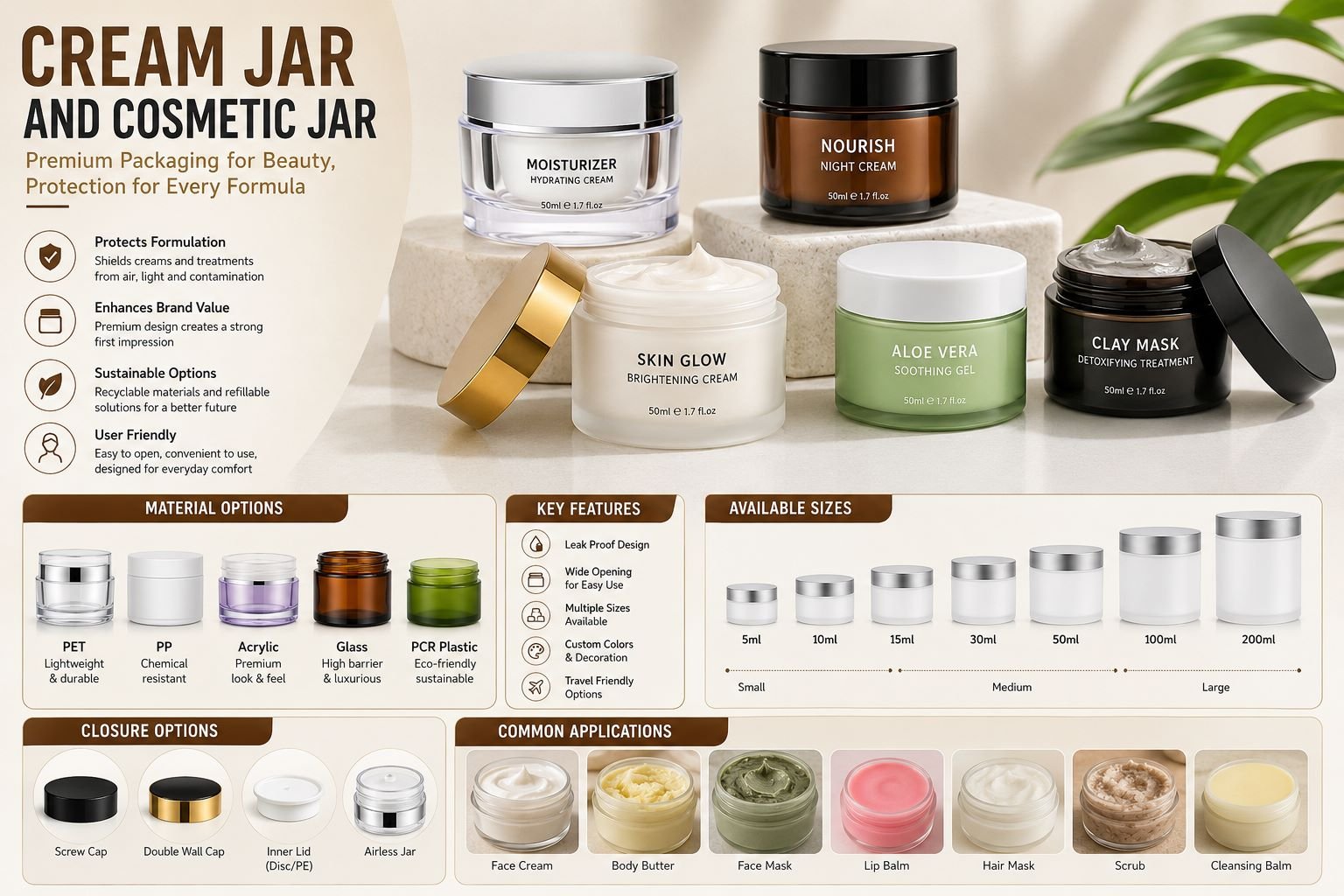
The global beauty packaging landscape is undergoing a noticeable transformation as skincare brands seek containers that combine attractive design with functionality, sustainability, and reliable product protection. The traditional cream jar is being redesigned with new materials, improved closures, refill concepts, and premium finishes, while the cosmetic jar is increasingly becoming an important element of brand positioning.
Beauty companies are facing changing consumer expectations. Customers are no longer influenced by appearance alone; convenience, hygiene, packaging waste, product protection, and ease of use can all affect how a cosmetic product is perceived.
This shift is encouraging packaging manufacturers and beauty brands to reconsider how jars are designed, manufactured, tested, and ultimately presented to consumers.
Skincare Growth Creates New Expectations for Jar Packaging
The expanding variety of skincare formulations has created demand for more specialized packaging.
Face creams are now joined by sleeping masks, cleansing balms, barrier creams, body butter, exfoliating treatments, scalp masks, styling products, and other specialized formulations. Many of these products require packaging capable of handling thicker textures.
The cream jar continues to be an effective option because its wide opening allows consumers to access high-viscosity products easily.
Typical applications include:
- Moisturizing creams
- Night treatments
- Body butter
- Cleansing balms
- Face masks
- Hair masks
- Scrubs
- Styling creams
- Hand treatments
- Professional cosmetics
Meanwhile, the broader cosmetic jar category gives manufacturers considerable flexibility in developing packaging for different beauty segments.
Packaging Engineers Focus More Closely on Formula Protection
The growing complexity of skincare formulations is making compatibility between the product and package increasingly important.
Modern cosmetics can contain botanical extracts, oils, fragrances, vitamins, acids, antioxidants, and other functional ingredients. Packaging materials need to remain stable when exposed to these formulations throughout the intended product life.
Compatibility Problems Can Become Expensive
Selecting an unsuitable container can potentially contribute to:
- Jar deformation
- Leakage
- Changes in appearance
- Closure problems
- Decoration damage
- Material discoloration
- Loss of product quality
For this reason, packaging evaluation should take place before full commercial production.
Real-World Testing Matters
Laboratory specifications provide useful information, but brands should also test the actual formulation inside the selected cream jar.
Testing under appropriate storage and transportation conditions can help reveal problems that may not be visible immediately after filling.
Glass Remains Strong While Advanced Plastics Expand
Material choice continues to be one of the biggest decisions in cosmetic packaging development.
Glass maintains an established position in prestige skincare because of its substantial weight, rigidity, and premium appearance. Plastic technologies, meanwhile, offer lightweight structures, impact resistance, and considerable design freedom.
| Packaging Material | Major Strength | Common Positioning |
| Glass | Premium feel and barrier | Prestige skincare |
| PET | Clarity and low weight | Everyday beauty |
| PP | Versatility and durability | Skincare and personal care |
| Acrylic | Luxury visual effect | Premium cosmetics |
| PCR Plastic | Recycled material content | Eco-focused ranges |
There is therefore no universal answer when selecting material for a cosmetic jar.
Transportation Is Becoming Part of Material Selection
A heavy glass container may create an impressive experience but also increases shipping weight and requires greater protection against breakage.
Plastic can reduce weight and improve impact resistance, which may be valuable for brands selling primarily through e-commerce.
Packaging decisions increasingly involve balancing perceived value against practical distribution requirements.
Cosmetic Jar Design Moves Toward Shelf and Screen Appeal
Traditionally, beauty packaging was largely designed to attract attention on retail shelves. Today’s packaging must also perform visually on smartphones, websites, marketplaces, and social media.
This has created a new requirement: jars need both shelf appeal and screen appeal.
A distinctive cosmetic jar can help a product become recognizable even when displayed as a small image in an online product grid.
Brands Explore Multiple Decoration Methods
Current customization possibilities include:
- Screen printing
- Foil stamping
- Matte finishing
- Gloss finishing
- Frosted surfaces
- Metallization
- Embossed logos
- Custom labels
- Gradient decoration
- Colored closures
Premium design does not necessarily mean adding more decoration. Minimalist packaging with strong proportions and carefully controlled typography can also create high perceived value.
Right-Sizing Packaging Gains Greater Attention
Beauty brands are also reconsidering container dimensions.
Oversized packaging can create additional material usage, larger cartons, increased transportation volume, and misleading consumer expectations.
Matching jar capacity more closely with actual usage can create a more efficient product.
Typical Cosmetic Jar Capacity Guide
| Capacity | Common Product |
| 5–15 ml | Eye treatment and samples |
| 20–30 ml | Concentrated skincare |
| 50 ml | Facial moisturizer |
| 100–200 ml | Scrubs and masks |
| 250 ml+ | Body and professional products |
A correctly proportioned cream jar can make packaging easier to handle while supporting more responsible material use.
Closures Become an Important Area of Innovation
The jar receives most of the visual attention, but closure design can determine whether the complete package performs successfully.
A poorly fitted cap may cause leakage, contamination concerns, or customer frustration.
Brands are consequently paying closer attention to closure engineering.
Modern Closure Features
Depending on the product, packaging may incorporate:
- Screw-thread caps
- Protective liners
- Inner discs
- Tamper-evident seals
- Double-wall caps
- Custom closures
- Controlled dispensing mechanisms
Small Components Can Influence Premium Perception
The way a cap rotates, aligns, opens, and closes contributes to the tactile experience.
For premium skincare, these seemingly minor interactions can reinforce—or weaken—the perceived quality of the entire product.
Refillable Cosmetic Jars Enter More Beauty Strategies
Refillable packaging is attracting attention as companies search for ways to reduce repeated use of decorative outer containers.
A refillable cosmetic jar may use a durable external package with a replaceable inner component containing the formulation.
The concept can allow customers to retain premium packaging while replacing only part of the system.
However, refill solutions must be carefully engineered. Product protection, refill installation, hygiene, material separation, and actual consumer participation all influence environmental effectiveness.
PCR Materials Create New Opportunities
Post-consumer recycled plastic is another area influencing beauty packaging.
Using PCR material can reduce reliance on virgin plastic, although recycled content may introduce variations in appearance or processing characteristics.
Brands considering PCR for a cream jar should evaluate:
- Material consistency
- Cosmetic compatibility
- Appearance requirements
- Manufacturing performance
- Applicable regulations
- Available recycled content
Sustainability objectives should remain aligned with product safety and package functionality.
Airless Jar Systems Target Advanced Skincare
One of the more technically interesting developments involves airless jar packaging.
Instead of repeatedly opening the entire product surface, some airless systems dispense a controlled amount through an integrated mechanism.
This can reduce direct contact with the bulk formulation during routine use.
Potential Benefits of Airless Designs
Depending on the system, potential advantages include:
- Controlled dispensing
- Cleaner application
- Reduced direct contact
- Premium user experience
- Better evacuation of some formulations
An airless cream jar, however, should not automatically be considered suitable for every product. Viscosity, formulation behavior, component compatibility, cost, and recyclability should all be evaluated.
E-Commerce Raises the Standard for Packaging Durability
Online distribution is creating another challenge for packaging manufacturers.
A cosmetic jar purchased online can experience multiple stages of handling before reaching the consumer.
Packaging may encounter vibration, impact, stacking pressure, changing temperatures, and individual parcel delivery.
Brands therefore need to consider whether closures remain secure and decoration stays attractive throughout transportation.
Leakage inside an e-commerce shipment can damage not only the cosmetic product but also surrounding products, cartons, and the overall customer experience.
Quality Control Becomes Critical for Growing Beauty Brands
Packaging consistency becomes increasingly important as production volumes grow.
Minor dimensional variations between jars and closures can create significant problems across thousands of units.
Beauty companies should discuss quality standards with suppliers before approving mass production.
Important areas include:
- Dimensional tolerances
- Closure fit
- Material specifications
- Printing consistency
- Surface defects
- Color matching
- Leakage performance
- Batch consistency
A dependable supplier should be capable of explaining how packaging quality is controlled rather than simply providing attractive samples.
Frequently Asked Questions
1. Why is cream jar packaging changing?
Beauty brands increasingly require improved functionality, distinctive branding, sustainability options, and packaging compatible with sophisticated formulations.
2. What products commonly use cream jars?
A cream jar is suitable for moisturizers, masks, balms, body butter, scrubs, hair treatments, and similar products.
3. Is glass the best cosmetic jar material?
Not necessarily. The correct material depends on formulation, branding, weight, protection, transportation, sustainability, and budget.
4. Why are plastic jars popular?
They offer low weight, impact resistance, flexible designs, multiple material choices, and extensive customization opportunities.
5. What does PCR mean in packaging?
PCR means post-consumer recycled material obtained from previously used products and processed for appropriate new applications.
6. Are refillable cosmetic jars sustainable?
They can reduce repeated packaging consumption when properly designed and when consumers consistently purchase and use refills.
7. Why is closure quality important?
A reliable closure helps maintain package integrity, prevent leakage, and provide a better customer experience.
8. Can cream jars be customized?
Yes. Brands can customize colors, printing, coatings, closures, labels, shapes, and other decorative features.
9. What is an airless cosmetic jar?
It is a jar-style dispensing system designed to limit direct access to the bulk formulation during normal product dispensing.
10. Why should jars undergo compatibility testing?
Testing helps determine whether packaging materials and components remain suitable when exposed to the actual cosmetic formulation.