Walk into a modern plastic manufacturing facility and you will find extrusion equipment performing some of the industry’s most important jobs. Pipes, films, profiles, compounds, masterbatches, cable coatings, sheets, and recycled polymer pellets can all pass through an extrusion process before reaching the market.
Yet extrusion requirements are not identical. A company producing standard polyethylene pipes has very different processing needs from a manufacturer combining polymers with pigments, minerals, fibers, and performance additives.
This is where the choice between a twin extruder and single extruder becomes important. Understanding what happens inside these machines can help manufacturers choose equipment based on real production requirements rather than specifications alone.
Start With the Material, Not the Machine
A common mistake when selecting extrusion equipment is beginning with machine capacity or price.
The better starting point is the raw material.
Manufacturers should understand whether the material arrives as a ready-to-process polymer or whether several ingredients must be combined during extrusion.
Important questions include:
- Does the polymer require intensive mixing?
- Are powders or mineral fillers involved?
- Will reinforcing fibers be added?
- Does moisture need to be removed?
- Are multiple polymers being blended?
- Is the material sensitive to temperature?
- How consistent is the feedstock?
The answers can quickly indicate whether a single extruder is sufficient or whether twin-screw processing is more appropriate.
Inside a Single Extruder
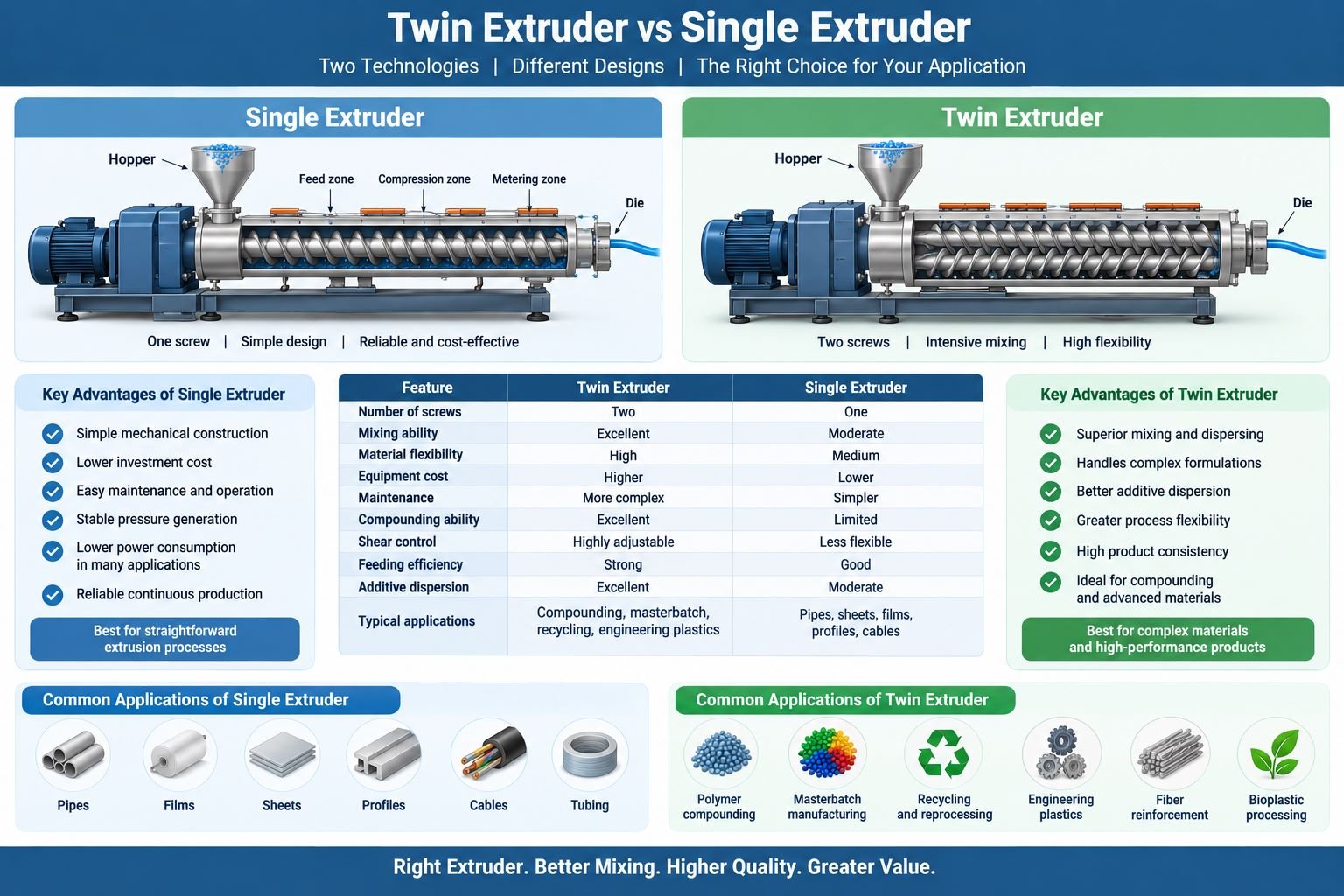
A single extruder operates using one screw rotating inside a heated barrel. The system continuously transports material from the feed section toward the extrusion die.
Although the machine appears mechanically simple, several important changes occur inside it.
Solid pellets enter the barrel, begin heating, become compressed, melt, and gradually form a relatively uniform polymer melt. The screw then generates the pressure required to move the material through the die.
This combination of conveying, melting, and pressure generation makes single-screw technology highly effective for conventional extrusion.
Why Simplicity Can Be a Major Advantage
Manufacturing equipment does not need additional complexity when the process itself is straightforward.
A single extruder can offer several advantages:
- Simpler construction
- Easier operation
- Lower maintenance complexity
- Stable melt pressure
- Continuous production
- Competitive equipment cost
- Efficient processing of standard thermoplastics
For manufacturers processing well-prepared materials, these characteristics can translate into reliable production and manageable operating costs.
Where Single Extrusion Makes Practical Sense
Consider a manufacturer producing polyethylene tubing. The polymer formulation may already contain the necessary additives before it reaches the production facility.
The main job of the extrusion machine is therefore to melt the material consistently and deliver it through a die at a stable rate.
This is an ideal environment for a single extruder.
The technology is widely used for:
- PE and PP pipes
- Plastic profiles
- Plastic tubing
- Film production
- Sheet extrusion
- Wire insulation
- Cable coating
- Extrusion coating
In these processes, stable output can be more valuable than intensive mixing capability.
When Extrusion Becomes More Complicated
Now consider another manufacturer producing an engineering plastic compound.
The formulation may contain a base polymer, glass fiber, mineral filler, colorant, stabilizer, lubricant, and impact modifier.
The challenge is no longer simply melting plastic.
Every ingredient needs to be introduced correctly, mixed thoroughly, and distributed throughout the polymer without unnecessarily damaging heat-sensitive components.
This type of processing requirement is where the twin extruder becomes particularly valuable.
How a Twin Extruder Changes Material Processing
A twin extruder contains two screws working inside a common barrel.
The screws create a more dynamic material flow pattern. Material can be divided, transferred between screw channels, compressed, stretched, and recombined repeatedly.
This allows twin-screw equipment to perform multiple processing functions within one continuous operation.
These functions may include:
- Polymer melting
- Ingredient distribution
- Filler incorporation
- Pigment dispersion
- Fiber addition
- Polymer blending
- Reactive processing
- Degassing
The machine therefore acts as more than a material-conveying system.
Mixing Is About More Than Combining Ingredients
One reason twin-screw extrusion is associated with compounding is its ability to control mixing.
Good mixing has two dimensions: distribution and dispersion.
Why Distribution Matters
Imagine adding black pigment to a natural polymer.
If the pigment is not distributed evenly, some portions of the finished compound may appear darker than others.
Distributive mixing helps move the pigment throughout the entire material volume.
Why Dispersion Matters
Pigments and fillers can form clusters.
Simply spreading these clusters throughout the polymer is not enough. They may need to be broken into smaller units.
The mechanical forces created inside a twin extruder can help break agglomerates and disperse particles more effectively.
The same principle applies to mineral fillers and numerous performance additives.
Comparing Twin and Single Extrusion Technology
| Manufacturing Requirement | Twin Extruder | Single Extruder |
| Basic polymer melting | Excellent | Excellent |
| Intensive mixing | Excellent | Moderate |
| Complex compounding | Highly suitable | Limited |
| Stable pressure generation | Good | Excellent |
| Filler incorporation | Highly suitable | Application-dependent |
| Equipment simplicity | Moderate | Excellent |
| Maintenance simplicity | Moderate | Excellent |
| Formulation flexibility | Excellent | Moderate |
| Initial investment | Higher | Lower |
| Standard product extrusion | Suitable | Highly suitable |
The table illustrates why one technology cannot automatically be called better than the other.
Why Screw Design Deserves More Attention
Manufacturers often compare motors, output rates, and barrel dimensions while overlooking screw design.
Yet screw geometry directly affects how the polymer behaves.
A typical single extruder screw includes feeding, compression, and metering sections.
Twin-screw systems can use modular screw elements that perform different functions.
Depending on the formulation, engineers may combine conveying elements, kneading blocks, mixing elements, and other specialized sections.
This provides greater control over:
- Mixing intensity
- Material residence time
- Shear
- Pressure
- Temperature development
Correct screw configuration can be just as important as selecting the machine itself.
Why Masterbatch Production Needs Strong Mixing
Masterbatch is a concentrated mixture of pigments or functional additives dispersed within a carrier material.
When masterbatch quality is inconsistent, downstream manufacturers can experience uneven color or variable product performance.
The strong mixing capability of a twin extruder makes it particularly useful for masterbatch manufacturing.
Pigments can be distributed and dispersed throughout the carrier resin before the compound is pelletized for later use.
Processing Filled and Reinforced Polymers
Fillers are widely used to modify plastic properties or manufacturing economics.
Common materials include:
- Calcium carbonate
- Talc
- Glass fiber
- Mineral fillers
- Wood-based fibers
- Functional additives
The challenge is introducing these ingredients without creating poor dispersion or unstable processing.
A properly configured twin extruder can provide dedicated zones for polymer melting, filler feeding, mixing, and venting.
This creates greater flexibility for developing specialized compounds.
Recycling Creates a Different Extrusion Challenge
Recycled polymers can behave differently from virgin materials.
Feedstock quality may vary between batches, and materials can contain moisture, printing residues, contamination, or volatile compounds.
For relatively clean and consistent recycled material, a single extruder may provide effective processing.
When recycling requires intensive blending, modification, or removal of volatile substances, twin-screw processing may offer additional advantages.
Machine selection should therefore reflect the actual quality and composition of the recycled feedstock.
Why Venting and Degassing Are Important
Air, moisture, and volatile substances can become trapped inside molten polymers.
If they remain in the material, they may contribute to:
- Bubbles
- Surface imperfections
- Odor
- Processing instability
- Poor final appearance
Extruders can include venting sections where these substances escape.
A twin extruder can be configured with vacuum degassing zones that remove volatile components while material continues through the process.
This capability is especially useful in recycling and specialty compounding.
Should Energy Consumption Influence the Decision?
Absolutely, but energy efficiency should be measured correctly.
Comparing only installed motor power can produce a misleading picture.
A single extruder may consume less energy for a straightforward application because its processing requirements are relatively simple.
A twin-screw line may require greater power but can potentially perform mixing, compounding, additive incorporation, and degassing within one continuous process.
A better measurement is energy consumed per kilogram of acceptable finished product.
What About Maintenance Costs?
A single extruder generally has an advantage in mechanical simplicity.
With only one screw and a relatively straightforward drive arrangement, routine inspection and servicing can be easier.
Twin-screw machines require attention to screw elements, barrel wear, gearbox condition, synchronization, and processing components.
However, maintenance costs depend heavily on material abrasiveness, operating conditions, machine quality, and preventive maintenance practices.
How to Make a Smarter Equipment Decision
Instead of asking, “Which extruder is best?” manufacturers should ask, “Which extruder best matches our process?”
Evaluate the following:
- Raw material characteristics
- Required mixing level
- Additive concentration
- Filler percentage
- Production capacity
- Degassing requirements
- Product specifications
- Energy consumption
- Maintenance resources
- Future formulation plans
If production mainly requires reliable melting and shaping, the single extruder deserves serious consideration.
If production involves complex compounding and formulation development, the twin extruder may provide greater process flexibility.
Frequently Asked Questions
What is the main purpose of a single extruder?
A single extruder continuously conveys, melts, homogenizes, pressurizes, and shapes suitable thermoplastic materials.
Why does a twin extruder have two screws?
Two screws provide greater control over material conveying, mixing, dispersion, compounding, and other complex processing operations.
Which extruder is better for pipe manufacturing?
Single-screw extrusion is commonly preferred for many PE and PP pipe manufacturing applications.
Which extruder is suitable for masterbatch?
A twin extruder is widely preferred because masterbatch production requires strong pigment or additive dispersion.
Can a single extruder process recycled plastic?
Yes. It can process suitable recycled polymers when the material characteristics match the machine and application.
Can twin extruders process glass fiber?
Yes. Properly configured twin-screw systems are commonly used to incorporate glass fibers into engineering polymer compounds.
Which extruder requires a larger investment?
A twin extruder generally has a higher initial cost because its mechanical and control systems are more complex.
Is single-screw extrusion outdated?
No. The single extruder remains highly relevant and efficient for many large-volume plastic manufacturing applications.
What determines extruder output?
Output depends on screw design, screw speed, machine size, material properties, feeding rate, temperature, pressure, and downstream equipment.
What should manufacturers prioritize when buying an extruder?
They should prioritize material compatibility, product quality, processing stability, capacity, energy efficiency, maintenance, and total production economics.
Read more – https://tandtlawassociates.com/twin-extruder-vs-single-extruder-deep-guide-to-extrusion-technology/