
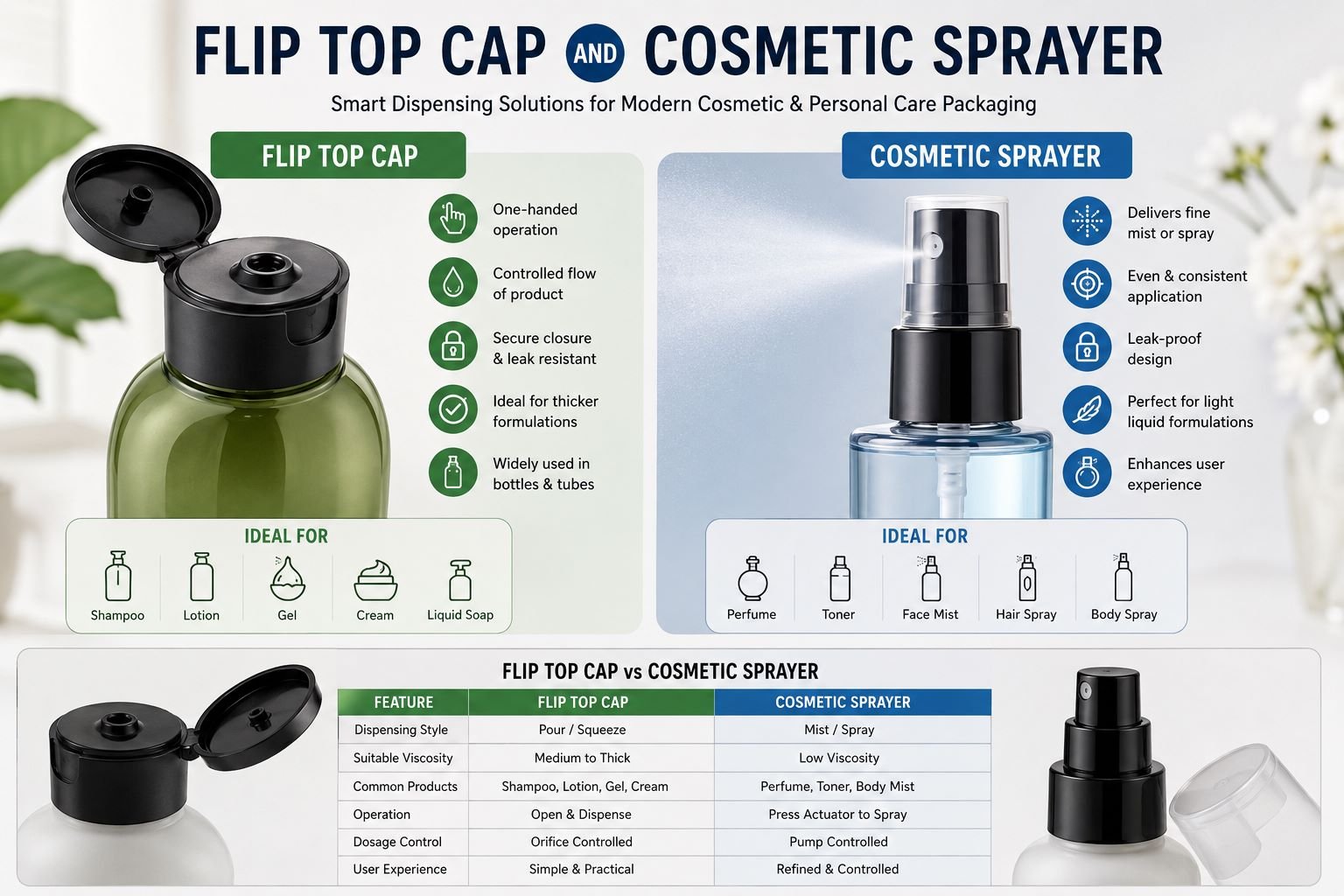
The beauty, cosmetics, and personal care industries are placing renewed emphasis on high-performance dispensing packaging as brands respond to changing consumer expectations around convenience, precision, sustainability, and premium presentation. This shift is creating new opportunities for manufacturers specializing in flip top cap and cosmetic sprayer solutions.
From everyday shampoos and lotions to premium facial mists and fragrances, dispensing components have become an integral part of the product experience. Brands increasingly recognize that consumers evaluate not only what is inside a package but also how easily, cleanly, and consistently the formulation can be used.
As a result, packaging development is moving toward solutions that combine functional engineering with visual differentiation.
Beauty Brands Reconsider the Role of Packaging
Packaging was traditionally viewed primarily as a means of containing and protecting a formulation. Today, it also influences convenience, dosage control, shelf appeal, portability, and consumer satisfaction.
A poorly designed closure can cause leakage or product waste, while an inconsistent sprayer can negatively affect application.
This changing perspective has increased demand for carefully engineered flip top cap and cosmetic sprayer systems designed around specific formulations and applications.
Flip Top Cap Supports Convenient Daily Dispensing
The flip top cap remains one of the most recognizable closure formats across personal care packaging.
Its integrated hinge allows consumers to open the package without completely removing the cap. After dispensing, the upper lid can be snapped back into position.
This format is commonly selected for:
- Shampoo
- Conditioner
- Shower gel
- Face wash
- Body lotion
- Sunscreen
- Haircare products
- Liquid soap
- Personal care oils
Its simplicity makes the closure particularly suitable for products used regularly at home, in salons, while traveling, or in other everyday environments.
Better Engineering Improves Closure Reliability
The performance of a flip top cap depends on more than its external appearance.
Packaging manufacturers must carefully evaluate hinge strength, sealing geometry, closure fit, opening force, wall thickness, dispensing-hole dimensions, and material characteristics.
Flow Control Becomes a Key Design Consideration
Different formulations require different dispensing behavior.
A thick shampoo may require a relatively large opening to flow comfortably. A lightweight oil can require a smaller opening to prevent excessive dispensing.
Matching orifice dimensions to viscosity helps brands provide greater control and potentially reduce product waste.
Cosmetic Sprayer Delivers a Different User Experience
For formulations intended to cover a larger application area, the cosmetic sprayer provides a fundamentally different dispensing method.
Instead of squeezing or pouring the formulation, consumers press an actuator. The internal pump draws liquid through a dip tube and pushes it through a specially designed nozzle.
The resulting spray characteristics depend on both the mechanism and the formulation.
Common applications include facial mist, toner, perfume, body mist, makeup setting spray, haircare liquid, and lightweight skincare products.
Precision Becomes Central to Sprayer Development
A high-quality cosmetic sprayer should ideally deliver predictable output with each complete actuation.
Manufacturers therefore evaluate technical parameters including pump dosage, spray angle, droplet distribution, priming, actuation force, and nozzle performance.
Fine Mist Applications Require Special Attention
Facial products demonstrate why spray quality matters.
Consumers generally expect a facial mist to distribute formulation comfortably rather than producing a concentrated stream or large, uneven droplets.
The relationship between nozzle design, formulation viscosity, pump pressure, and output must therefore be carefully balanced.
Understanding the Differences Between Dispensing Options
| Performance Area | Flip Top Cap | Cosmetic Sprayer |
| Product delivery | Flow dispensing | Atomized dispensing |
| Common consistency | Medium/thick | Liquid |
| Operation | Open and squeeze | Press and spray |
| Primary control | Orifice size | Pump output |
| Typical products | Shampoo and lotion | Mist and toner |
| Components | Relatively few | Multiple |
| Application style | Direct | Distributed |
| User positioning | Practical | Practical to premium |
Selecting between these systems should begin with understanding how the formulation needs to reach the consumer.
Packaging Compatibility Receives Greater Attention
Industry development is also highlighting the importance of compatibility testing.
Cosmetic formulations can contain ingredients capable of interacting with packaging components over extended storage periods.
Fragrances, alcohol, essential oils, preservatives, solvents, and active ingredients may affect different polymers, elastomers, or metallic components differently.
Before approving a flip top cap or cosmetic sprayer, brands can conduct compatibility assessments to identify changes in appearance, sealing, structural integrity, or dispensing behavior.
Testing Helps Reduce Packaging Failure
Packaging problems discovered after market launch can create product returns, negative reviews, additional logistics expenses, and brand damage.
Performance evaluation can include:
- Leakage testing
- Drop testing
- Storage testing
- Repeated-use testing
- Transportation simulation
- Dispensing-output assessment
- Formulation compatibility evaluation
For the cosmetic sprayer, repeated actuation can help determine whether spray performance remains consistent as the bottle empties.
For hinged closures, repeated opening tests can help evaluate hinge durability.
E-Commerce Influences Packaging Development
Online retail has introduced additional challenges for cosmetic packaging.
A product purchased in a physical store may remain upright for much of its journey. E-commerce packages can experience multiple orientations, vibration, impact, compression, and temperature variations.
Secure sealing is therefore becoming increasingly important.
A properly engineered flip top cap can help protect squeeze bottles during distribution, while sprayer systems require effective sealing around pump and bottle interfaces.
Sustainability Creates New Innovation Opportunities
Environmental priorities are encouraging manufacturers to reconsider how dispensing components are constructed.
Lightweighting is one area receiving particular attention. Using less material per closure can reduce total material consumption across large production volumes.
Simplifying packaging construction may also support improved recyclability.
Sprayers Present a Unique Sustainability Challenge
A cosmetic sprayer can contain several materials because different components must perform mechanical, sealing, and pumping functions.
Manufacturers are therefore exploring simplified structures and alternative material configurations while working to preserve spray performance.
Customization Helps Brands Compete Visually
Despite the increasing emphasis on technical performance, appearance continues to influence purchasing decisions.
The flip top cap can be customized through color matching, surface texture, shape, embossing, matte effects, and glossy finishes.
Similarly, sprayers can feature customized actuators, decorative collars, coordinated colors, and different surface treatments.
Combining technical performance with distinctive visual design can help products create stronger shelf recognition.
Frequently Asked Questions
What makes a flip top cap useful?
A flip top cap provides convenient opening, controlled dispensing, secure closing, and straightforward everyday operation.
Which industries use flip top closures?
Cosmetics, personal care, healthcare, household products, and other consumer categories commonly use hinged dispensing closures.
What does a cosmetic sprayer do?
A cosmetic sprayer uses a pumping mechanism and nozzle to distribute liquid as a controlled spray or mist.
What products are suitable for sprayers?
Facial mists, perfumes, toners, body sprays, haircare liquids, and setting sprays are common examples.
What affects the spray pattern?
Nozzle geometry, formulation viscosity, pump pressure, dosage, actuator design, and spray angle can affect performance.
Why is formulation viscosity important?
Viscosity determines how easily a formulation moves through an opening, tube, pump, or nozzle.
Can packaging components be customized?
Yes. Colors, finishes, dimensions, textures, dispensing characteristics, and decorative features can often be customized.
Why should brands perform leakage tests?
Leakage tests help evaluate packaging performance during storage, handling, transportation, and consumer use.
Are sustainable dispensing systems available?
Manufacturers are developing lightweight, simplified, and more recyclable solutions, although sustainability depends on the complete packaging structure.
What should buyers consider when selecting a supplier?
Buyers should consider manufacturing quality, compatibility support, customization capabilities, testing procedures, consistency, and production capacity.
https://newsgrow.blogspot.com/2026/08/cream-jar-and-cosmetic-jar.html
https://gosarkarijobs.com/disc-cap-and-cosmetic-pump-a-deep-guide-to-modern-cosmetic-packaging/
https://newsgrow.blogspot.com/2026/08/disc-cap-and-cosmetic-pump-essential.html
https://tandtlawassociates.com/past-and-future-of-disc-cap-and-body-lotion-bottle-packaging/
https://newsgrow.blogspot.com/2026/08/disc-cap-and-body-lotion-bottle-designs.html