
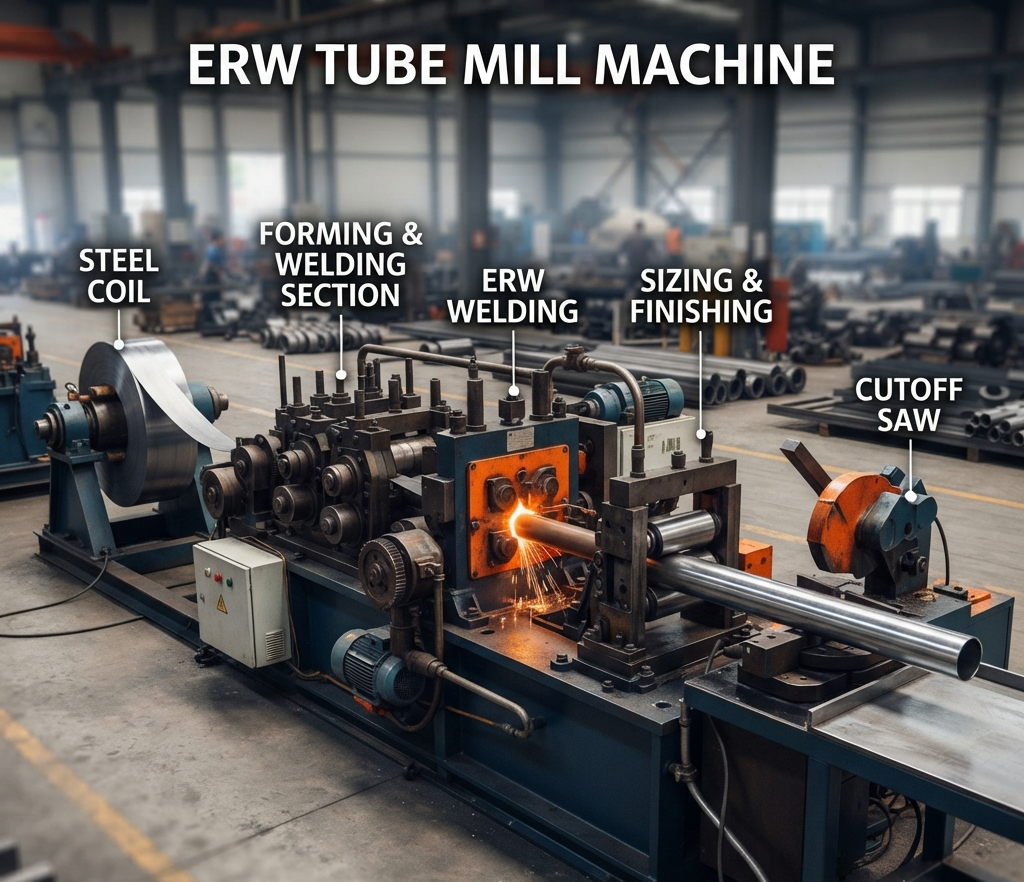
The steel tube manufacturing sector is undergoing a significant technological transformation as producers look for faster, more precise, flexible, and energy-conscious production methods. The Tube Mill Machine has evolved from conventional mechanical equipment into an integrated manufacturing system capable of continuous forming, welding, sizing, cutting, monitoring, and quality control.
A key technology behind this development is the ERW Tube Mill Machine. Using Electrical Resistance Welding, these production systems allow manufacturers to form metal strip into tubes and weld the edges continuously. The technology has become an important solution for industries requiring dependable welded tubes in high production volumes.
The transformation is not limited to production speed. Automation, digital monitoring, predictive maintenance, artificial intelligence, and energy-efficient engineering are expected to influence the future direction of tube mill manufacturing.
From Traditional Tube Making to Continuous Manufacturing
The history of tube manufacturing began with processes that required significant mechanical and manual involvement. Metal sheets or strips had to be shaped and joined before finished tubes could be supplied to industrial users.
As demand for steel products increased, manufacturers needed a better way to produce tubes at scale. Continuous roll forming emerged as an important solution.
The basic principle was simple: a continuous strip of metal would pass through a sequence of forming rolls, with each station gradually changing its shape.
This approach established the foundation for the modern Tube Mill Machine and significantly changed the economics of tube manufacturing.
ERW Technology Creates a Production Breakthrough
Electrical Resistance Welding introduced another major improvement.
In an ERW Tube Mill Machine, the edges of the formed strip are brought together and joined using electrical resistance. Heat generated through electrical current enables the welding process to take place continuously as the material moves through the line.
This creates a production system in which forming and welding work together rather than operating as completely separate manufacturing stages.
A modern ERW production line can integrate:
- Coil loading and uncoiling
- Strip preparation
- Forming
- High-frequency welding
- Weld bead removal
- Sizing
- Cutting
- Straightening
- Online inspection
The integration of these operations helps manufacturers achieve a consistent and efficient production flow.
The Present Generation of Tube Mill Machines
Today’s Tube Mill Machine represents a significant departure from earlier generations of equipment.
Digital controls allow operators to monitor multiple aspects of production from centralized control systems. Sensors and electronic components can provide information about machine performance, while automated systems can manage repetitive operations.
Depending on the configuration, modern mills may monitor:
- Production speed
- Welding conditions
- Strip position
- Motor performance
- Tube dimensions
- Cutting operations
- Equipment alarms
This combination of mechanical engineering and digital control is helping manufacturers improve production consistency.
Automation Reshapes the Role of Operators
Automation does not simply make a machine run faster. It changes how production is managed.
Instead of manually adjusting every stage of the process, operators can supervise machine performance through digital interfaces. Automated systems can execute predefined production parameters while personnel focus on quality, troubleshooting, and process optimization.
This can be especially valuable in facilities producing different tube sizes or specifications.
Greater automation can contribute to:
- Repeatable production
- Faster setup
- Reduced manual errors
- Improved monitoring
- Better production documentation
- More efficient resource utilization
Predictive Maintenance Moves to the Forefront
Unplanned downtime remains a major concern for industrial manufacturers.
A failure involving a welding system, forming stand, motor, bearing, or cutting unit can interrupt an entire production line.
Future ERW Tube Mill Machine systems are expected to make greater use of predictive maintenance technologies. Sensors can continuously collect information about temperature, vibration, electrical characteristics, and machine behavior.
Advanced software can analyze these signals and identify unusual patterns.
Instead of waiting for equipment to fail, maintenance teams may be able to intervene earlier.
This approach can potentially improve:
- Machine availability
- Maintenance planning
- Component life
- Production continuity
- Overall equipment efficiency
AI and Machine Vision Bring New Quality Possibilities
The future of tube manufacturing will also involve more sophisticated quality inspection.
Machine vision systems can observe tube surfaces and production characteristics while products move through the line. AI-based software can analyze inspection information and identify patterns that may be difficult to recognize through manual inspection alone.
Potential applications include:
- Weld quality monitoring
- Surface defect identification
- Dimensional inspection
- Production anomaly detection
- Automated quality classification
- Process trend analysis
As these technologies develop, quality control could move closer to real-time decision-making.
Sustainability Becomes a Manufacturing Priority
The future development of tube mills will not be measured only by how many tubes a machine can produce per hour.
Manufacturers are increasingly concerned with energy consumption and material efficiency.
Modern equipment can use efficient motors, electronic drives, optimized welding controls, and automated systems to reduce unnecessary energy use.
Reducing scrap is equally important. Better forming control and automated inspection can help prevent large quantities of material from being lost because of production errors.
Future Tube Mill Machine designs are therefore likely to combine productivity with resource efficiency.
Flexible Production Will Shape Future Investments
Manufacturers increasingly need to respond to changing customer requirements. Orders may involve different dimensions, wall thicknesses, materials, profiles, or production quantities.
A highly flexible mill can help manufacturers respond to these changes more effectively.
Future equipment may incorporate:
- Automated tooling adjustment
- Faster roll changes
- Digital production recipes
- Automated parameter settings
- Modular production sections
- Improved changeover procedures
Flexibility can become a major competitive advantage for manufacturers serving diverse markets.
Where ERW Tube Mills Are Used
The versatility of welded steel tubes has helped ERW technology expand across multiple industries.
Common application areas include:
- Building and construction
- Automotive manufacturing
- Furniture production
- Agricultural equipment
- Industrial machinery
- Infrastructure projects
- Engineering applications
- Fabrication
Each application has different requirements, making material selection, tube dimensions, welding parameters, and production standards important considerations.
What the Future Tube Mill Could Look Like
The next generation of tube manufacturing may operate as a connected digital ecosystem.
A production order could be transferred electronically to the manufacturing system. The Tube Mill Machine could automatically load relevant parameters, while sensors continuously monitor production.
At the same time, inspection systems could evaluate tube quality and maintenance software could monitor equipment health.
Production data could then be collected for analysis and optimization.
This would move tube manufacturing from simple machine automation toward a more comprehensive Industry 4.0 production model.
Selecting a Tube Mill for Long-Term Production
Manufacturers considering new equipment should evaluate both current and future requirements.
Key questions include:
- What tube sizes need to be produced?
- Which material grades will be processed?
- What production capacity is required?
- How much automation is appropriate?
- What level of quality inspection is needed?
- How quickly must tooling changes occur?
- What are the expected energy costs?
- What maintenance support is available?
- Can the machine be upgraded later?
The answers can help manufacturers identify equipment that supports long-term business objectives rather than only immediate production requirements.
Tube Mill Machine vs ERW Tube Mill Machine
| Category | Tube Mill Machine | ERW Tube Mill Machine |
| General definition | Equipment for tube manufacturing | Tube mill based on electrical resistance welding |
| Forming process | Commonly roll forming | Roll forming |
| Welding | Depends on configuration | Electrical resistance welding |
| Production style | Depends on design | Continuous production |
| Automation | Varies | Often advanced |
| Typical use | Broad range of tube production | Welded tube manufacturing |
Understanding this difference helps buyers communicate their production requirements more accurately when evaluating equipment.
Frequently Asked Questions
What is a Tube Mill Machine?
A Tube Mill Machine is a production system that forms metal strip into tubes and can integrate welding, sizing, cutting, straightening, and inspection processes.
What does ERW stand for?
ERW stands for Electrical Resistance Welding.
What does an ERW Tube Mill Machine manufacture?
It manufactures welded tubular products from compatible metal strip materials through continuous forming and resistance welding.
Why did continuous tube production become important?
Continuous production increased manufacturing efficiency and enabled larger quantities of standardized tubes to be produced.
What is the biggest advantage of ERW production?
One major advantage is the ability to combine continuous forming and welding within an integrated production line.
Are ERW mills suitable for industrial production?
Yes. Their continuous operating principle makes them suitable for many high-volume tube manufacturing applications.
How does automation help tube manufacturers?
Automation can improve repeatability, process monitoring, production efficiency, and operator control.
Why is predictive maintenance important?
It can help identify potential equipment problems before they result in unexpected production stoppages.
Can AI inspect welded tubes?
AI-supported machine vision can potentially assist with surface, dimensional, and weld-related inspection.
What will future tube mills focus on?
Future systems are expected to emphasize smart automation, predictive maintenance, flexible production, energy efficiency, connected monitoring, and intelligent quality control.
Read more – https://tandtlawassociates.com/past-and-future-of-erw-tube-mill-line-and-tube-mill-line/
https://newsgrow.blogspot.com/2026/08/erw-tube-mill-line-and-tube-mill-line.html
https://tandtlawassociates.com/tube-mill-machine-and-erw-tube-mill-machine-past-present-and-future/