
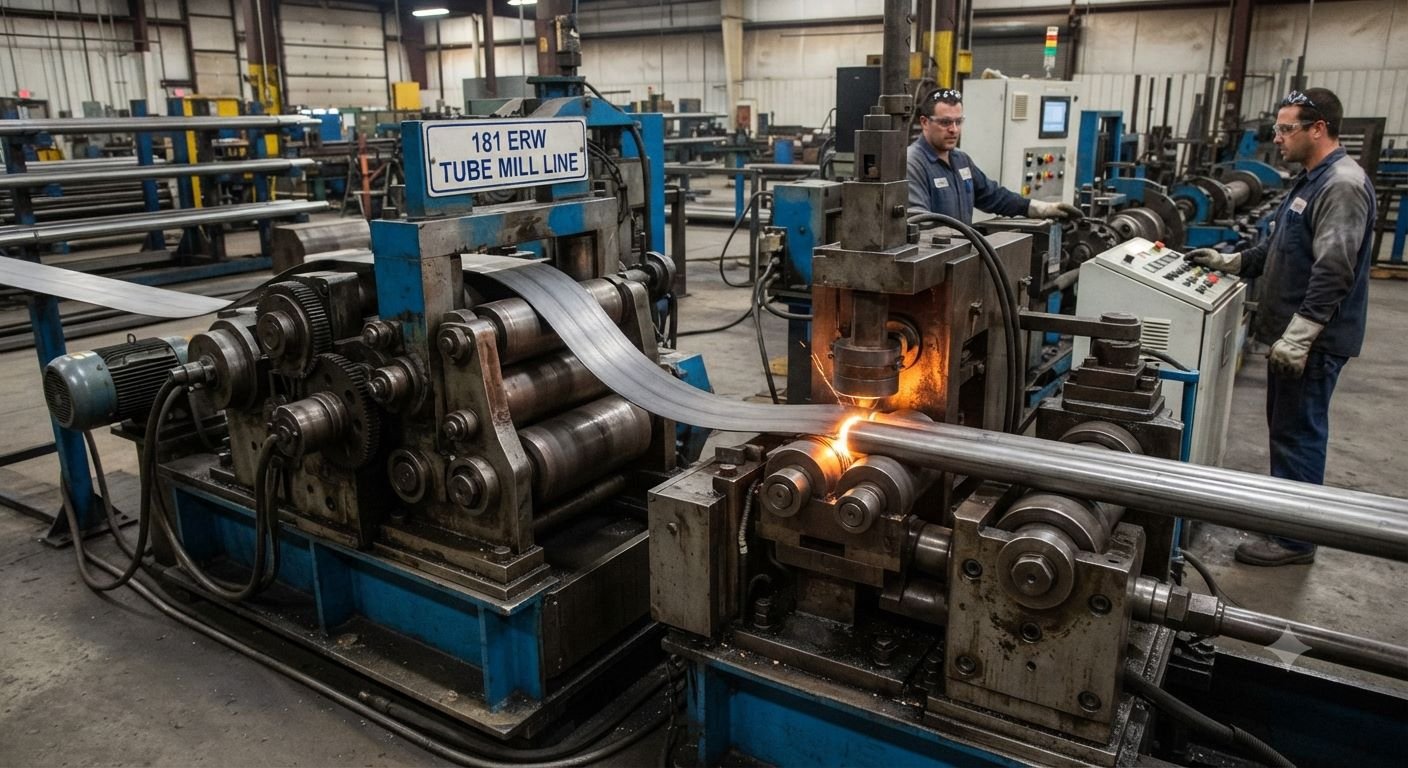
Steel tubes are an essential part of modern industrial development. They can be found in building structures, automobile components, machinery, furniture, agricultural equipment, infrastructure projects, and countless fabricated products. Although a finished tube may appear straightforward, its manufacturing process involves a carefully controlled combination of forming, welding, sizing, cutting, inspection, and material handling.
The ERW Tube Mill Line and Tube Mill Line have become important technologies for meeting this demand. Their development reflects the broader transformation of manufacturing—from conventional mechanical production to highly automated and digitally monitored systems.
What Is an ERW Tube Mill Line?
An ERW Tube Mill Line is a continuous production system used to manufacture welded steel tubes from steel strip or coil. ERW stands for Electric Resistance Welding.
During production, a flat steel strip is progressively formed into a cylindrical or shaped section. The two edges are brought together and heated through electrical resistance. Pressure is then applied to create a longitudinal welded seam.
Unlike a production process where every operation is completed separately, a modern tube mill integrates multiple stages into one continuous manufacturing line.
A typical line may include:
- Coil handling equipment
- Uncoiler
- Strip feeding system
- Accumulator
- Forming stands
- High-frequency welding system
- Weld seam processing equipment
- Sizing stands
- Straightening equipment
- Flying cutting saw
- Inspection equipment
- Run-out and collection systems
The exact configuration depends on the required tube dimensions, material, production speed, and application.
The Historical Journey of Tube Mill Technology
The earliest tube manufacturing systems were much less automated than those available today. Production involved separate mechanical operations and substantial operator involvement.
As industrialization accelerated, industries required greater quantities of steel tubing. Construction projects became larger, automobile production expanded, and machinery manufacturers needed reliable tubular components.
This created a strong need for continuous manufacturing.
The Transition to Roll Forming
Roll forming became a major technological development because it allowed flat steel strip to be shaped progressively through multiple stands.
Instead of attempting to bend the material into its final shape in one operation, each stand performed a controlled amount of deformation.
This improved production consistency and made continuous manufacturing practical.
The Expansion of Resistance Welding
The development of resistance welding provided a suitable method for joining the formed strip continuously.
As electrical technology improved, high-frequency welding systems became increasingly capable of supporting high production rates while maintaining controlled welding conditions.
Together, continuous roll forming and resistance welding established the basic architecture of modern ERW tube mills.
How the Modern Tube Mill Production Process Works
Although tube mill designs vary, the production process generally follows a logical sequence.
Coil Preparation
Steel strip is supplied in coil form. The coil must be loaded correctly and fed into the production system at a controlled rate.
Material characteristics such as thickness, width, grade, and surface condition influence the subsequent process.
Continuous Forming
The strip moves through a series of forming stands. The rolls gradually change the flat strip into the desired tubular profile.
Accurate roll alignment is essential because poor alignment can affect tube geometry, weld positioning, and production stability.
High-Frequency ERW Welding
At the welding section, the edges of the formed strip are heated using high-frequency electrical energy.
The heated edges are then brought together under controlled pressure to create the weld.
Welding stability is critical because the longitudinal seam can influence the mechanical integrity and quality of the finished product.
Sizing and Straightening
After welding, the tube passes through sizing rolls. These rolls refine the dimensions and profile of the finished product.
Straightening equipment can then improve alignment where necessary.
Automatic Cutting
Continuous production requires a cutting system capable of separating the finished tube into specified lengths.
Flying saws can synchronize with the moving tube, allowing cutting without repeatedly stopping the main production line.
Why ERW Tube Mills Are Important to Industry
The popularity of ERW technology is connected to its ability to combine productivity with consistent manufacturing.
For high-volume applications, continuous production can reduce unnecessary handling and improve overall manufacturing efficiency.
The technology is particularly valuable when manufacturers need large quantities of standardized steel tubes.
Major Industrial Applications
ERW tube products can be used in:
- Building and structural construction
- Automotive manufacturing
- Furniture production
- Agricultural equipment
- Industrial machinery
- Infrastructure projects
- General engineering
- Fabrication and manufacturing
- Material-handling equipment
- Mechanical structures
Different industries require different tube specifications, which is why mill configuration and tooling selection are so important.
Automation Has Redefined Tube Manufacturing
One of the biggest changes in tube mill technology is the transition from operator-dependent production to automated control.
Modern lines can use PLCs, HMIs, sensors, servo drives, digital controls, and automated fault monitoring.
This technology provides operators with information about the condition of the production line and allows many machine functions to be controlled more precisely.
Benefits of Automation
Automation can provide several advantages:
- More consistent production
- Reduced manual intervention
- Faster troubleshooting
- Better repeatability
- Improved production monitoring
- Reduced setup errors
- More efficient material handling
However, automation does not eliminate the need for skilled personnel. Experienced operators and maintenance technicians remain important for setup, process optimization, troubleshooting, and equipment care.
The Importance of Online Quality Control
A modern tube mill must do more than manufacture products quickly. It must manufacture products that meet the required specifications.
Online inspection systems can monitor dimensions and production conditions while the tube is being manufactured.
From Final Inspection to Defect Prevention
Traditional quality control often depended heavily on inspecting finished products. Modern manufacturing increasingly focuses on identifying problems during production.
Sensors, cameras, laser measurement devices, and other inspection technologies can provide continuous information.
This allows manufacturers to react before a small process deviation becomes a large quantity of defective production.
Major Challenges Facing Tube Mill Operators
Even advanced equipment faces manufacturing challenges.
Material Variation
Differences in steel properties can influence forming and welding behavior. Proper material selection and process adjustment are therefore important.
Weld Stability
The welding section requires accurate control. Changes in speed, electrical conditions, edge alignment, or material characteristics can affect weld performance.
Tooling Wear
Forming and sizing rolls operate continuously and are subject to wear. Worn tooling can contribute to dimensional variation and production instability.
Unplanned Downtime
A failure in one critical component can affect the entire production line. Maintenance planning is therefore essential.
Product Changeovers
Manufacturers producing multiple sizes may lose valuable production time when changing tooling and machine parameters.
This has increased demand for quick-change systems and programmable production settings.
The Future of ERW Tube Mill Lines
The future of tube manufacturing is increasingly connected to smart manufacturing principles.
The next generation of ERW Tube Mill Line technology is likely to combine physical machinery with software, sensors, analytics, and connected control systems.
Artificial Intelligence and Data Analytics
Future systems may use AI to analyze production information collected from different sections of the line.
Data from welding, forming, motors, bearings, inspection systems, and electrical equipment could be analyzed to identify patterns.
AI may help answer questions such as:
- Is the machine operating normally?
- Is a component showing early signs of failure?
- Is product quality changing?
- Is energy consumption higher than expected?
- Should a process parameter be adjusted?
This could make production decisions faster and more data-driven.
Predictive Maintenance
Predictive maintenance is likely to become increasingly important as tube mills become more sophisticated.
Instead of replacing components only according to fixed schedules or waiting for failures, manufacturers can use equipment data to estimate when maintenance may be required.
This approach can help reduce unexpected downtime and improve equipment utilization.
The Future of Flexible Manufacturing
Customer expectations are changing. Manufacturers may increasingly need to produce smaller batches with multiple specifications.
Future tube mills are therefore expected to provide:
- Faster changeovers
- Digital setup instructions
- Automatic parameter adjustment
- Stored production recipes
- Flexible tooling
- Multi-size manufacturing capability
This flexibility can help manufacturers respond more quickly to changing orders.
Energy Efficiency and Environmental Responsibility
Energy and material efficiency will become increasingly important.
Modern manufacturers need to consider not only production volume but also how efficiently resources are being used.
Future tube mills may incorporate advanced energy monitoring, efficient drives, optimized welding systems, and process controls designed to reduce unnecessary consumption.
At the same time, reducing scrap can improve both profitability and resource efficiency.
Tube Mill Investment: What Should Buyers Evaluate?
A tube mill is a major capital investment, so purchasing decisions should be based on long-term requirements.
Before selecting a machine, manufacturers should examine:
| Evaluation Area | Important Question |
| Product range | What tube sizes are required? |
| Material | Which grades and thicknesses will be processed? |
| Capacity | What production volume is expected? |
| Automation | How much manual intervention is acceptable? |
| Quality | What inspection systems are required? |
| Changeover | How frequently will products change? |
| Maintenance | How easily can critical components be serviced? |
| Support | Is technical assistance available? |
| Energy | What are the expected operating requirements? |
| Expansion | Can the system support future production growth? |
The lowest purchase price is not always the lowest overall cost. Reliability, productivity, maintenance, energy consumption, spare parts, and technical support all influence the total cost of ownership.
Frequently Asked Questions
What does ERW mean in tube manufacturing?
ERW means Electric Resistance Welding, a welding process that uses electrical resistance to generate heat for joining steel edges.
What is the main function of a Tube Mill Line?
It continuously converts steel strip into welded tubes or profiles through forming, welding, sizing, and cutting.
Why is roll forming used?
Roll forming provides controlled and gradual deformation of steel strip, allowing continuous production of consistent profiles.
Are ERW tube mills suitable for mass production?
Yes. Continuous ERW production is widely suited to applications requiring significant quantities of welded steel tubes.
Can an ERW mill produce different profiles?
Depending on its design and tooling, a tube mill can produce round, square, rectangular, and other profiles.
What is the purpose of sizing rolls?
Sizing rolls refine the final tube dimensions and help maintain consistent geometry.
Why are flying saws used?
Flying saws cut continuously moving tubes into required lengths while minimizing interruptions to production.
How does automation improve tube manufacturing?
It improves process repeatability, reduces manual intervention, provides real-time information, and can help operators identify problems earlier.
What role will AI play in future tube mills?
AI can analyze production and equipment data to support quality control, process optimization, and predictive maintenance.
What is the long-term future of ERW Tube Mill technology?
The industry is moving toward intelligent automation, connected equipment, predictive maintenance, advanced inspection, flexible production, and improved energy efficiency.
Read more – https://tandtlawassociates.com/past-and-future-of-erw-tube-mill-line-and-tube-mill-line/