
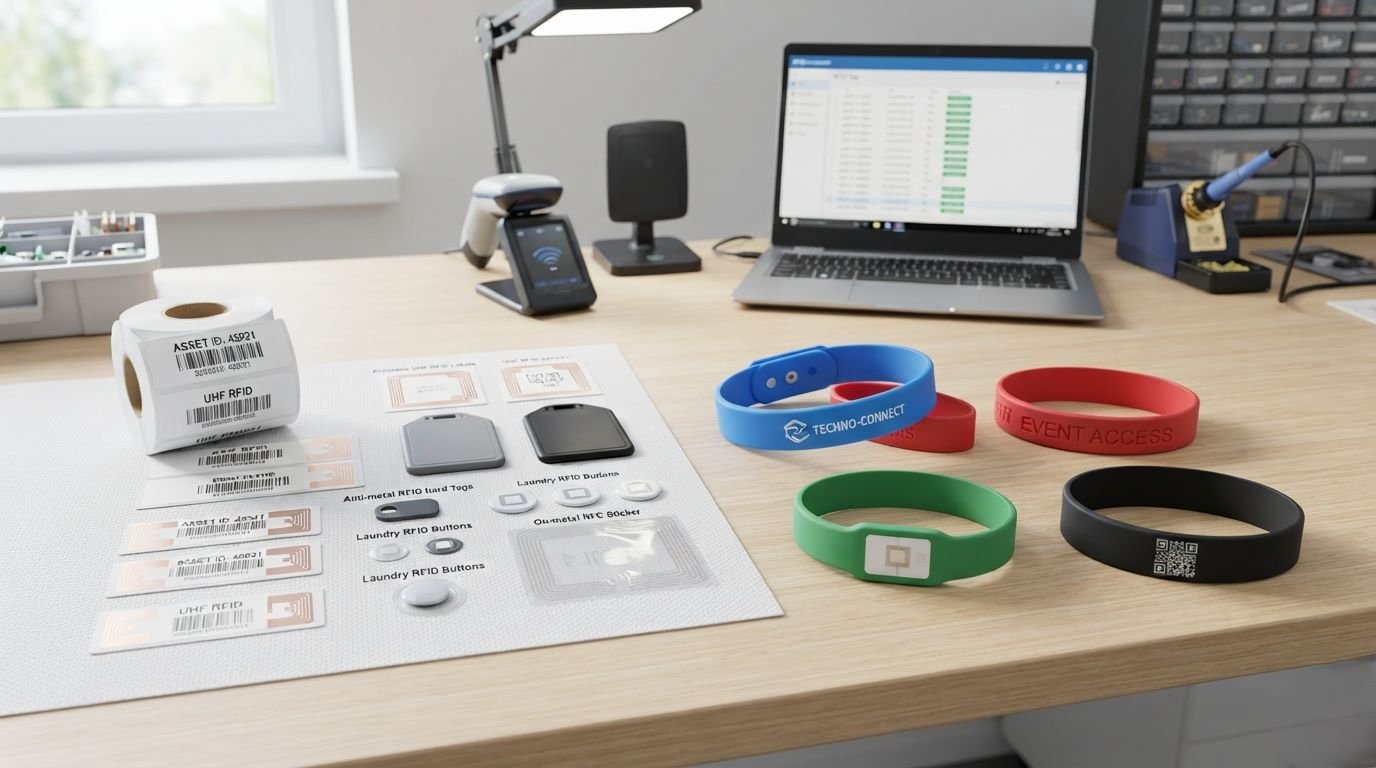
Radio-frequency identification has become an important part of modern identification, tracking, and access-control systems. Among its most practical formats are RFID labels and RFID silicone wristbands. Although both use RFID technology, they are designed for very different environments.
RFID labels primarily connect products, packages, documents, and assets with digital identification systems. RFID silicone wristbands are designed to provide wearable identification for people at events, hotels, fitness centers, resorts, and other controlled environments.
Their development shows how RFID has progressed from basic electronic identification toward connected, automated, and data-driven systems.
What Is RFID Technology?
RFID stands for Radio Frequency Identification. It is a technology that uses radio waves to identify compatible tags through a reader.
A basic RFID system generally consists of:
- RFID tag or inlay
- RFID reader
- Antenna
- Software or database
- Communication infrastructure
An RFID tag typically contains an integrated circuit and antenna. Depending on the RFID technology, the tag may be passive, active, or battery-assisted.
Passive tags do not normally contain their own battery. Instead, they receive energy from the reader’s electromagnetic field and use that energy to communicate stored information.
The important advantage is that identification can occur without the same direct visual scanning process associated with conventional barcodes.
The Past: How RFID Developed
The foundations of RFID can be traced to developments in radio communication and radar technology. Over time, electronic components became smaller, while computing and wireless communication became more capable.
Early RFID applications were relatively specialized because readers, chips, and supporting systems were expensive. As semiconductor manufacturing improved, RFID became increasingly practical for commercial use.
The technology gradually entered:
- Supply-chain management
- Manufacturing
- Retail
- Transportation
- Healthcare
- Asset tracking
- Access management
The development of standardized RFID technologies and more affordable hardware accelerated adoption.
The Evolution of RFID Labels
RFID labels represent one of the most practical developments in RFID manufacturing. Instead of using a bulky standalone tag, an RFID inlay can be integrated into an adhesive label.
A typical label may contain:
- RFID microchip
- Antenna
- Substrate
- Adhesive layer
- Printable face material
- Protective coating when required
This construction allows organizations to combine conventional printed information with electronic identification.
For example, a warehouse can place an RFID label on a carton while maintaining familiar product information on the printed surface.
Why RFID Labels Became Important
The primary value of RFID labels is scalable identification. Businesses managing thousands or millions of products can use RFID to improve visibility across their operations.
Potential applications include:
- Inventory counting
- Retail stock management
- Warehouse receiving
- Shipment verification
- Asset identification
- Manufacturing workflows
- Healthcare inventory
- File and document tracking
RFID can reduce dependence on repeated manual scanning when the system is appropriately designed.
Understanding RFID Frequency
One of the most important technical decisions is RFID frequency.
Common RFID categories include:
| Frequency | Typical Characteristics | Common Applications |
| LF | Short-range communication | Animal identification and specialized applications |
| HF | Shorter-range identification | Cards, access, libraries and NFC-related applications |
| UHF | Longer read range and fast identification | Logistics, retail and inventory |
| NFC | Very short-range interaction | Mobile interaction, authentication and smart devices |
The appropriate frequency depends on the required reading distance, environment, tag size, reader infrastructure, data requirements, and application.
There is no single RFID frequency that is ideal for every business.
The Emergence of RFID Silicone Wristbands
As RFID expanded beyond products, wearable identification became increasingly important. This led to the development of RFID silicone wristbands.
Instead of attaching a credential to a package, the RFID component is integrated into a wrist-worn product.
Silicone is commonly selected because it provides flexibility, lightweight construction, and comfortable wear. Properly designed products can also be suitable for environments involving moisture and repeated handling.
This makes RFID wristbands particularly useful where users need to carry an identification credential throughout an activity.
How RFID Silicone Wristbands Work
An RFID silicone wristband contains an RFID component positioned within the wristband structure.
When the wristband enters the operating field of a compatible reader, the reader communicates with the RFID component. Depending on the technology and system configuration, the reader can obtain an identification number or other authorized information.
The system can then associate that identification with a record in a database.
For example:
Wristband → RFID Reader → Identification Data → Software Platform → Authorized Action
The authorized action could involve access verification, attendance recording, membership recognition, or another application supported by the system.
Major Applications of RFID Silicone Wristbands
The flexibility of RFID silicone wristbands has created opportunities across many sectors.
Events and Entertainment
Concerts, festivals, exhibitions, and sporting events can use wearable credentials for controlled entry and attendee management.
Hotels and Resorts
Wristbands can potentially support guest identification and access to selected services when integrated with compatible systems.
Waterparks
Silicone is particularly practical in recreational environments where visitors may encounter water and frequent physical activity.
Fitness Centers
Membership identification can be connected to access-control systems using wearable RFID credentials.
Conferences
Organizers can use RFID-enabled credentials to simplify participant identification and support event-management workflows.
RFID Labels vs RFID Silicone Wristbands
Although both technologies rely on RFID, their objectives are different.
| Factor | RFID Labels | RFID Silicone Wristbands |
| Identification target | Products and assets | People |
| Physical format | Adhesive label | Wearable band |
| Typical use | Inventory and logistics | Access and events |
| Customization | Printing and variable data | Colors, logos and graphics |
| Durability | Depends on label material | Generally designed for wear |
| Reusability | Application dependent | Possible with suitable designs |
| Key advantage | Automated item tracking | Convenient wearable identification |
The correct choice should therefore be based on the business process rather than appearance or unit cost.
Important Factors Affecting RFID Performance
RFID performance is influenced by more than the chip itself.
Important factors include:
- Reader power
- Antenna design
- Tag orientation
- Reading distance
- Operating frequency
- Metal surfaces
- Liquids
- Environmental conditions
- Tag placement
- Software configuration
For example, a tag that performs effectively on cardboard may behave differently when placed directly against metal.
This is why testing is important before a large RFID deployment.
The Present: RFID as a Connected Business Tool
Modern RFID systems increasingly connect physical identification with digital platforms.
A business may connect RFID information to:
- Enterprise resource planning systems
- Warehouse-management software
- Inventory platforms
- Access-control systems
- Event-management software
- Cloud databases
- Analytics platforms
This integration makes RFID more valuable than a standalone identification device.
For example, an RFID label can help identify a product while software records its location and movement. A wristband can identify a visitor while an access-control system determines whether entry should be permitted.
The Future of RFID Labels
The future of RFID labels is expected to focus on intelligence, automation, sustainability, and integration.
Emerging directions may include:
- Smaller and more efficient inlays
- Improved performance on challenging materials
- Sensor-enabled RFID solutions
- Recyclable label constructions
- Automated inventory monitoring
- Cloud-connected tracking
- AI-assisted inventory analysis
The biggest shift will be from identification toward decision support.
Instead of asking only, “What is this item?”, future systems may help businesses understand where the item is, how it is moving, whether stock is available, and what operational action may be required.
The Future of RFID Silicone Wristbands
The future of RFID silicone wristbands will likely involve greater integration with digital customer experiences.
Potential developments include:
- Improved comfort
- More personalized designs
- Enhanced authentication
- Reusable products
- Better chip protection
- Mobile application integration
- Cloud-connected services
- Advanced event analytics
For hospitality and entertainment businesses, the wristband could become a central wearable credential rather than merely an entry ticket.
Sustainability and RFID
Environmental considerations are increasingly influencing product development.
High-volume disposable identification products can create substantial material consumption. Manufacturers are therefore exploring ways to reduce material usage and improve recyclability or reusability.
Reusable RFID silicone wristbands can be relevant to recurring events, memberships, resorts, and other applications where a wearable credential can be used repeatedly.
However, businesses should evaluate the complete lifecycle, including production, cleaning, reuse, and end-of-life management.
How Businesses Should Implement RFID
A successful RFID project should begin with a clearly defined operational problem.
A practical implementation process includes:
- Identify the tracking or identification requirement.
- Select the appropriate RFID frequency.
- Determine the required read distance.
- Select compatible tags or wristbands.
- Test products in the real environment.
- Install suitable readers and antennas.
- Integrate RFID data with business software.
- Measure system performance.
- Expand gradually after successful testing.
Pilot testing is especially important because real-world RFID performance can differ from laboratory specifications.
FAQ About RFID Labels and RFID Silicone Wristbands
What are RFID labels?
RFID labels are adhesive identification products containing an RFID chip and antenna for wireless identification.
What are RFID silicone wristbands?
They are wearable silicone bands containing RFID technology for applications such as access, identification, membership, and event management.
How do passive RFID labels work?
Passive labels receive energy from a compatible reader and use that energy to communicate their stored identification information.
Do RFID silicone wristbands need batteries?
Many passive wristbands do not require batteries, although the exact technology depends on the RFID system being used.
Can RFID labels be printed?
Yes. Many RFID labels are designed to combine electronic identification with conventional printed information.
Can RFID wristbands be customized?
Depending on the manufacturer, wristbands can be customized with colors, logos, graphics, numbering, shapes, and RFID encoding.
Are RFID labels useful for warehouses?
Yes. They can support inventory, asset, receiving, shipping, and supply-chain identification processes.
Can RFID wristbands be used in waterparks?
Yes. Silicone wristbands are commonly considered for environments involving water, provided the selected product meets the required environmental specifications.
What can reduce RFID reading performance?
Metal, liquids, tag orientation, reader configuration, distance, interference, and unsuitable antenna design can affect performance.
What is the future of RFID technology?
RFID is moving toward greater automation, cloud integration, AI-assisted analytics, sensor capabilities, sustainable materials, and connected digital ecosystems.
Read more – https://newsgrow.blogspot.com/2026/08/building-smarter-entry-systems-what.html
https://bhoomijanatural.info/rfid-cards-and-keyfobs-move-to-the-center-of-modern-access-security/