
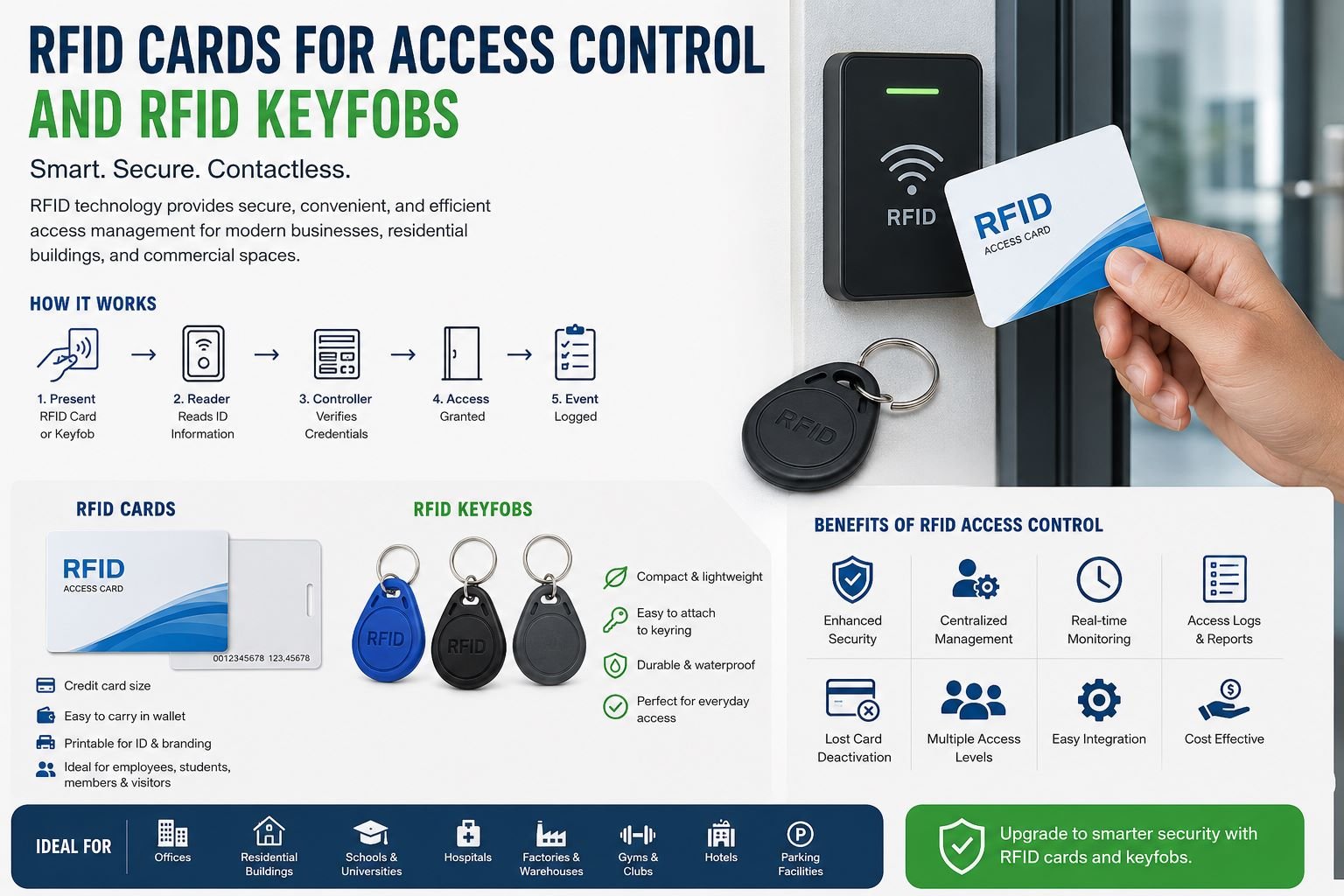
Security Technology News: The way organizations control physical entry is undergoing a significant transformation. Mechanical keys, manually maintained visitor registers and basic identification systems are increasingly being supplemented or replaced by electronically managed credentials. At the center of this transition are RFID cards for access control and RFID keyfobs, which combine contactless identification with centralized security management.
RFID credentials are now available across multiple form factors and technologies, ranging from traditional proximity credentials to sophisticated smart cards supporting stronger authentication and multiple applications. Modern credential platforms can extend beyond door entry to applications such as secure printing, attendance and biometric verification.
The development signals an important change in physical security: organizations are moving from simply controlling locks toward controlling identities, permissions and access events.
RFID Credentials Turn Every Controlled Door Into a Decision Point
RFID, or Radio Frequency Identification, enables compatible credentials and readers to communicate wirelessly.
When an employee or authorized visitor presents a credential, the system does not simply unlock the door automatically. Instead, it can evaluate whether that particular credential is permitted to access that particular location.
The transaction generally involves four major elements: the RFID credential, reader, access controller and electronic locking system.
A typical sequence includes credential detection, data exchange or authentication, permission verification and a final grant-or-deny decision. Depending on the access platform, the transaction may also be recorded.
This provides administrators with substantially greater control than conventional keys.
RFID Cards Develop From Door Passes Into Digital Identities
RFID cards for access control remain especially important in workplaces because they can combine electronic credentials with visual identification.
A suitable printable card can display a photograph, employee name, department, identification number and corporate branding while simultaneously functioning as the person’s electronic access credential.
The underlying technology can also be considerably more sophisticated than the physical card suggests. Modern portfolios include low-frequency, high-frequency, multi-technology and smart credentials designed for different security requirements.
That flexibility allows organizations to establish individual access policies instead of distributing broadly usable physical keys.
RFID Keyfobs Bring the Same Concept Into a Smaller Form
Another area seeing widespread application is RFID keyfobs.
Instead of carrying a full-size identification card, users can attach a compact credential directly to a keyring. This makes keyfobs particularly attractive for residential properties, gyms, parking facilities, warehouses and environments where visible photo identification is unnecessary.
The smaller form factor does not automatically mean reduced capability. Some modern smart keyfobs can provide security technologies comparable to smart-card credentials. For example, contemporary platforms can incorporate mutual authentication, secure messaging and multi-application capabilities inside a keyfob format.
The Real Difference Is Inside the Credential
Security specialists increasingly emphasize that buyers should look beyond the physical appearance of cards and keyfobs.
Two cards that appear identical can use very different technologies.
The same applies to RFID keyfobs.
Factors influencing credential performance include:
- Operating frequency
- Chip technology
- Communication protocol
- Credential format
- Authentication mechanism
- Encryption capabilities
- Reader configuration
- Access-control software
This means purchasing an RFID credential based only on its shape or frequency can result in incompatibility or inadequate security.
125 kHz and 13.56 MHz Technologies Serve Different Systems
Two frequency ranges frequently encountered in access-control deployments are 125 kHz and 13.56 MHz.
125 kHz Remains Present in Legacy Environments
125 kHz proximity technology has been widely deployed for physical access control and remains part of many existing installations.
Organizations maintaining older infrastructure may continue using these credentials because replacing readers, cards and associated equipment can represent a substantial migration project.
13.56 MHz Supports Modern Smart Credential Options
13.56 MHz is associated with numerous high-frequency contactless smart-card technologies.
Modern HF credentials can support capabilities beyond simple identification. Depending on the platform, these can include authentication, stronger protection of credential information and multi-application functionality. Commercial access-control portfolios currently include technologies such as MIFARE DESFire, iCLASS and Seos within this broader category.
Same Frequency Does Not Guarantee Compatibility
This is one of the most important technical details for buyers.
Two products operating at 13.56 MHz are not necessarily interchangeable. They can use different protocols, credential technologies, security keys or reader configurations.
Organizations should therefore verify the exact credential specification supported by their readers before purchasing replacements.
Security Concerns Put Older Credential Technologies Under Greater Scrutiny
As RFID access expands, credential security is receiving increased attention.
Research into physical access systems has repeatedly demonstrated why organizations should not treat possession of an RFID credential as an automatically strong security mechanism. Credential architecture, cryptographic implementation, key management and reader configuration all matter.
Publicly disclosed research has also demonstrated cloning and credential-security risks affecting certain implementations, reinforcing the importance of updates, secure key management and layered physical security.
For sensitive facilities, organizations should evaluate the security properties of the underlying technology rather than relying on the term “RFID” as an indication of security.
RFID Cards and Keyfobs Deliver Different User Experiences
| Requirement | RFID Cards | RFID Keyfobs |
| Contactless entry | Excellent | Excellent |
| Employee identification | Excellent | Limited |
| Photo printing | Yes | Generally no |
| Corporate branding | Extensive | Limited |
| Keyring portability | Limited | Excellent |
| Residential access | Good | Excellent |
| Office environments | Excellent | Excellent |
| Parking applications | Good | Excellent |
| Permission control | System-based | System-based |
| Security level | Technology-dependent | Technology-dependent |
The comparison shows that physical format is primarily a usability decision. Security depends largely on the technology implemented inside the credential and throughout the access-control architecture.
Centralized Credential Management Changes Security Operations
A major advantage of RFID cards for access control is the ability to manage authorization digitally.
Consider an employee who changes departments. Instead of issuing a completely different set of physical keys, administrators can potentially modify the person’s access permissions.
The same principle applies when an employee leaves.
Their credential can be deactivated so it no longer has authorized access.
This capability can also be used for temporary personnel. Contractors may receive credentials limited to specific doors, days or working hours, depending on the access platform.
Lost Keyfobs No Longer Necessarily Mean Changing Locks
Credential revocation is particularly valuable when cards or RFID keyfobs disappear.
With conventional mechanical systems, losing an important key may create uncertainty about whether unauthorized copies exist.
Electronic credential systems provide another option.
Administrators can normally deactivate the missing credential and issue a replacement. Other authorized credentials can continue functioning without changing the entire credential population.
However, organizations still need rapid lost-credential reporting procedures because a missing credential can potentially remain active until administrators revoke it.
Access Records Create Greater Security Visibility
Modern electronic access control can also provide audit information unavailable with conventional keys.
Depending on the system, administrators may be able to review:
- Which credential was presented
- Which reader received it
- When the event occurred
- Whether access was granted
- Whether access was denied
This information can support security investigations, facility management and access reviews.
Organizations should nevertheless establish appropriate policies governing who can access these records, how long they are retained and how personal information is protected.
Frequently Asked Questions
What are RFID cards for access control?
They are contactless electronic credentials used with compatible readers and access systems to manage entry to controlled locations.
What are RFID keyfobs?
They are compact RFID credentials designed for convenient keyring-based access.
Do RFID credentials require contact with readers?
Generally, no. Compatible RFID credentials communicate wirelessly within the reader’s supported operating range.
Are RFID cards and keyfobs technically the same?
They can use similar technologies, but their chips, frequencies, protocols and security capabilities may differ.
Can a lost RFID credential be deactivated?
Yes. Managed access systems generally allow administrators to revoke the authorization associated with a credential.
Can one card control several doors?
Yes. A user’s access profile can potentially authorize multiple doors, buildings or security zones.
Are 125 kHz and 13.56 MHz credentials interchangeable?
No. They operate at different frequencies, and compatibility also depends on the underlying credential and reader technology.
Can RFID cards support employee identification?
Yes. Printable cards can combine electronic access credentials with photographs, names and organizational information.
Are RFID keyfobs suitable for businesses?
Yes. They can be practical for offices, warehouses, parking facilities and other environments not requiring visible ID badges.
What should organizations check before purchasing RFID credentials?
Reader compatibility, frequency, credential technology, security requirements, durability, software support and future expansion should all be evaluated.
https://newsgrow.blogspot.com/2026/08/from-pocket-sized-tools-to-digital.html
https://freeseobacklinks.online/why-nfc-tags-and-smart-wristbands-are-changing-the-future-of-events/
https://blogstream.net/event-technology-enters-a-new-phase-as-nfc-wristbands-gain-wider-attention/
https://newsgrow.blogspot.com/2026/08/nfc-tag-china-market-advances-as-nfc.html