
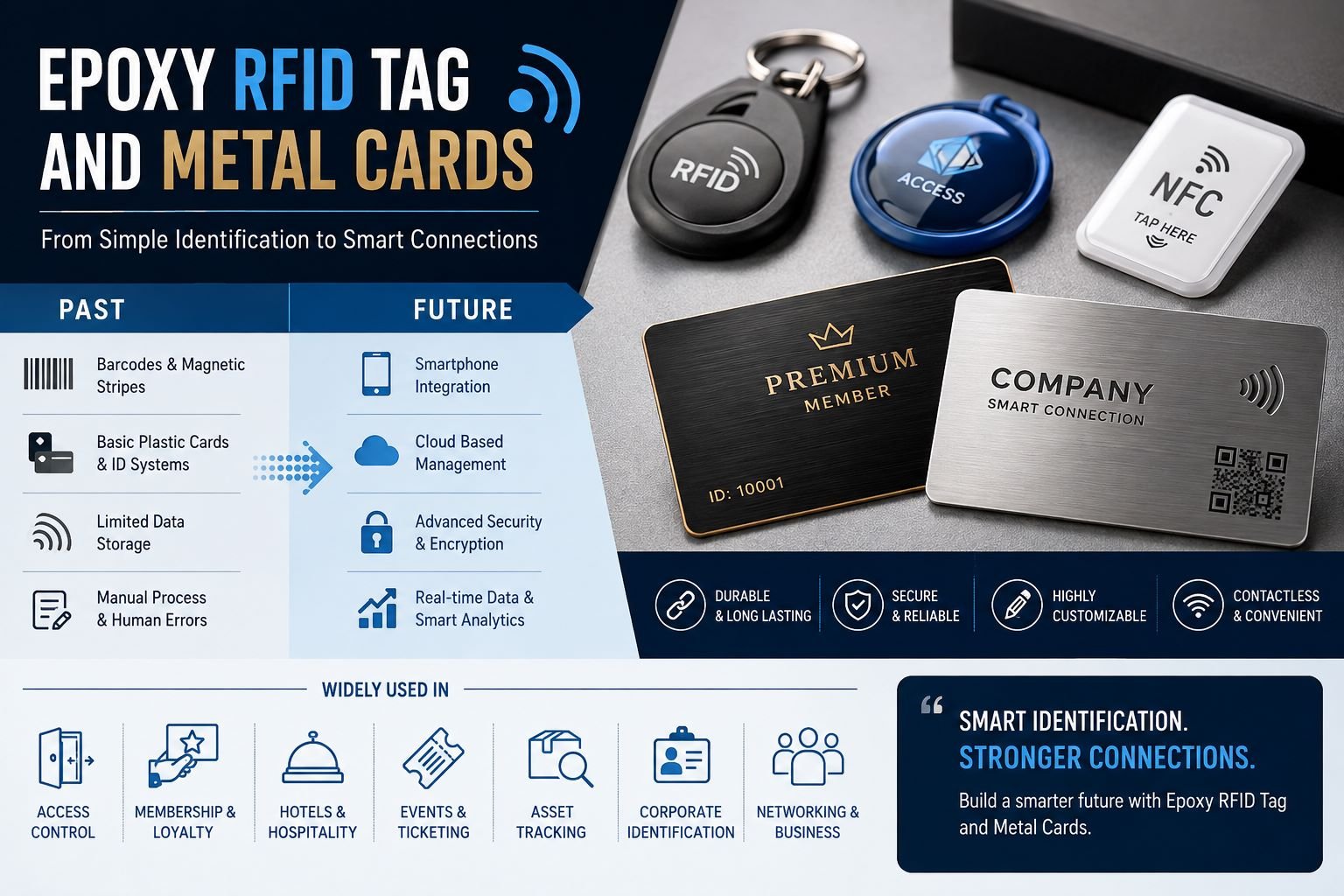
A small tag attached to a keychain and a premium card kept inside a wallet may look like ordinary everyday objects. Behind their surfaces, however, they represent a major change in how people interact with information.
The Epoxy RFID tag has evolved from basic electronic identification into a practical tool for access, attendance, membership, and connected operations. At the same time, metal cards have moved beyond luxury presentation and are increasingly being combined with NFC, QR codes, and digital profiles.
Their past was largely physical. Their future is increasingly digital. For businesses, that evolution creates new opportunities to make identification faster, branding stronger, and everyday interactions more convenient.
Where the Story of Smart Identification Began
Long before contactless technology became familiar, identification was mostly visual or manual.
Employees showed printed badges. Customers presented membership cards. Warehouses used labels and handwritten records. Professionals exchanged paper business cards during meetings.
Barcodes and magnetic stripes improved these processes by making information machine-readable, but physical interaction was still necessary. A barcode needed to face a scanner, while a magnetic card usually had to be swiped.
RFID changed this relationship.
Radio frequency technology enabled compatible tags and readers to exchange identification data wirelessly. This development created a foundation for faster, more automated systems.
How Epoxy RFID Tags Became More Practical
The first generations of RFID products were primarily developed around function. Industrial identification, inventory, logistics, and security mattered more than visual appeal.
That changed as RFID entered everyday environments.
Businesses wanted tags that were compact, recognizable, customizable, and suitable for repeated handling. The Epoxy RFID tag became an interesting solution because it could combine electronic functionality with branded presentation.
What Makes an Epoxy RFID Tag Different?
The defining characteristic is its epoxy-covered exterior. The clear protective surface can help preserve the underlying printed design while providing a smooth finish.
Depending on manufacturing specifications, customization can include:
- Company logos
- Custom graphics
- Serial numbers
- QR codes
- Brand colors
- Different shapes
- Personalized text
This versatility allows an Epoxy RFID tag to function as both a technological credential and a branded physical item.
The Expansion From Access to Everyday Applications
Access control remains one of the most recognizable RFID applications, but the technology has moved considerably beyond doors and security gates.
An Epoxy RFID tag can potentially become part of systems designed for employee attendance, customer loyalty, memberships, hospitality, events, equipment identification, and asset management.
The Important Change Happening Behind the Tag
The tag itself is only one element of an RFID system.
When it interacts with a compatible reader, software can determine what should happen next. Depending on the application, the system might validate a credential, retrieve a record, register an interaction, or update information.
This is why modern RFID should be viewed as more than an electronic replacement for a printed number.
Physical Actions Can Create Digital Data
Every authorized RFID interaction can potentially become a useful digital event.
For organizations, this means physical activities can be connected with software-driven processes. That connection is one reason RFID continues to have relevance in increasingly automated environments.
Metal Cards Started With a Completely Different Goal
The development of metal cards followed another route.
Business cards were never primarily designed for automation. Their job was simple: provide contact information and remind someone who you were.
For decades, paper handled that responsibility successfully.
As competition for attention increased, however, brands began looking for ways to make their cards more memorable. Premium papers, unusual shapes, plastic, textured finishes, and eventually metal became part of this evolution.
Metal offered an immediate sensory difference.
A recipient could notice its weight and texture before reading a single word.
Why Metal Cards Became a Branding Statement
Premium presentation explains much of the early appeal of metal cards.
Businesses could use engraving, etched details, cut-outs, specialized finishes, and carefully planned typography to create something noticeably different from conventional stationery.
The applications soon expanded beyond traditional business cards.
Today they may be considered for:
- Executive networking
- VIP memberships
- Premium loyalty programs
- Luxury hospitality
- Special invitations
- Brand promotions
- Corporate identification
But the next stage of their evolution is less about the material and more about connectivity.
When Metal Meets Digital Technology
A traditional business card is static. Once printed, its information remains unchanged.
A digitally connected card introduces another possibility.
Some metal cards can incorporate appropriately engineered NFC technology or use QR codes to connect recipients with online destinations.
Rather than printing every detail, the physical card can direct people to a digital profile containing current information.
That profile might include contact details, websites, portfolios, appointment links, product catalogues, videos, or professional social profiles.
Epoxy RFID Tags and Metal Cards at a Glance
Although both products can connect physical and digital experiences, their strengths are different.
| Category | Epoxy RFID Tag | Metal Cards |
| Primary Strength | Contactless identification | Premium branding |
| Typical Form | Compact tag | Wallet-size card |
| Technology | RFID/NFC | NFC or QR when supported |
| Access Management | Common | Application-dependent |
| Membership Use | Strong | Strong |
| Professional Networking | Possible | Highly suitable |
| Customization | Printing and shapes | Engraving, cutting and finishes |
| Digital Potential | Established | Rapidly growing |
Neither solution is automatically better. The correct choice depends on the application and technical requirements.
Where Epoxy RFID Tag Technology Is Heading
The next phase of the Epoxy RFID tag is likely to be shaped by connectivity rather than appearance alone.
Connecting RFID With Cloud Platforms
Cloud-based management systems can make information available across multiple locations and devices. When RFID forms part of these environments, identification events can become easier to manage centrally.
Future possibilities include:
- Cloud-managed access
- Automated asset identification
- Smarter attendance systems
- Mobile-connected platforms
- Improved authentication
- IoT integration
- Operational analytics
RFID and the Internet of Things
IoT is fundamentally about connecting physical objects with digital systems.
RFID can contribute by giving physical objects recognizable identities. As IoT infrastructure expands, RFID tags may play supporting roles in smart offices, logistics, manufacturing, hospitality, and other connected environments.
Where Metal Cards Are Heading Next
For metal cards, the future could involve maintaining premium physical design while making digital interaction increasingly useful.
One Physical Card With Changing Information
Consider a professional who changes their designation or launches a new website.
With a conventional printed card, new information usually requires new cards. With a connected solution, the online destination may potentially be updated while the physical card remains usable.
That makes smart cards interesting for professionals seeking a combination of durability and digital flexibility.
Networking Is Only the Beginning
Future applications could extend into loyalty experiences, event check-ins, memberships, hospitality, product information, digital portfolios, and customer engagement.
Instead of being the end of an interaction, metal cards can become the beginning of one.
Why Security and Compatibility Will Matter
More connectivity also creates greater responsibility.
Businesses adopting RFID or NFC should consider reader compatibility, chip specifications, intended operating environment, information security, privacy, and system configuration.
An attractive Epoxy RFID tag will provide limited value if it is incompatible with the intended reader. Similarly, smart metal cards require appropriate technical construction because metal can affect radio-frequency communication.
Successful implementation therefore requires balancing design with engineering.
Frequently Asked Questions
What is an Epoxy RFID tag?
An Epoxy RFID tag is a customizable RFID credential protected by an epoxy-covered surface for identification and contactless applications.
Where can epoxy RFID tags be used?
They can support access, attendance, memberships, loyalty programs, hospitality, events, and asset identification.
Can epoxy RFID tags be customized?
Yes. Customization may include logos, text, graphics, numbers, colors, shapes, and QR codes.
What are metal cards made for?
Metal cards are commonly created for premium business networking, memberships, branding, invitations, and identification.
Can metal cards work with NFC?
Yes, but NFC functionality requires suitable engineering because the metal construction can influence wireless communication.
What is the difference between NFC and RFID?
NFC is a short-range communication technology within the broader RFID family.
Can RFID help with attendance management?
Yes. RFID credentials can interact with compatible attendance readers and software to record authorized identification events.
Are metal business cards reusable?
Yes. Their durable construction allows repeated use, particularly when used as NFC-enabled digital networking cards.
Can a smart card open a digital profile?
A compatible NFC or QR-enabled card can direct a smartphone user toward a configured digital profile or webpage.
What will shape the future of RFID?
Cloud computing, IoT, mobile integration, automation, authentication, analytics, and improved user experiences will influence future RFID applications.