
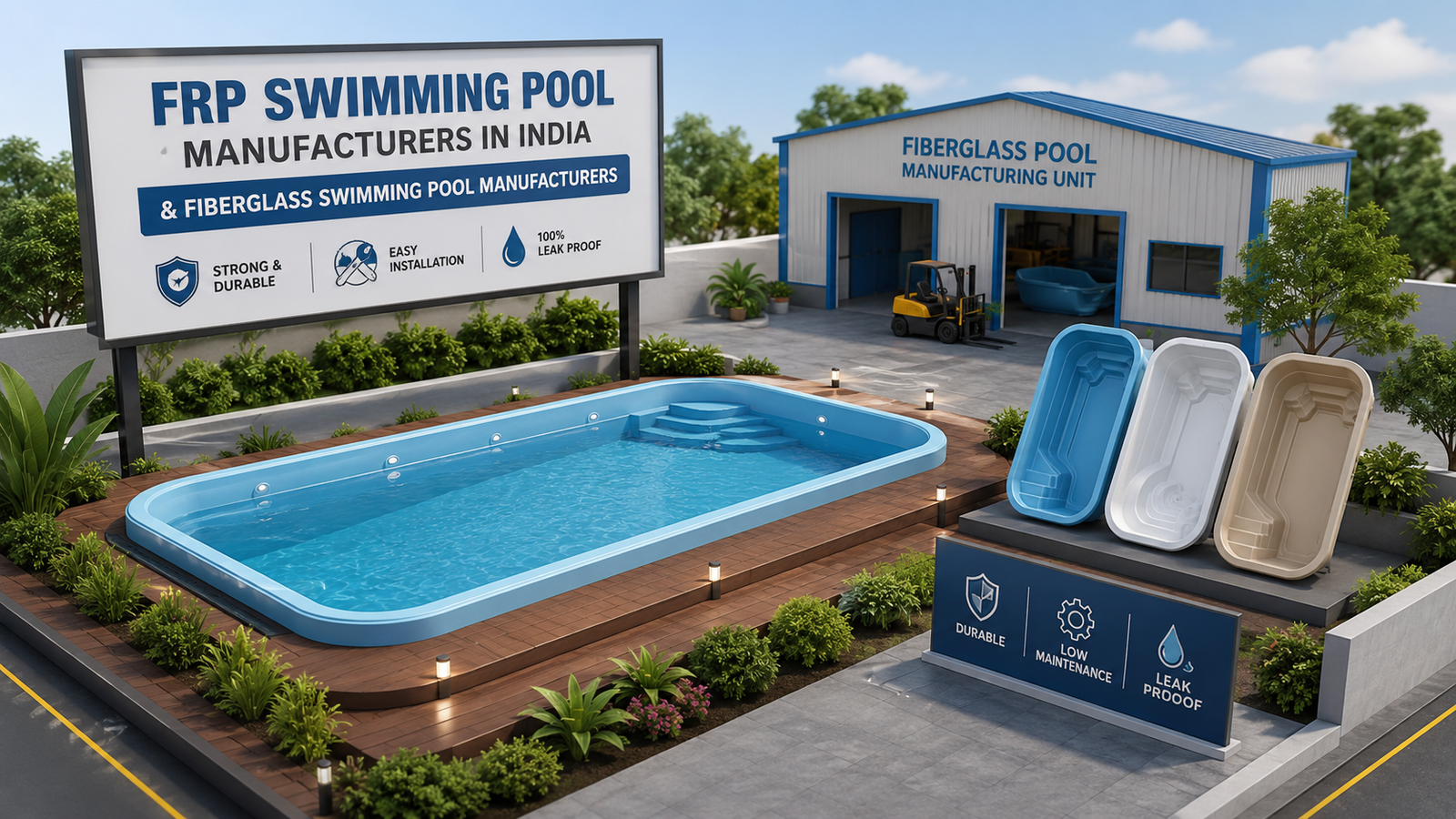
A swimming pool can completely change the way a property looks and functions. For a homeowner, it can create a private space for relaxation and exercise. For a resort or hotel, it can become an important recreational amenity. Yet one question often appears early in the planning process: should you build a conventional concrete pool or consider a prefabricated fiberglass alternative?
Growing awareness of faster construction methods has brought FRP swimming pool manufacturers in India into focus. At the same time, fiberglass swimming pool manufacturers are introducing factory-produced pools in different sizes, depths and layouts for residential and commercial applications.
Before choosing either option, it helps to understand what FRP pools actually are and what separates a well-manufactured pool from an ordinary one.
Why Swimming Pool Construction Is Changing
For decades, concrete has been the familiar choice for permanent swimming pools. It provides excellent flexibility when architects need unusual dimensions, curves or completely bespoke designs.
The trade-off is that conventional construction can require several stages. Excavation, reinforcement, plumbing, concrete work, curing, waterproofing and finishing all have to be coordinated.
FRP pools take a different route.
The main shell is manufactured away from the construction site and transported as a finished or substantially completed structure. Site preparation and pool manufacturing can therefore take place independently.
This approach is one reason FRP swimming pool manufacturers in India are attracting interest from homeowners and developers looking for alternatives to lengthy on-site pool construction.
So, What Is an FRP Pool Made Of?
FRP means Fibre Reinforced Plastic. Despite the word “plastic”, an FRP swimming pool should not be confused with a simple moulded plastic container.
It is a composite structure.
Resin forms the matrix, while glass fibres reinforce it. Different layers are combined to produce the pool shell.
The construction may include:
- A decorative gelcoat surface
- Resin-rich protective layers
- Fibreglass reinforcement
- Structural laminates
- Reinforcement around critical sections
- Protective exterior layers
The precise laminate structure depends on the manufacturing process and pool design.
This is why comparing fiberglass swimming pool manufacturers solely on the basis of pool dimensions can be misleading. What is underneath the visible surface matters considerably.
What Makes Fiberglass Different from FRP?
Buyers often come across both terms while researching pools and wonder whether they are different products.
In the swimming pool industry, they frequently describe closely related or essentially similar composite construction.
Fiberglass refers to the glass-fibre reinforcement. FRP refers to the complete fibre-reinforced polymer or plastic composite.
Therefore, companies describing themselves as FRP swimming pool manufacturers in India may offer products similar to those marketed by fiberglass pool manufacturers.
Rather than focusing heavily on terminology, buyers should examine construction specifications and installation quality.
From Factory Mould to Your Backyard
One of the interesting aspects of fiberglass pools is how they are produced.
Manufacturing begins with a mould. The mould defines everything from the basic pool dimensions to curves, steps and seating areas.
A surface gelcoat is applied first. Once the pool is removed from the mould, this becomes the visible interior finish.
Behind the gelcoat, manufacturers apply resin and fibreglass reinforcement to develop the required structure.
Why Curing Matters
Composite materials need appropriate curing conditions so the resin system can develop its intended properties.
Rushing production can compromise quality.
Why Reinforcement Matters
Not every section of a pool experiences identical loading. Steps, corners, walls and equipment openings may require additional attention.
Why Inspection Matters
Before dispatch, established fiberglass swimming pool manufacturers should inspect the shell for visible defects, dimensional consistency and manufacturing quality.
A swimming pool may look simple after installation, but producing a reliable composite shell requires controlled manufacturing.
Why Would Someone Choose Fiberglass Instead of Concrete?
Convenience is perhaps the simplest answer, but there are several considerations.
Fiberglass pools can provide a combination of:
- Factory-controlled production
- Reduced on-site structural construction
- Smooth interior finish
- Relatively quick installation
- Corrosion-resistant composite materials
- Integrated steps and seating
- Straightforward routine cleaning
The smooth surface is particularly attractive to homeowners who want a clean, modern appearance without extensive tile joints.
However, fiberglass is not automatically the best option for every project.
FRP vs Concrete: A Practical Comparison
| Area | FRP/Fiberglass Pool | Concrete Swimming Pool |
| Main structure | Manufactured off-site | Built on-site |
| Installation | Generally quicker | Usually longer |
| Surface | Gelcoat | Tile, plaster or coating |
| Custom shapes | Limited by manufacturing/mould | Highly flexible |
| Site labour | Comparatively lower | Higher |
| Structural weight | Lower | Higher |
| Cleaning | Smooth surface assists cleaning | Depends on finish |
| Architectural freedom | Moderate | Excellent |
A homeowner wanting a standard rectangular or curved pool may find fiberglass highly practical.
A luxury resort requiring a huge free-form pool integrated into a complex landscape may prefer concrete.
The correct answer depends on the project rather than the popularity of either material.
Where Are FRP Swimming Pools Being Used?
The market is considerably broader than private homes.
Today’s FRP swimming pool manufacturers in India can cater to projects such as:
- Residential homes
- Luxury villas
- Farmhouses
- Resorts
- Hotels
- Holiday properties
- Clubs
- Wellness centres
- Schools
- Recreational facilities
Compact pools may work well in private properties, while larger models can support selected hospitality and leisure applications.
Site conditions, however, must always be evaluated before ordering.
The Question Buyers Forget to Ask: Can the Pool Reach the Site?
Imagine purchasing a large prefabricated pool only to discover that the road leading to your property is too narrow for transportation.
Because fiberglass pools are manufactured as large shells, logistics should be considered from the beginning.
The manufacturer may need to assess:
- Road access
- Property entrance width
- Overhead cables or obstacles
- Crane accessibility
- Installation space
- Distance from unloading point
Experienced fiberglass swimming pool manufacturers should include logistics in project planning rather than treating transportation as an afterthought.
Your Pool Is More Than a Fiberglass Shell
The shell receives most of the attention because it is visually impressive, but the equipment operating behind the scenes is equally important.
Swimming pool water needs circulation and filtration.
A typical system may contain a pump, filter, skimmer, return inlets, drains, pipes and valves.
You may also want additional features such as underwater lighting, heating, fountains, waterfalls or automated chemical treatment.
When comparing quotations from FRP swimming pool manufacturers in India, check whether these components are included.
A low quotation for the shell alone should not be compared directly with a complete installation package.
Why Site Preparation Can Make or Break the Project
The fact that a pool arrives prefabricated does not mean it can simply be placed into any hole in the ground.
Excavation dimensions must be appropriate. The supporting base needs to be correctly prepared and the pool must be properly levelled.
Backfilling also requires attention because pressure around the pool shell should remain appropriately managed.
Plumbing connections need to be installed and tested before the surrounding area is permanently finished.
For this reason, manufacturing quality and installation expertise should be considered together.
What Should You Look for in a Pool Manufacturer?
Before placing an order, have a technical conversation with the manufacturer.
Ask about the shell materials, laminate system and manufacturing process.
You should also review previous projects and understand who will actually perform the installation.
Professional fiberglass swimming pool manufacturers should be prepared to discuss:
- Material specifications
- Available pool dimensions
- Structural construction
- Filtration requirements
- Site preparation
- Transportation
- Installation
- Commissioning
- Maintenance
- Warranty conditions
If a quotation provides little more than pool dimensions and a final price, ask for additional details.
Why FRP Swimming Pool Prices Can Vary So Much
A 20-foot pool from one supplier may cost considerably more or less than a pool of similar dimensions from another.
That doesn’t automatically mean one company is expensive.
You need to know what each quotation includes.
Material specifications, structural reinforcement, filtration equipment, transportation distance, installation conditions and accessories can influence the final price.
For example, a project may require excavation machinery, specialised lifting equipment or additional drainage work.
Therefore, buyers comparing FRP swimming pool manufacturers in India should request itemised quotations.
Price matters, but the total scope matters more.
Keeping a Fiberglass Swimming Pool in Good Condition
Once installed, an FRP pool still requires regular care.
Fortunately, the smooth gelcoat surface generally makes routine cleaning straightforward.
Owners should maintain appropriate water chemistry, clean filters, monitor pumps and remove leaves or debris.
The circulation system should also be operated according to the pool’s requirements.
Avoid assuming that adding more chemicals automatically produces cleaner water. Water treatment should be properly balanced to protect swimmers, pool surfaces and equipment.
Frequently Asked Questions About Fiberglass Swimming Pools
1. Are FRP pools permanent?
They are designed as installed swimming pool structures, provided the shell and installation are appropriate for the project.
2. What is fiberglass made from?
Fiberglass reinforcement consists of fine glass fibres used with resin to create a composite material.
3. Can an FRP pool be installed at a farmhouse?
Yes. Farmhouses are among the common applications for prefabricated swimming pools.
4. Are fiberglass pools available in different depths?
Yes. Available depths depend on the manufacturer’s moulds and product range.
5. Can I choose the pool colour?
Many fiberglass swimming pool manufacturers offer multiple gelcoat colour choices.
6. Do FRP pools need tiles?
Normally, the gelcoat provides the finished interior surface, so interior tiling is generally unnecessary.
7. Does a fiberglass pool require filtration?
Yes. Proper circulation and filtration are essential for maintaining water quality.
8. Can FRP pools include built-in seating?
Yes. Steps, benches and seating areas can be integrated into suitable mould designs.
9. What determines FRP swimming pool cost?
Pool dimensions, shell specifications, equipment, transportation, installation and site conditions influence cost.
10. Are fiberglass pools suitable for resorts?
They can be suitable for selected resort and hospitality applications, depending on design and operational requirements.
Read more – https://gosarkarijobs.com/how-swimming-pool-manufacturers-in-india-are-redefining-the-modern-designer-pool/
https://newsgrow.blogspot.com/2026/08/swimming-pool-manufacturers-in-india.html
https://newsgrow.blogspot.com/2026/08/frp-swimming-pool-manufacturers-in.html