A new product can look flawless on a computer screen and still reveal unexpected problems when it becomes a physical object. A cover may not close smoothly, two components may interfere during assembly, or the chosen material may not provide the expected feel. Discovering these issues before mass production is one of the most important parts of product development.
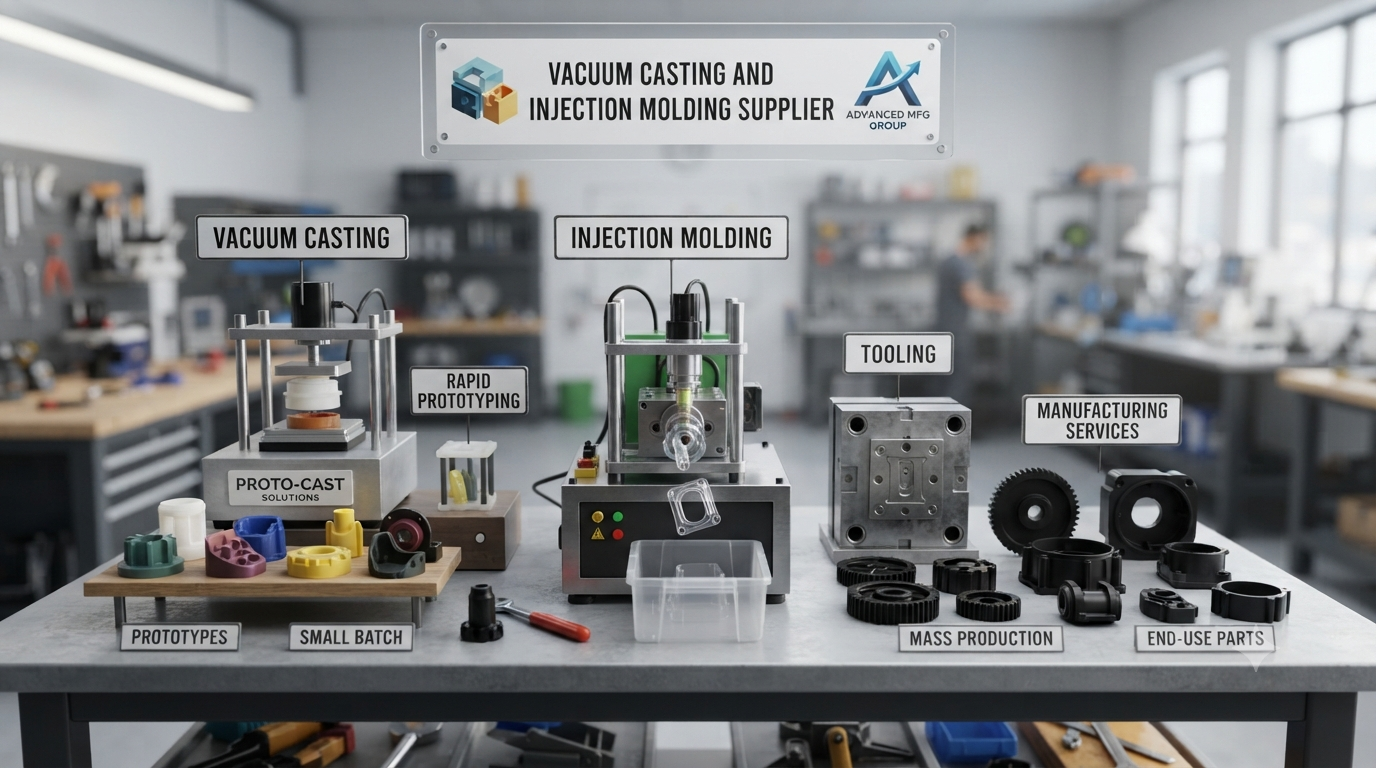
For this reason, manufacturers often use vacuum casting to create realistic prototypes and small batches before committing to permanent tooling. When the design is proven and larger quantities are required, an experienced injection molding supplier can take the project towards repeatable production.
The important question is therefore not simply “Which manufacturing process is better?” It is “Which process makes sense at this stage of the product?”
Why the First Physical Product Should Rarely Be the Final Product
Product development is naturally iterative. Even experienced engineering teams cannot evaluate every physical characteristic through CAD drawings and simulations alone.
A physical prototype allows designers to hold, assemble, inspect and test the component under realistic conditions.
It can reveal issues involving:
- Assembly clearances
- Component alignment
- Ergonomics
- Surface appearance
- Button or connector positioning
- Structural rigidity
- Access to internal components
- Product dimensions
When only a few basic models are required, 3D printing may be sufficient. However, businesses sometimes reach a stage where they need multiple parts with a more production-like appearance.
That is where vacuum casting becomes valuable.
Vacuum Casting: More Than Just Another Prototyping Method
Vacuum casting is designed to reproduce a master component using a flexible silicone mould.
First, an accurate master pattern is manufactured, commonly through CNC machining or high-resolution additive manufacturing. Silicone is then formed around the pattern.
After curing, the mould is carefully opened and the master removed. The resulting cavity can then be filled with a suitable polyurethane casting resin.
The casting process takes place under vacuum conditions to help remove unwanted air and improve reproduction of detailed features.
Once the material has cured, the component can be removed and finished.
Depending on the project, finishing may involve:
- Sanding
- Painting
- Polishing
- Texturing
- Printing
- Colour matching
- Assembly
This combination of relatively simple tooling and professional finishing makes vacuum casting attractive for products that need to look and feel closer to production components.
A Realistic Scenario: Testing a Product Before Tooling
Imagine a company developing a new portable diagnostic device.
The initial CAD design has been completed and a 3D-printed prototype confirms the overall dimensions. The company now needs 40 units for engineering evaluation, customer presentations and controlled field testing.
Ordering a production mould immediately would mean committing to the current design.
Instead, the company produces a small batch through vacuum casting.
During testing, users report that a side button is difficult to operate while wearing gloves. Engineers modify the button area before finalising the design.
This is exactly the type of information that prototype production is intended to uncover.
Where Injection Moulding Enters the Picture
Once the product has been sufficiently validated, the manufacturing objective changes.
The business is no longer asking, “Does our design work?”
It is now asking, “How can we manufacture this component repeatedly, consistently and at the required scale?”
This is where an injection molding supplier becomes essential.
Injection moulding uses metal tooling, usually manufactured from aluminium or steel depending on the application and production strategy. Thermoplastic material is heated, injected into the mould cavity, cooled and ejected.
Once the tooling and manufacturing process are established, production cycles can be repeated efficiently.
Vacuum Casting vs Injection Moulding at a Glance
| Consideration | Vacuum Casting | Injection Moulding |
| Main objective | Prototype/low-volume production | Scalable manufacturing |
| Tool construction | Silicone | Metal |
| Initial investment | Relatively low | Higher |
| Tool longevity | Limited | High |
| Design changes | More flexible | More difficult after tooling |
| Typical material | Polyurethane systems | Production thermoplastics |
| Production volume | Small batches | Medium to large batches |
| Automation | Relatively low | High |
| Repeatability | Good | Very high |
| Best development stage | Validation | Commercial production |
The table demonstrates why comparing only the cost of individual parts can be misleading. Tooling investment, quantity and expected future demand must also be considered.
The Hidden Value of a Good Injection Molding Supplier
An injection molding supplier should not simply receive a CAD file, manufacture a mould and start production.
One of the supplier’s most valuable contributions can happen before any metal is cut.
Experienced engineers can examine the component from a manufacturing perspective and identify design features that could influence tooling complexity or final product quality.
This process is generally known as Design for Manufacturing, or DFM.
What Does a DFM Review Examine?
A detailed DFM assessment can vary according to component complexity, but several areas commonly receive attention.
Wall Thickness
Plastic does not behave exactly like metal during manufacturing. Thick and thin areas can cool at different rates, potentially affecting appearance or dimensions.
More consistent wall design can support predictable moulding behaviour.
Draft Angles
Parts need to leave the mould after cooling. Appropriate draft on relevant surfaces helps make ejection easier.
Parting Lines
Every mould must open somewhere. The location of the parting line can influence tooling construction and the visible appearance of the finished product.
Ribs and Bosses
Ribs can add structural support, while bosses are commonly used around screws and assembly points. Poorly designed features may contribute to sink marks or other manufacturing concerns.
Undercuts
Features that prevent straightforward mould opening may require sliders, lifters or alternative design solutions.
A knowledgeable injection molding supplier can discuss these issues before they become expensive tooling problems.
Material Choice Can Change the Entire Project
Material selection should never be based on appearance alone.
A plastic component might need to withstand heat, repeated impacts, chemicals, sunlight, friction or mechanical loads. Another product may require transparency, flexibility or a specific surface feel.
Injection moulding supports numerous thermoplastics, such as:
- ABS
- Polypropylene
- Polyethylene
- Polycarbonate
- Nylon
- POM
- PMMA
- TPE
- TPU
- Reinforced engineering plastics
An injection molding supplier can provide processing information, but the product designer must also consider the actual service environment.
For example, material suitable for an indoor electronic enclosure may not necessarily be appropriate for an automotive component exposed to heat and sunlight.
Where Vacuum Casting Can Save More Than Tooling Cost
The financial value of vacuum casting is not limited to its relatively inexpensive silicone tooling.
Its greater value can come from information.
Suppose prototype testing identifies three changes before production tooling begins. Correcting those features digitally and validating them again may prevent modifications to a completed metal mould.
The process can therefore help businesses answer critical questions early:
- Does everything fit?
- Can users operate the product comfortably?
- Is the appearance acceptable?
- Are assembly procedures practical?
- Does the physical design match expectations?
- Should anything change before tooling?
Every useful answer improves confidence in the final production design.
When Vacuum Casting May Not Be Necessary
Despite its advantages, vacuum casting should not automatically be included in every manufacturing project.
A simple component based on an already proven design may not require extensive prototype batches.
Similarly, if exact production-material performance is essential during testing, another prototype method may be more appropriate because casting resins do not always duplicate every characteristic of commercial thermoplastics.
The manufacturing route should therefore be determined by the project’s technical requirements.
How to Compare Injection Molding Suppliers Properly
It can be tempting to send the same drawing to several manufacturers and choose the lowest quotation.
However, tooling and manufacturing projects should be evaluated more broadly.
When selecting an injection molding supplier, investigate:
- Experience with similar products
- DFM and engineering capabilities
- Mould manufacturing processes
- Tool maintenance support
- Material expertise
- Injection moulding equipment
- Dimensional inspection
- Quality procedures
- Secondary finishing
- Assembly capabilities
- Communication quality
- Production capacity
A cheaper tool can become expensive if it requires frequent corrections, creates inconsistent components or cannot support the intended production programme.
Questions Worth Asking Before Placing an Order
Before choosing a manufacturing partner, ask questions that reveal technical capability rather than focusing exclusively on delivery and price.
Useful questions include:
- Will you provide a DFM review?
- Where will the mould be manufactured?
- Which material would you recommend and why?
- Which dimensions require special attention?
- Are there any difficult undercuts?
- Where will gates and parting lines appear?
- What quality inspections will be performed?
- Can you manufacture prototypes before tooling?
- Can you support assembly and finishing?
- How are engineering changes managed?
The answers can reveal how deeply the supplier understands the project.
What Should You Send to an Injection Molding Supplier?
Accurate quotations require accurate information.
Instead of sending only photographs or basic dimensions, prepare a proper manufacturing package containing:
- 3D CAD files
- 2D technical drawings
- Material specifications
- Estimated order quantities
- Annual production forecast
- Critical tolerances
- Surface requirements
- Colour requirements
- Product application
- Assembly information
- Testing requirements
If the product is still under development, tell the manufacturer. The supplier may recommend vacuum casting, CNC prototypes or another development process before permanent tooling.
Frequently Asked Questions
1. What exactly is vacuum casting?
Vacuum casting uses silicone moulds and casting resins to reproduce detailed prototypes and low-volume components from a master pattern.
2. Why is vacuum casting performed under vacuum?
Vacuum conditions help reduce trapped air and improve resin flow into detailed areas of the mould.
3. Is vacuum casting suitable for new product development?
Yes. It can provide realistic physical components for design, assembly, functional and customer evaluation.
4. Can vacuum casting be used for production?
It can support certain low-volume requirements, but silicone tooling has a limited lifespan compared with metal injection moulds.
5. When is injection moulding a better choice?
Injection moulding generally becomes more attractive when designs are stable and repeatable production quantities increase.
6. What does an injection molding supplier need from a customer?
An injection molding supplier typically needs CAD data, drawings, quantities, material requirements, tolerances and information about the product’s application.
7. Why are injection moulds more expensive than silicone moulds?
Injection moulds require precision engineering and machining of durable metals designed to withstand repeated production cycles.
8. What is DFM in plastic manufacturing?
DFM, or Design for Manufacturing, reviews component geometry to improve manufacturability and identify potential tooling or production challenges.
9. Which materials are commonly injection moulded?
ABS, PP, PE, PC, nylon, POM, PMMA, TPU and TPE are among the many available thermoplastics.
10. Can the same company handle prototypes and production?
Yes. Some manufacturers provide vacuum casting, prototyping, mould manufacturing and injection moulding within one service.
https://newsgrow.blogspot.com/2026/08/rapid-injection-molding-and-china-rapid.html
https://newsgrow.blogspot.com/2026/08/aluminum-prototype-and-sheet-metal.html
https://newsgrow.blogspot.com/2026/08/deep-information-about-sheet-metal.html
https://newsgrow.blogspot.com/2026/08/vacuum-casting-and-injection-molding.html