
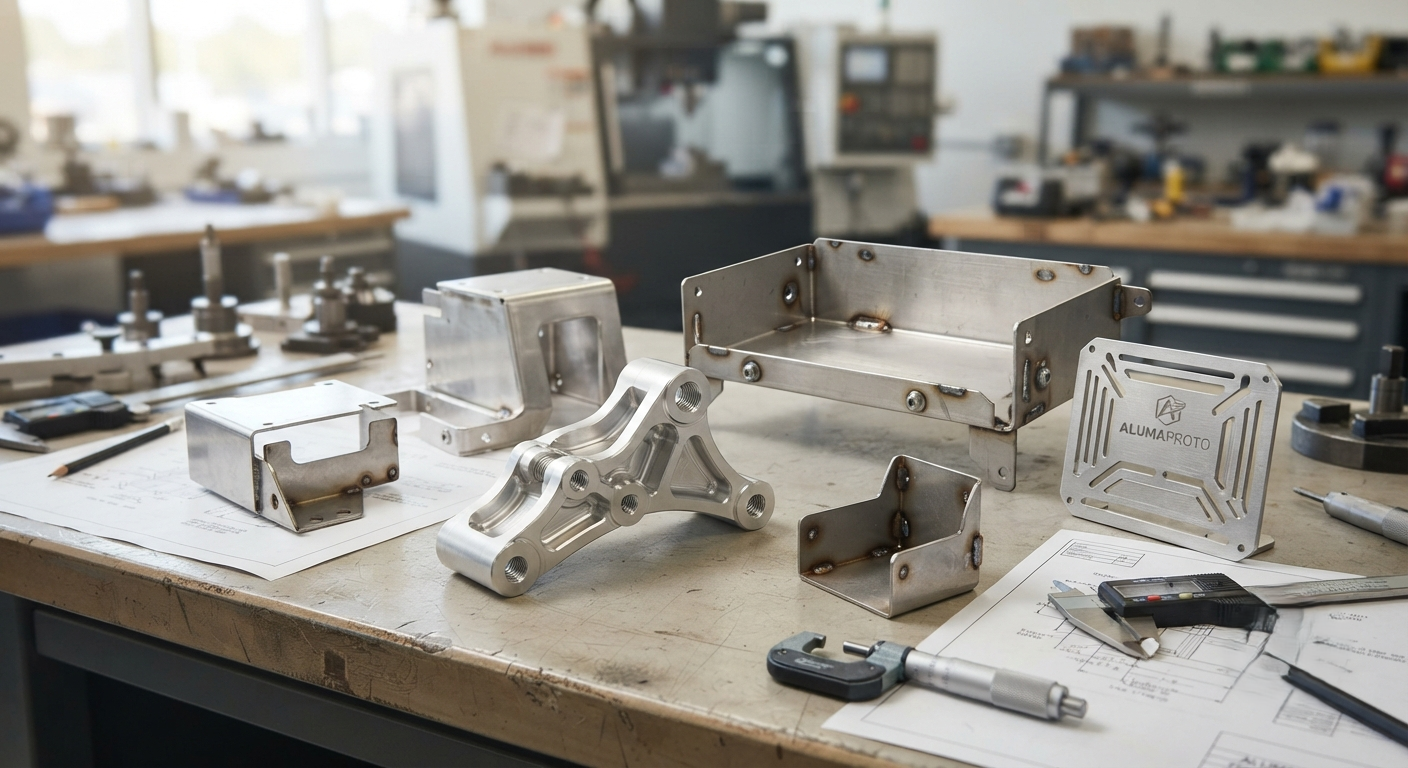
A product can appear flawless on a computer screen and still fail its first real-world test. A mounting point may be slightly misplaced, an enclosure may be difficult to assemble, or a component may be heavier than expected. Discovering these problems after production has started can lead to costly modifications.
That is why aluminum prototype manufacturing and sheet metal prototyping are important parts of modern product development. Instead of treating prototyping as simply creating a sample, engineering teams use it to answer practical questions: Does the component fit? Can it be manufactured efficiently? Is the material appropriate? Can technicians assemble and service it?
The answers help transform an attractive CAD design into a product that is genuinely ready for manufacturing.
The Real Purpose of Metal Prototyping
Metal prototyping creates an opportunity to learn before scaling.
A physical prototype can be handled, assembled, measured and tested. This provides information that is difficult to obtain from drawings alone.
Engineers can use prototypes to examine:
- Dimensional accuracy
- Component fit
- Mechanical movement
- Fastener locations
- Structural rigidity
- Surface quality
- Weight
- Heat dissipation
- Assembly accessibility
An aluminum prototype, for example, may be used to verify a precision mechanical housing. Sheet metal prototyping may be used to test the enclosure surrounding that housing.
Both approaches reduce the gap between engineering theory and manufacturing reality.
What Makes an Aluminum Prototype Different?
An aluminum prototype is a physical aluminium component manufactured before full production, often using CNC machining.
Manufacturing typically starts with a solid aluminium billet. CNC cutting tools remove material according to the programmed design until the required geometry is achieved.
The process can produce detailed features such as:
- Precision holes
- Threads
- Internal pockets
- Mounting surfaces
- Slots
- Channels
- Curved profiles
- Complex contours
This makes aluminium machining useful for components that require greater geometric complexity than conventional sheet fabrication can easily provide.
Where Aluminum Prototypes Are Most Useful
Consider a company developing a new automated inspection machine. The system may require camera mounts, sensor holders, motor brackets and precision locating components.
Plastic samples could demonstrate the general shape, but an aluminum prototype may provide a more realistic way to evaluate stiffness, mounting accuracy, weight and thermal behaviour.
Typical applications include:
- Robotics
- Automotive systems
- Aerospace equipment
- Electronic products
- Industrial machinery
- Medical equipment
- Automation systems
- Research equipment
The appropriate manufacturing process still depends on the individual component rather than the industry alone.
Why Aluminium Is a Practical Prototype Material
Aluminium provides an attractive combination of manufacturing and engineering properties.
It offers relatively low weight while maintaining useful mechanical strength. It is also easier to machine than many harder metals.
Important benefits include:
- Good machinability
- High strength-to-weight potential
- Corrosion resistance
- Thermal conductivity
- Electrical conductivity
- Wide alloy availability
- Multiple finishing options
Grades such as aluminium 6061 are popular for general engineering, while stronger alloys such as 7075 can be considered for applications with more demanding mechanical requirements.
The correct material should be selected according to function rather than simply choosing the strongest available grade.
What Makes Sheet Metal Prototyping Different?
Sheet metal prototyping creates components from relatively thin, flat metal stock.
Instead of removing large amounts of material, the manufacturer cuts the required flat profile and forms it into shape.
A typical workflow can include:
- CAD preparation
- Flat-pattern development
- Laser cutting or punching
- Press-brake bending
- Welding or fastening
- Finishing
- Inspection
This manufacturing approach is particularly effective when the component consists mainly of thin surfaces, flanges and bends.
Everyday Products That Depend on Sheet Metal Prototyping
Many products around us contain fabricated sheet-metal components.
An industrial control cabinet is a straightforward example. Its body may contain doors, ventilation openings, mounting holes, cable entries and internal support structures.
Before producing hundreds of cabinets, sheet metal prototyping can help verify whether the design provides sufficient space and accessibility.
Other applications include:
- Battery enclosures
- Server chassis
- Electronic housings
- Machine guards
- Equipment panels
- Automotive brackets
- Electrical boxes
- Mounting plates
- Industrial covers
Materials may include aluminium, stainless steel, mild steel, copper or other suitable sheet materials.
Aluminum Prototype vs Sheet Metal Prototyping: Which One Fits Your Design?
The geometry of the component usually provides the strongest clue.
| Design Requirement | Aluminum Prototype | Sheet Metal Prototyping |
| Precision 3D geometry | Excellent | Limited |
| Thin-walled structure | Possible | Excellent |
| Internal pockets | Excellent | Not typically suitable |
| Large enclosure | Less efficient | Excellent |
| Precision threads | Easy to incorporate | May require tapping/inserts |
| Brackets | Suitable | Excellent |
| Material utilisation | Moderate | Generally efficient |
| Surface finishing | Wide range | Wide range |
| Prototype quantity | Suitable | Suitable |
| Low-volume manufacturing | Suitable | Suitable |
An aluminum prototype makes sense when machining naturally matches the component’s geometry. Sheet metal prototyping makes sense when cutting and bending can create the required shape more efficiently.
Why Design for Manufacturing Matters
One of the most common mistakes in prototyping is designing a component without considering how it will actually be manufactured.
Design for Manufacturing, commonly abbreviated as DFM, addresses this problem.
DFM evaluates whether a component can be simplified while preserving its function.
For an aluminum prototype, a DFM review may examine:
- Deep machining pockets
- Very thin walls
- Sharp internal corners
- Tool accessibility
- Excessive tolerances
- Difficult undercuts
For sheet metal prototyping, the review may focus on:
- Bend radius
- Hole-to-bend distance
- Material thickness
- Flange dimensions
- Welding requirements
- Number of bends
DFM is not simply about making a component cheaper. It is about making the design more compatible with reliable manufacturing.
Small Design Choices Can Have a Big Manufacturing Impact
Imagine a machined component containing several perfectly sharp internal corners.
The designer may consider them visually insignificant. For the manufacturer, however, those corners could require additional processes because standard rotating milling cutters naturally produce a radius.
The same principle applies to sheet metal prototyping.
A hole placed extremely close to a bend may appear correct in CAD, but forming the sheet could distort that hole.
These are exactly the kinds of issues prototype development is intended to discover.
Surface Finishing Should Be Planned Early
Surface treatment is often treated as the final cosmetic stage, but it can also serve functional purposes.
An aluminum prototype may receive:
- Anodising
- Bead blasting
- Polishing
- Brushing
- Painting
- Chemical conversion treatment
Sheet-metal components may be powder coated, painted, plated, polished or treated according to their operating environment.
When a prototype is being produced for appearance evaluation, specifying the intended production finish can provide a more realistic representation of the final product.
What Really Determines Prototype Cost?
There is no simple formula based only on component size.
A small, complicated aluminum prototype may require significantly more machining time than a larger but simpler component.
CNC prototype cost can be influenced by:
- Geometry
- Material grade
- Machine time
- Number of setups
- Tolerances
- Finishing
- Inspection
Similarly, sheet metal prototyping costs can depend on:
- Sheet thickness
- Cutting complexity
- Number of bends
- Welding
- Hardware
- Finishing
- Quantity
The best cost-reduction strategy is often to remove manufacturing complexity that provides no functional benefit.
Can Aluminum and Sheet Metal Prototypes Work Together?
Yes, and many successful products use exactly this approach.
Imagine an electric vehicle charging unit. The internal heat-management or mounting components might require CNC-machined aluminium, while the external cabinet could be manufactured from fabricated sheet metal.
Similarly, an industrial robot may contain machined aluminium joints surrounded by sheet-metal guards.
Using both aluminum prototype manufacturing and sheet metal prototyping allows each component to be produced using a process suited to its function.
From First Prototype to Production
The first prototype does not always need to be perfect.
Its purpose is often to reveal what should change.
A practical development cycle may look like this:
Design → Prototype → Inspect → Assemble → Test → Improve → Rebuild → Validate → Produce
During each cycle, engineering teams collect information about dimensions, manufacturing, assembly and performance.
Once the design becomes stable, the same CNC machining and sheet-metal fabrication technologies may also support bridge or low-volume production.
This can be useful for specialised industrial products and new products where initial demand does not justify expensive dedicated tooling.
Frequently Asked Questions
1. What is an aluminum prototype?
An aluminum prototype is a physical aluminium component produced before mass manufacturing to evaluate design, dimensions, functionality and manufacturability.
2. Why is aluminium preferred for many prototypes?
Aluminium combines relatively low weight, useful strength, good machinability, corrosion resistance and versatile surface finishing.
3. What is sheet metal prototyping?
Sheet metal prototyping creates prototype components from flat metal sheets using processes such as cutting, bending, welding and fastening.
4. Which process is better for an enclosure?
Sheet-metal fabrication is generally more appropriate for thin-walled cabinets, chassis, covers and large enclosures.
5. Is CNC machining suitable for prototypes?
Yes. CNC machining is particularly useful for detailed metal components requiring controlled dimensions and complex features.
6. Can aluminium be used for sheet metal components?
Yes. Aluminium sheets can be cut, bent, joined and finished for lightweight fabricated components.
7. What is DFM?
Design for Manufacturing is the process of reviewing a design to improve its practicality, reliability and efficiency during manufacturing.
8. Can aluminum prototypes have threads?
Yes. CNC machining can produce tapped holes and other threaded features according to design requirements.
9. Why are bends important in sheet metal design?
Bending changes material geometry. Bend radius, thickness and feature position must therefore be considered during design.
10. Can prototypes receive production-style finishes?
Yes. Prototypes can receive suitable anodising, powder coating, polishing, painting and other finishes.
https://newsgrow.blogspot.com/2026/08/rapid-injection-molding-and-china-rapid.html
https://newsgrow.blogspot.com/2026/08/aluminum-prototype-and-sheet-metal.html