The conversation around water quality in the national capital is gradually moving beyond basic filters and household TDS meters, with residents, institutions and businesses showing greater interest in comprehensive laboratory analysis to understand the actual characteristics of their water.
From municipal connections and borewells to private tankers and RO systems, Delhi properties can depend on different water sources. This has increased the relevance of professional water testing in Delhi, particularly when users need information about chemical composition, physical characteristics or microbiological quality that cannot be determined through appearance alone.
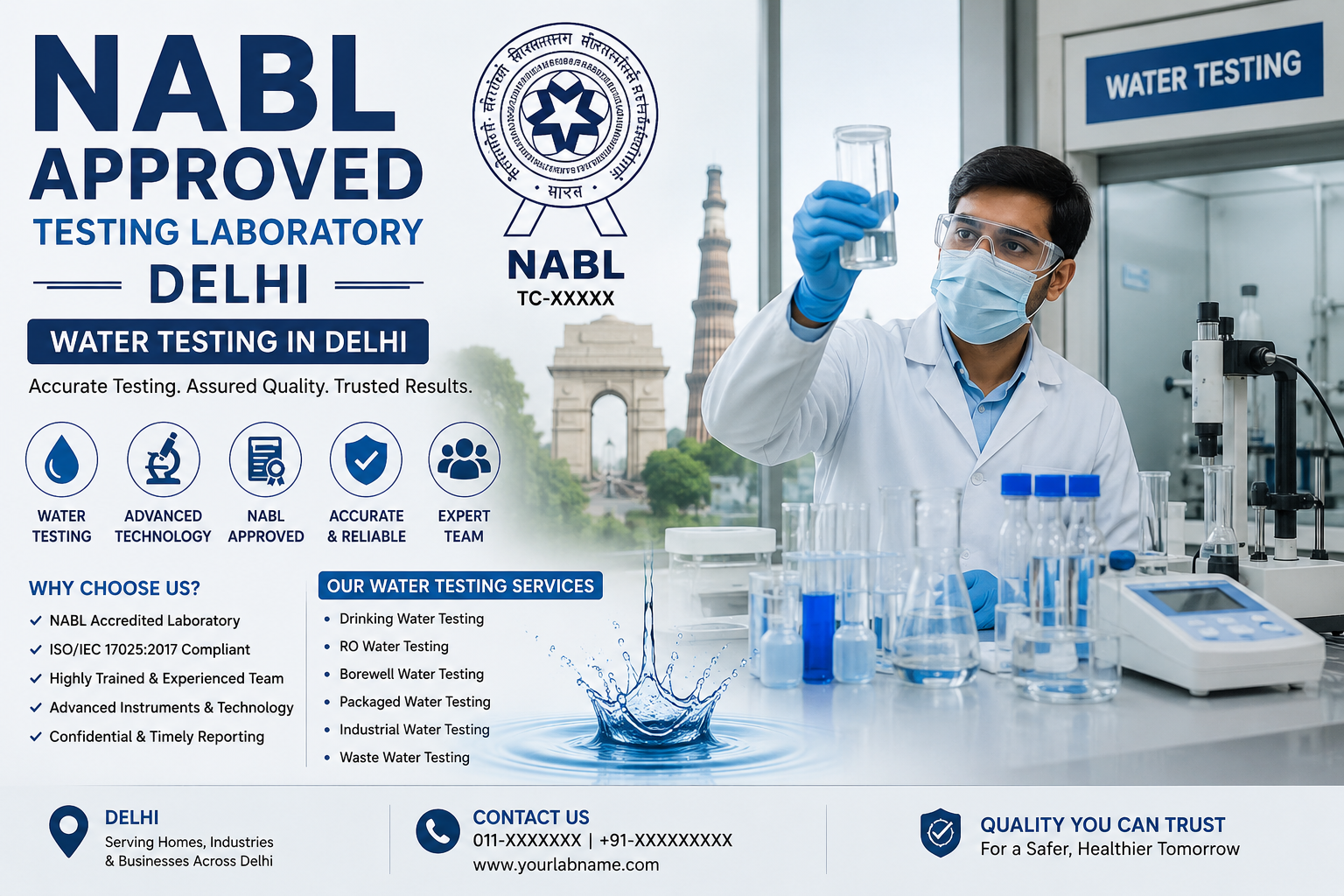
The role of a NABL approved testing laboratory Delhi is also receiving attention as organisations look for technically competent laboratories capable of producing documented analytical results.
Water Can Change Before It Reaches the Consumer
The condition of water at its source and at the point of consumption may not always be identical.
Water can travel through distribution pipelines before entering underground reservoirs and overhead tanks. It may subsequently pass through pumps, internal plumbing and treatment equipment before finally reaching a tap.
For properties dependent on tankers, the supply and storage chain can be different again.
This creates an important question: which water should actually be tested?
The answer depends on the problem being investigated.
Testing incoming water can provide information about the original supply, while testing water from a storage tank or final tap can provide insights into water quality after storage and distribution.
Experts Point to Three Major Areas of Water Analysis
Laboratory water analysis is generally much broader than the TDS measurements familiar to many consumers.
A comprehensive investigation may examine physical, chemical and microbiological characteristics.
Physical Water Quality
Physical analysis can include:
- Colour
- Odour
- Taste
- Turbidity
- Total dissolved solids
Visible or sensory changes can provide an early indication that further investigation may be worthwhile, but normal appearance does not rule out other water-quality issues.
Chemical Water Quality
Chemical analysis may examine:
- pH
- Hardness
- Alkalinity
- Chloride
- Sulphate
- Fluoride
- Nitrate
- Calcium
- Magnesium
- Iron
Depending on the water source and purpose of testing, laboratories may also examine selected metals or other substances.
Microbiological Water Quality
For water intended for consumption, microbiological analysis can be particularly important.
Relevant testing may include indicators such as total coliform organisms and E. coli, according to the applicable testing requirement.
Because these organisms cannot be identified through visual inspection, laboratory analysis plays an important role in assessing microbiological characteristics.
NABL Accreditation: What Consumers Need to Understand
Consumers searching online for a NABL approved testing laboratory Delhi often assume that NABL accreditation automatically applies to every test offered by the laboratory.
That assumption requires caution.
The National Accreditation Board for Testing and Calibration Laboratories provides accreditation for defined laboratory activities. Testing laboratories are assessed against applicable competence requirements, including those associated with ISO/IEC 17025.
The assessment covers important elements of laboratory operation such as:
- Personnel competence
- Testing procedures
- Equipment management
- Calibration
- Quality-control systems
- Traceability
- Record keeping
- Reporting
However, accreditation is scope-specific.
Before commissioning testing, particularly for formal requirements, customers should verify that the necessary parameter or method falls within the laboratory’s current accredited scope.
Drinking Water Testing Cannot Depend on TDS Alone
TDS meters have become widely used because they provide quick numerical readings and are relatively easy to operate.
However, TDS represents total dissolved solids. It does not individually identify all substances present in water and does not provide microbiological information.
This means two water samples with similar TDS readings could still differ in other characteristics.
For a broader assessment, water testing in Delhi may involve a combination of parameters selected according to the intended purpose.
IS 10500 is an important Indian Standard associated with drinking-water requirements and methods of sampling and testing.
Borewell and Groundwater Testing Remains Relevant
Groundwater deserves separate consideration because its characteristics can be influenced by local geology and environmental conditions.
Borewell-water analysis may therefore include parameters related to hardness, dissolved minerals, chloride, fluoride, nitrate, iron and other relevant characteristics.
Microbiological parameters may also be included depending on the purpose of the investigation.
Testing becomes particularly useful when a new borewell is commissioned or when noticeable changes occur in water characteristics.
Tanker Supplies Raise a Different Testing Question
Many residential and commercial properties may rely on tanker water during periods when their primary supply is insufficient.
Unlike a fixed water source, tanker supplies can create additional questions concerning the source and consistency of supplied water.
Laboratory analysis of a representative tanker-water sample can provide objective information about the sample received at a particular time.
For organisations regularly dependent on tanker supplies, an appropriate monitoring programme may be more informative than relying on appearance or verbal assurances alone.
Water Storage Can Also Influence the Testing Strategy
Even where incoming water meets expected characteristics, storage conditions deserve attention.
Underground sumps and overhead tanks form part of the building’s water-distribution system. Their condition, maintenance and handling can influence the quality of stored water.
This is why determining the correct sampling location is essential.
| Testing Location | Information It May Provide |
| Incoming supply | Characteristics before on-site storage |
| Borewell outlet | Characteristics of groundwater source |
| Tanker discharge | Characteristics of delivered tanker sample |
| Underground tank | Water condition following initial storage |
| Overhead tank | Water after secondary storage |
| Final tap | Water characteristics near point of use |
| RO outlet | Characteristics following treatment |
Testing multiple points can sometimes help narrow down where changes are occurring.
Sample Collection Becomes a Key Part of Accurate Testing
Selecting a competent NABL approved testing laboratory Delhi is only part of obtaining meaningful results.
The sample itself must also be collected correctly.
Using an inappropriate container, leaving the sample exposed, delaying transportation or failing to follow preservation requirements can reduce sample integrity.
Before collection, users should confirm:
- Which container should be used?
- How much water is required?
- Where should the sample be collected?
- Is preservation necessary?
- Does the sample need temperature control?
- How quickly should it reach the laboratory?
Requirements may differ according to the parameters being analysed.
Institutions Increasingly Need Structured Water Monitoring
Water-quality assessment is relevant beyond residential properties.
Schools, colleges, hospitals, hotels, restaurants, offices, housing societies, manufacturing facilities and food-related businesses may all need to understand the quality of water used within their premises.
For such organisations, testing can form part of a structured quality-management approach rather than being carried out only after complaints arise.
The appropriate frequency should be determined according to the source, usage, risk and applicable organisational or regulatory requirements.
What Should Consumers Check Before Paying for a Water Test?
Laboratory selection should focus on technical suitability rather than simply comparing package prices.
Consumers considering water testing in Delhi should first explain where their water comes from and why they want it tested.
They can then ask the laboratory about the appropriate parameters, accredited scope, sampling procedure, expected turnaround time and reporting format.
A smaller but correctly selected testing programme may sometimes provide more meaningful information than a large package containing parameters unrelated to the actual requirement.
Frequently Asked Questions
1. Why is scientific water testing important?
It provides measurable information about physical, chemical and microbiological characteristics that cannot always be detected through normal observation.
2. What is a NABL-accredited laboratory?
It is a laboratory accredited by the National Accreditation Board for Testing and Calibration Laboratories for defined activities within an approved scope.
3. Does NABL accreditation apply to every laboratory test?
No. Accreditation applies to specific activities included within the laboratory’s accredited scope.
4. Can Delhi municipal water be tested?
Yes. Municipal water can be sampled at suitable points and analysed for relevant parameters.
5. Is borewell water suitable for laboratory analysis?
Yes. Groundwater and borewell water are commonly tested for relevant physical, chemical and microbiological characteristics.
6. Can water supplied by tankers be tested?
Yes. Representative samples can be collected and submitted for laboratory analysis.
7. Is a home TDS meter sufficient?
A TDS meter is useful for measuring total dissolved solids but does not provide a complete assessment of water quality.
8. Can RO water undergo laboratory testing?
Yes. Raw and treated water can be analysed to understand changes resulting from treatment.
9. Which standard is commonly associated with drinking water in India?
IS 10500 is the BIS specification commonly referenced for drinking-water requirements.
10. Why should microbiological parameters be checked?
Microbiological characteristics cannot generally be determined from water’s appearance, taste or smell.
https://newsgrow.blogspot.com/2026/08/chemical-testing-lab-in-delhi-and-water.html
https://newsgrow.blogspot.com/2026/08/bis-approved-labs-and-wood-testing-lab.html
https://newsgrow.blogspot.com/2026/08/nabl-approved-testing-laboratory-delhi.html
https://shopnets.com/is-your-water-really-safe-why-laboratory-testing-matters-more-than-you-think/