
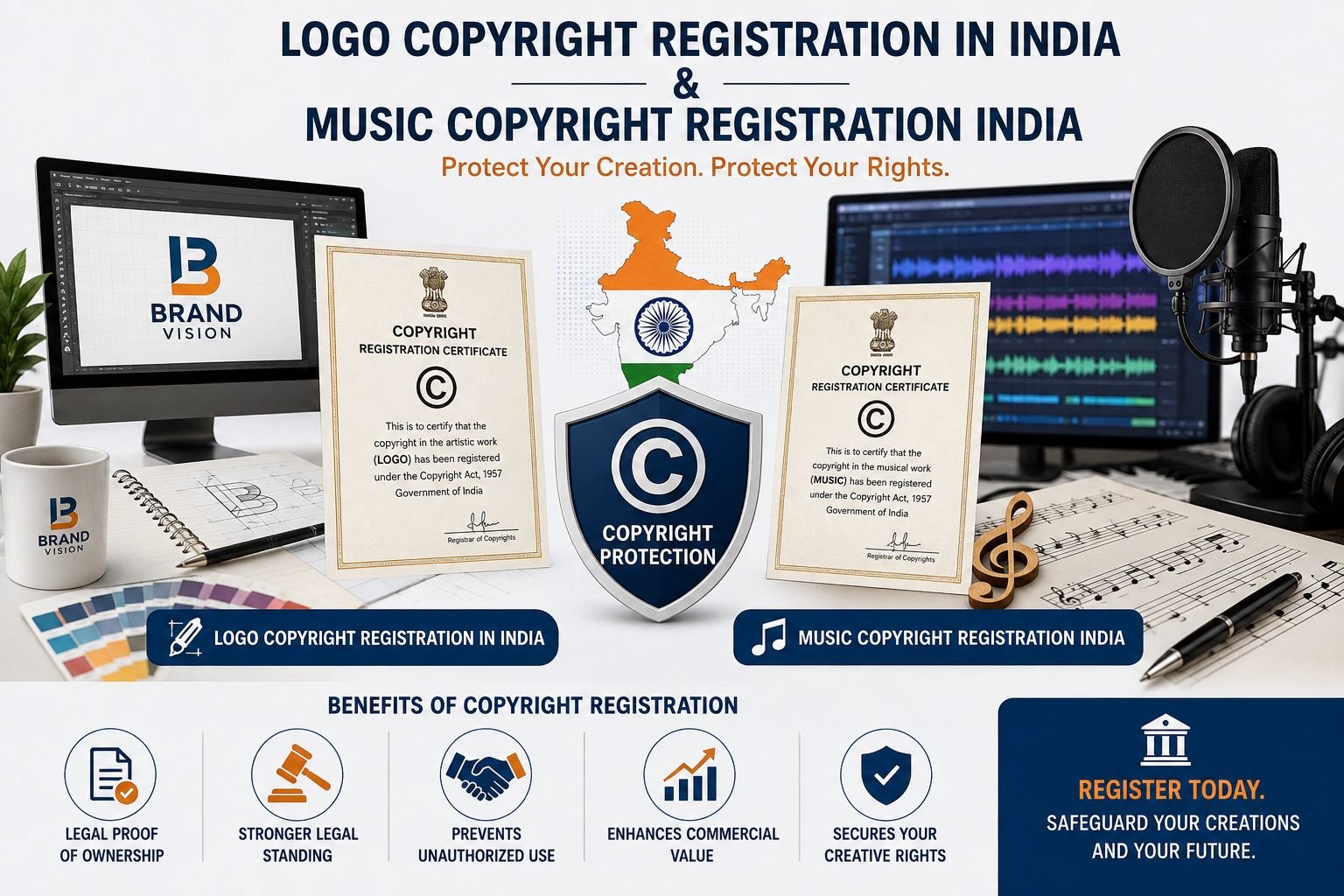
India’s rapidly expanding digital economy is changing how businesses and creators think about ownership of creative assets. From corporate identities appearing across e-commerce platforms to independent songs reaching millions of digital users, copyright has become an increasingly important commercial consideration.
Against this backdrop, Logo Copyright Registration in India and Music Copyright Registration India are drawing attention from startups, designers, musicians, composers, production companies and other rights holders seeking stronger documentation of their intellectual property.
The development reflects a wider shift in the creative economy: logos and music are no longer viewed only as creative outputs. They can be licensable, transferable and revenue-generating business assets.
Digital Distribution Creates New Copyright Concerns
The internet has dramatically reduced the barriers to distributing creative work.
A newly launched company can place its logo across its website, online store, social networks and digital advertisements on the same day. Similarly, musicians can release compositions and recordings through streaming and video platforms without relying entirely on traditional distribution.
However, greater visibility also increases exposure.
Images can be downloaded and reused, while music can potentially be copied, sampled or incorporated into other digital content.
For rights holders, the challenge is therefore not simply creating original work but maintaining evidence showing who created it, who owns it and who is authorised to exploit it commercially.
Logo Copyright Registration in India Goes Beyond Brand Appearance
A logo is frequently the first visual element consumers associate with a company.
Original artwork contained within a logo may potentially qualify as an artistic work for copyright purposes where the applicable requirements are satisfied.
Through Logo Copyright Registration in India, rights holders can seek formal registration of qualifying artistic work.
The distinction between an idea and its artistic expression remains important.
For example, the general idea of creating a logo based on an eagle is not the same as an artist’s particular original drawing of that eagle. Copyright is concerned with eligible expression rather than granting exclusive control over broad concepts.
Copyright and Trademark Protection Address Different Risks
Businesses seeking logo protection can encounter two different areas of intellectual property law: copyright and trademarks.
Although they may overlap in practice, they are not interchangeable.
| Question | Copyright | Trademark |
| What is primarily protected? | Original creative expression | Distinctive commercial identity |
| How can it apply to a logo? | Protecting qualifying artwork | Protecting a brand identifier |
| What is the main concern? | Unauthorised reproduction | Confusing marketplace use |
| Can both be relevant? | Yes | Yes |
A business pursuing Logo Copyright Registration in India may therefore separately evaluate trademark registration where the logo functions as an identifier for goods or services.
The appropriate strategy depends on the nature and commercial use of the asset.
Ownership Can Become Complicated When Agencies Create Logos
A common commercial scenario involves a business outsourcing logo development.
The company provides a brief, the designer creates several concepts, the business approves one design and payment is made.
The process appears straightforward, but the copyright position should still be documented.
Businesses should ensure their agreements clearly address:
- Who created the artwork
- Who owns the resulting copyright
- Whether copyright is assigned
- Scope of transferred rights
- Commercial usage
- Territory and duration where relevant
- Consideration
- Rights retained by the designer
Without appropriate documentation, questions may arise when the logo later becomes commercially valuable.
Logo Registration Requires an Accurate Chain of Ownership
Before applying for Logo Copyright Registration in India, applicants should establish the relationship between the author and copyright owner.
A typical registration process broadly includes:
- Identifying the copyrightable artistic work.
- Confirming authorship.
- Establishing current ownership.
- Preparing the prescribed application.
- Providing relevant particulars.
- Uploading the artwork.
- Submitting applicable supporting documents.
- Paying the prescribed fee.
- Obtaining a Diary Number.
- Responding to examination issues or objections where required.
Commercial logos may also involve specific procedural requirements where the artistic work is used or capable of being used in connection with goods or services.
Music Rights Become More Important as Independent Releases Grow
India’s music sector has undergone significant digital transformation.
Independent artists can now write, record, publish and promote music using online tools and distribution platforms. This has created opportunities outside traditional record-label structures.
It has also made copyright knowledge increasingly valuable.
Music Copyright Registration India can be particularly relevant because a single song may involve several contributors and multiple categories of rights.
Creators who fail to establish these rights before release can encounter complications when the song begins generating commercial interest.
A Song Can Represent Several Intellectual Property Assets
One of the biggest misconceptions is that one song automatically means one copyright.
In practice, several distinct rights can exist.
| Song Component | Relevant Category |
| Original musical composition | Musical work |
| Original written lyrics | Literary work |
| Recorded version | Sound recording |
| Performance by musicians or singers | Performers’ rights may apply |
Suppose a composer creates the melody, a lyricist writes the words and a production company arranges the recording.
The resulting track combines these contributions, but that does not necessarily mean every contributor owns the same rights.
Contracts and applicable copyright law determine the legal position.
Music Copyright Registration India Begins Before Filing
Creators considering Music Copyright Registration India should first conduct a basic rights review.
They should determine:
Who composed the music?
Who wrote the lyrics?
Who produced the sound recording?
Were collaborators involved?
Has anyone assigned their rights?
Has the music already been published?
Are samples or third-party elements included?
These questions can reveal potential ownership issues before an application is submitted or a commercial licence is signed.
The correct copyright category should then be selected according to the work being registered.
Commercial Music Use Extends Far Beyond Streaming
Streaming is only one part of the modern music economy.
Original music can potentially be monetised through:
- Film and television
- Advertising
- Web series
- Social media
- Games
- Mobile applications
- Podcasts
- Corporate productions
- Events
- Digital campaigns
- Online video content
These uses can involve different commercial permissions.
This is why Music Copyright Registration India should be considered alongside licensing and rights-management agreements.
Registration documents the relevant work, while contracts determine how another party may use it.
Licensing Can Preserve Ownership While Generating Revenue
Creators sometimes believe they must sell their copyright to earn money from it.
That is not necessarily the case.
A copyright licence can authorise another party to exercise specified rights while the copyright owner may retain ownership.
Consider a musician whose original track is requested for a promotional campaign. Instead of transferring the entire copyright, the musician may negotiate permission limited by purpose, duration and territory.
Important licensing terms can include:
- Permitted media
- Geographic territory
- Duration
- Exclusivity
- Royalty or fixed fee
- Editing permission
- Distribution
- Credit requirements
- Sub-licensing
- Termination provisions
Assignments should be considered separately because they can involve transferring copyright interests.
Poor Documentation Can Create Disputes Years Later
Copyright problems do not always arise immediately.
A logo may remain relatively unknown for years before the company becomes successful. A song may receive little attention before suddenly becoming popular through a film, advertisement or social media trend.
At that point, unclear ownership can become commercially significant.
Design contracts, music collaboration agreements, assignments, licences and other records should therefore be created while the relationships between parties are clear.
Registration can strengthen the overall documentation surrounding an intellectual property asset, but it should not replace appropriate commercial agreements.
Frequently Asked Questions
1. What does Logo Copyright Registration in India protect?
It can protect qualifying original artistic expression contained in a logo.
2. Is copyright registration mandatory in India?
Registration is generally not required for eligible copyright to subsist.
3. Can copyright protect a logo used commercially?
Yes, qualifying artistic elements may potentially receive copyright protection.
4. Is logo copyright better than trademark registration?
Neither automatically replaces the other because they protect different interests.
5. Who owns a logo designed by an outside agency?
Ownership depends on applicable law and contractual arrangements, including assignments where relevant.
6. What is Music Copyright Registration India?
It refers to registering eligible musical and related copyright works under India’s copyright system.
7. Are song lyrics independently protected?
Original lyrics can qualify as literary works.
8. Does owning a composition mean owning its recording?
Not necessarily. Musical works and sound recordings are separate copyright subject matter.
9. Can collaborators have different rights in one song?
Yes. Different contributors can hold different rights depending on authorship and agreements.
10. Can music be licensed without transferring copyright?
Yes. Licensing can grant specified usage rights while ownership remains with the copyright holder.
https://newsgrow.blogspot.com/2026/08/logo-copyright-registration-in-india.html