
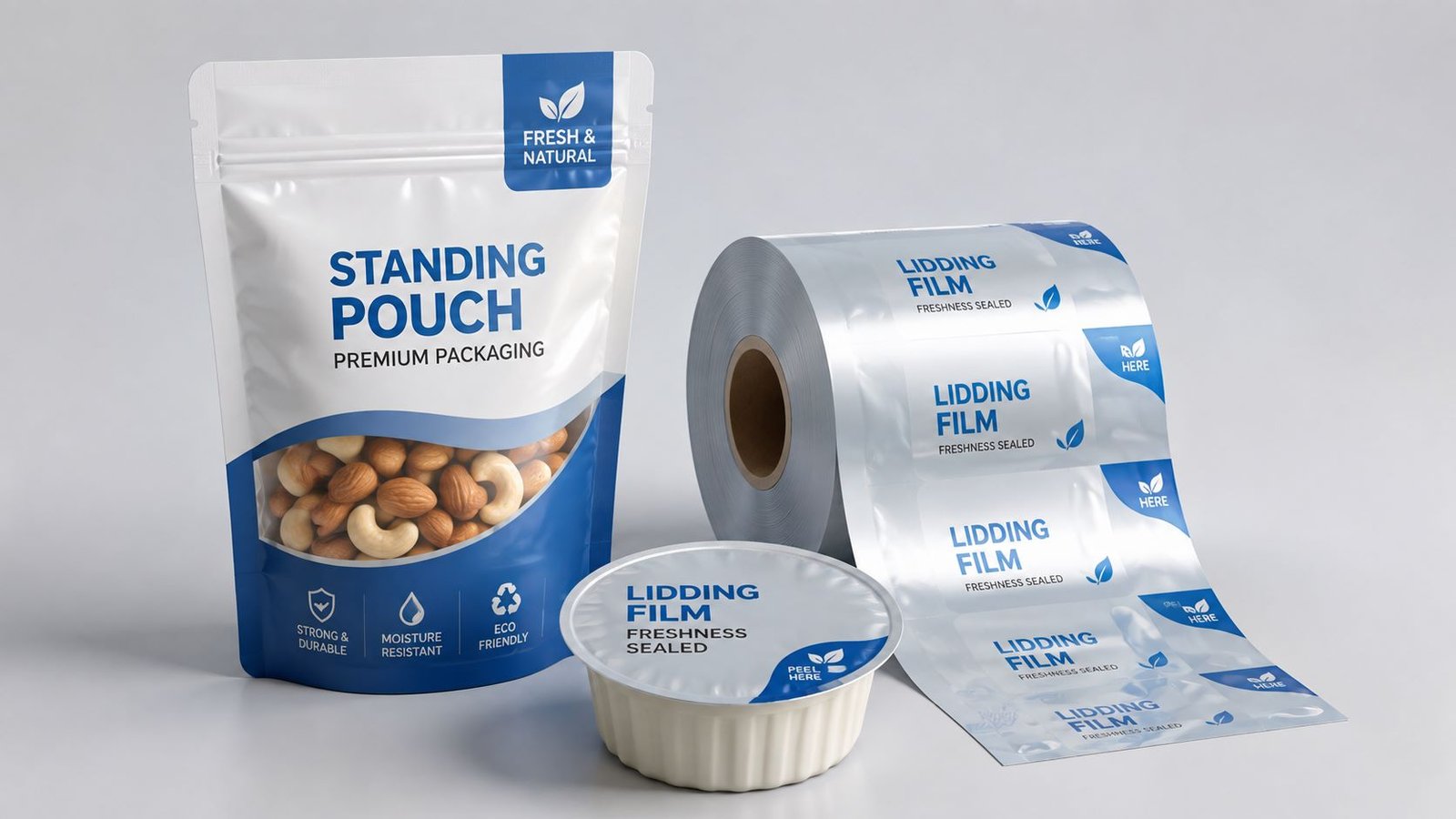
As manufacturers continue to review packaging performance, material efficiency and consumer convenience, standing pouch and Lidding Film solutions are attracting attention across a broad range of product categories. From coffee and snacks to dairy products, ready meals and fresh foods, these flexible packaging formats provide manufacturers with different ways to protect and present products.
The shift is not simply about replacing traditional packaging. Businesses increasingly need packaging that works effectively throughout filling, sealing, transportation, retail display, storage and final consumer use.
A standing pouch offers a self-supporting flexible format with substantial branding space and optional convenience features. Lidding Film, meanwhile, provides a flexible sealing solution for trays, cups, tubs and other preformed containers.
Although the technologies perform different functions, both demonstrate how packaging design is becoming increasingly focused on application-specific performance.
Standing Pouch Creates New Possibilities for Product Presentation
The standing pouch, also widely known as a stand-up pouch, is characterised by a bottom gusset that expands after filling. This creates a stable base, allowing the finished package to remain upright on a retail shelf.
The format is now used for products including:
- Coffee and tea
- Nuts and dry fruits
- Snacks
- Spices and seasonings
- Confectionery
- Nutritional powders
- Pet food
- Sauces
- Personal care products
- Household products
One important advantage is the available printable surface. Front and back panels can accommodate branding, product information, nutritional information, preparation instructions and other required details.
For brands competing in crowded retail categories, this combination of functional packaging and shelf visibility can make the format particularly attractive.
Convenience Features Expand the Role of Standing Pouches
Modern consumers increasingly expect packaging to be easy to open, store and reuse.
Manufacturers can customise a standing pouch with different functional elements depending on the application.
Popular options include resealable zippers, tear notches, transparent windows, handles, spouts and valves.
A zipper, for example, can be particularly valuable for coffee, snacks, nuts or pet treats that are not consumed immediately after opening. Spouted formats can provide controlled dispensing for certain liquids and semi-liquid products.
The selection of such features should be based on actual product requirements rather than appearance alone.
Packaging Performance Begins with Material Selection
Behind the printed exterior of a standing pouch is an engineered film structure designed around the characteristics of the packed product.
Different layers may contribute:
- Mechanical strength
- Print quality
- Heat-sealing performance
- Moisture resistance
- Oxygen protection
- Light protection
- Aroma retention
- Puncture resistance
A product sensitive to oxygen may require a different barrier structure from a dry product mainly affected by moisture.
Similarly, packaging for liquids must address seal strength and leakage risks that may not be as significant for lightweight dry products.
This makes material specification an important part of flexible packaging development.
Lidding Film Supports Secure Tray and Container Packaging
While standing pouches create an independent package, Lidding Film is designed primarily to seal another packaging component.
The film is typically positioned across the open surface of a cup, tray or tub and sealed around the rim.
Applications can be found throughout the food and related industries, including:
- Yoghurt and dairy products
- Ready meals
- Fresh meat
- Poultry
- Seafood
- Cheese
- Desserts
- Fresh produce
- Dips and sauces
- Selected pharmaceutical applications
The tray provides physical structure, while the film contributes closure, protection and presentation.
Seal Compatibility Remains Critical for Lidding Film Performance
Selecting Lidding Film requires more than choosing the correct width and thickness.
Film, tray material and sealing equipment need to work as a complete packaging system.
The sealing process is influenced by several variables:
- Container material
- Sealant composition
- Sealing temperature
- Applied pressure
- Dwell time
- Condition of the tray rim
- Product contamination in the seal area
- Packaging equipment settings
Incorrect combinations can contribute to weak seals, leakage or inconsistent opening behaviour.
Manufacturers are therefore encouraged to conduct packaging trials under realistic production conditions before committing to large-volume orders.
Easy-Peel and Anti-Fog Features Improve Packaging Functionality
Convenience and visual presentation are two important considerations in tray-based packaging.
Easy-peel Lidding Film can be engineered to provide adequate sealing during transportation and storage while allowing consumers to remove the film in a controlled manner.
Anti-fog performance addresses a different challenge.
Refrigerated products can generate condensation inside transparent packages. Accumulated droplets can reduce visibility and make it more difficult for shoppers to inspect the contents.
Anti-fog film is designed to minimise this visual obstruction, making it particularly relevant for selected refrigerated foods, fresh produce and other products where visibility matters.
Standing Pouch and Lidding Film Serve Different Packaging Requirements
| Factor | Standing Pouch | Lidding Film |
| Primary role | Complete flexible package | Container sealing material |
| Separate tray needed | Generally no | Generally yes |
| Self-standing | Yes | Depends on container |
| Resealable option | Common | Application dependent |
| Large print area | Yes | Primarily top-facing |
| Barrier options | Available | Available |
| Anti-fog option | Less common | Widely relevant |
| Easy-peel capability | Possible | Common |
| Typical applications | Coffee, snacks, powders | Dairy, meat, meals |
The appropriate choice depends on the product rather than packaging trends.
A business selling resealable dry snacks may benefit from a standing pouch, while a manufacturer packaging fresh food portions may require a tray combined with specialised Lidding Film.
Barrier Packaging Remains an Important Development Area
Protecting product quality during its intended shelf life remains one of the primary purposes of packaging.
Flexible materials can be designed with different levels of protection against oxygen, moisture, light and aroma transfer.
The required barrier should be determined by the product itself.
Coffee may require protection against oxygen and aroma loss. Certain dry products may need strong moisture resistance. Fresh and prepared foods can have their own oxygen-transmission and storage requirements.
Rather than automatically selecting the highest possible barrier, manufacturers should determine what level is actually necessary for the intended product and shelf life.
Sustainability Influences Flexible Packaging Development
Environmental considerations are also influencing the development of both standing pouch and Lidding Film structures.
Flexible packaging can offer material and transportation efficiencies in certain applications because of its relatively low weight. However, environmental performance should not be judged by package weight alone.
Manufacturers should evaluate factors such as:
- Material composition
- Packaging-to-product ratio
- Recyclability
- Product protection
- Shelf-life requirements
- Transportation efficiency
- Product waste
- Local recycling infrastructure
Mono-material packaging structures are also receiving attention where performance requirements allow their use.
However, manufacturers need to balance end-of-life considerations with the fundamental requirement to safely protect the packaged product.
Flexible Packaging Selection Becomes More Application-Specific
Industry requirements increasingly demonstrate that there is no universal flexible packaging structure suitable for every product.
Before selecting either format, businesses should evaluate product consistency, weight, sensitivity, filling conditions, storage temperature, shelf-life expectations, transportation environment and packaging machinery.
Testing Can Reduce Commercial Packaging Risks
Prototype samples and production-line trials allow manufacturers to assess packaging performance before full commercial implementation.
Important tests may examine:
- Seal integrity
- Leakage resistance
- Drop performance
- Puncture resistance
- Opening characteristics
- Machine compatibility
- Appearance after transportation
Testing is particularly important when introducing a new material structure, changing packaging suppliers or moving to a different tray or sealing system.
Frequently Asked Questions
1. What is a standing pouch?
A standing pouch is flexible packaging incorporating a bottom gusset that allows the filled package to stand upright.
2. What products can use standing pouches?
Applications include coffee, snacks, spices, powders, nuts, pet food, sauces and various consumer products.
3. Can standing pouches be resealable?
Yes. Zippers, spouts and other closure systems can provide resealable functionality.
4. What is Lidding Film?
Lidding Film is flexible material designed to seal the opening of compatible trays, cups, tubs or containers.
5. Where is lidding film commonly used?
It is commonly used for dairy, meat, seafood, ready meals, fresh produce, desserts and prepared foods.
6. What is easy-peel lidding film?
It is a film designed to provide controlled opening while maintaining the required seal during storage and distribution.
7. Why is anti-fog film used?
Anti-fog technology helps minimise visible condensation on transparent packaging.
8. Can flexible films provide oxygen protection?
Yes. Barrier structures can be engineered to control oxygen transmission according to product requirements.
9. Is a standing pouch better than lidding film?
Neither is universally better because they perform different packaging functions.
10. Why should packaging samples be tested?
Testing helps verify seal quality, mechanical strength, machine compatibility and overall performance before large-scale production.
Read more – https://newsgrow.blogspot.com/2026/08/foil-lid-and-stand-up-pouch.html
https://newsgrow.blogspot.com/2026/08/spout-pouch-and-stand-up-pouch-with.html
https://newsgrow.blogspot.com/2026/08/stand-up-pouch-filling-machines.html
https://newsgrow.blogspot.com/2026/08/why-zipper-stand-up-pouch-packaging-is.html
https://blogstream.net/standing-pouch-and-lidding-film-a-deep-guide-to-modern-flexible-packaging/