The metal fabrication industry is witnessing continued interest in architectural components that combine traditional craftsmanship with modern manufacturing efficiency. Forged Elements and Wrought Iron Components are increasingly being considered for projects where decorative character, customization, durability, and repeatable production are important.
The development reflects a broader shift within architectural metalworking. Buyers are no longer looking only for decorative pieces. Contractors, fabricators, architects, furniture manufacturers, and project developers increasingly consider material specifications, production accuracy, corrosion protection, installation efficiency, and long-term performance when selecting metal components.
As manufacturing technology advances, ornamental metalwork is moving from labor-intensive individual production toward a combination of skilled craftsmanship and controlled industrial manufacturing.
Architectural Metalwork Enters a New Manufacturing Era
Traditional ornamental ironwork was largely created by skilled blacksmiths who manually heated, hammered, bent, and twisted metal.
That craftsmanship remains influential, but production methods have changed dramatically.
Manufacturers of Forged Elements can now use hydraulic presses, power hammers, forming machines, dies, rollers, precision cutting equipment, welding systems, and digital design technologies.
The transition offers several practical advantages:
- Improved dimensional accuracy
- Consistent decorative patterns
- Faster production cycles
- Better repeatability
- Greater customization
- Increased production capacity
- More controlled quality
These capabilities are particularly valuable for hotels, residential developments, commercial properties, and infrastructure projects requiring large quantities of matching components.
Forged Elements Move Beyond Traditional Applications
While decorative metalwork remains a highly visible market, Forged Elements are not limited to ornamental applications.
Forging is a manufacturing process in which metal is shaped through compressive forces. Depending on the process and material, the metal may be heated and subsequently hammered, pressed, rolled, or formed using specialized tooling.
Proper process control can produce components with favorable grain flow and reliable mechanical properties.
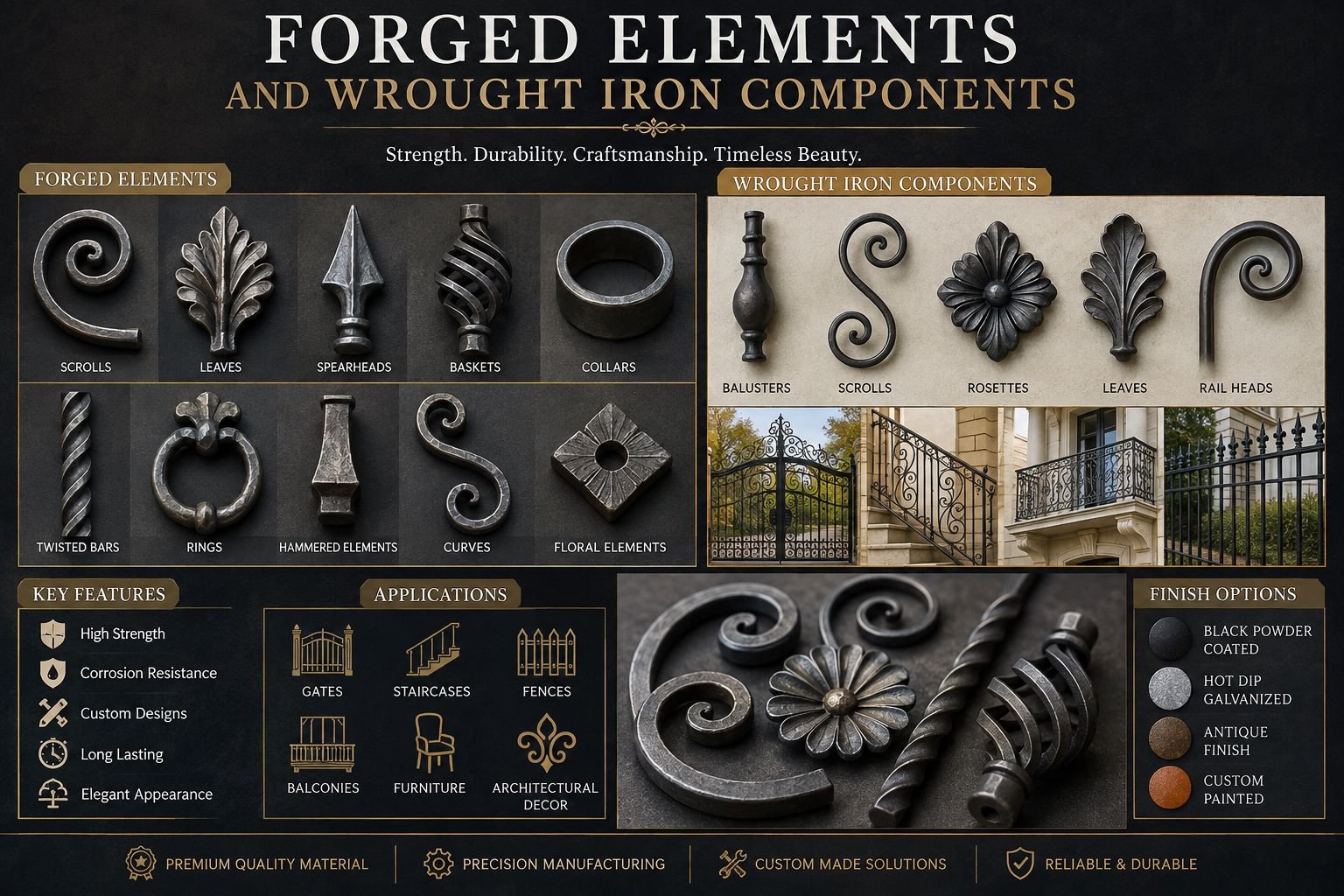
Typical products can include:
- Forged rings
- Collars
- Scrolls
- Baskets
- Bars
- Leaves
- Railheads
- Spear points
- Decorative fittings
- Customized metal parts
The flexibility of the process allows manufacturers to serve both architectural and functional requirements.
Wrought Iron Components Remain Popular in Premium Architecture
Despite changing architectural trends, Wrought Iron Components continue to appear in luxury homes, hotels, resorts, villas, commercial developments, gardens, and restoration projects.
Their popularity comes partly from design flexibility.
Ornamental metalwork can complement classical European architecture, traditional properties, Mediterranean designs, heritage environments, and even contemporary buildings when simpler patterns are selected.
Gates Become Architectural Statements
A gate is no longer viewed only as a security barrier.
Architects can combine scrolls, leaves, flowers, baskets, rosettes, collars, and railheads to turn entrance systems into prominent architectural features.
Staircases Gain Decorative Identity
Interior staircases represent another important market for Wrought Iron Components.
Decorative balusters and forged inserts allow designers to create visual continuity between flooring, furniture, lighting, and other interior elements.
Balconies Influence Building Character
Balcony railings can significantly affect the appearance of a building façade. Customized metal patterns give architects additional control over proportions, repetition, and visual identity.
Modern Wrought Iron Is Not Always Traditional Wrought Iron
Industry terminology can sometimes create confusion.
Historically, wrought iron referred to a particular low-carbon iron material containing characteristic slag inclusions. It was highly workable and became widely associated with decorative gates, fences, and railings.
Today, many products commercially described as Wrought Iron Components are manufactured using mild steel rather than traditional wrought iron.
For decorative applications, mild steel provides several practical benefits, including availability, weldability, formability, and compatibility with common finishing systems.
Professional buyers should therefore verify actual material specifications when material composition is important to the project.
Custom Designs Become an Important Market Differentiator
Standard decorative catalogs remain widely used, but customization is becoming an important part of architectural metalwork.
A luxury hotel may require a unique pattern. A property developer might want decorative elements repeated across multiple buildings. Restoration specialists may need components matching an existing historical design.
Modern manufacturers can develop custom Forged Elements from:
- CAD drawings
- Engineering drawings
- Architectural sketches
- Physical samples
- Reference components
- Approved prototypes
This provides considerably more flexibility than selecting only standard catalog products.
Technology Improves Prototype-to-Production Workflows
Digital manufacturing technologies are helping reduce the gap between an architectural concept and finished metal component.
CAD-based drawings can define dimensions and geometry before tooling begins. Prototype production then allows the component to be evaluated before large-volume manufacturing.
Typical Development Process
A custom project may progress through:
- Design review
- Material selection
- Dimension confirmation
- Tooling preparation
- Prototype manufacturing
- Sample evaluation
- Design approval
- Production
- Final inspection
This process is particularly useful for complex Wrought Iron Components where appearance and dimensional consistency are equally important.
Forged Elements vs Wrought Iron Components
Understanding the distinction between these categories helps project teams make informed sourcing decisions.
| Requirement | Forged Elements | Wrought Iron Components |
| Core characteristic | Formed strength and geometry | Decorative character |
| Typical manufacturing | Pressing, hammering, forging | Bending, forming, fabrication |
| Main applications | Industrial and architectural | Architectural and decorative |
| Custom designs | Available | Highly common |
| Mechanical requirements | Frequently important | Project dependent |
| Decorative potential | High | Very high |
| Volume manufacturing | Possible | Possible |
There is significant overlap because many ornamental components can themselves be forged.
Corrosion Protection Moves Higher on Project Priorities
Outdoor metalwork can remain visually attractive only when environmental exposure is properly considered.
Rainwater, humidity, industrial pollution, temperature fluctuations, and salt can accelerate corrosion.
Manufacturers and fabricators therefore use several protection methods for Forged Elements:
- Galvanizing
- Powder coating
- Protective primers
- Industrial paints
- Electroplating
- Blackening
- Specialized coating systems
The correct system depends on the installation environment.
A railing installed inside a hotel and a gate installed near a coastline, for example, can require very different levels of corrosion protection.
Quality Consistency Becomes Essential for Large Projects
Mass production introduces an important challenge: every component should remain consistent.
A small dimensional variation may seem insignificant when examining one decorative piece. Across 2,000 components, however, such variation can create substantial fabrication difficulties.
Manufacturers Increase Inspection
Professional quality control can include checks for:
- Material grade
- Dimensions
- Tolerances
- Shape consistency
- Surface defects
- Cracking
- Straightness
- Coating coverage
- Packaging quality
Inspection is particularly important for customized Forged Elements because replacement components must integrate correctly with existing assemblies.
Ready-Made Components Help Reduce Workshop Time
Another factor influencing the sector is the availability of standardized ornamental products.
Traditionally, a fabrication workshop might manually produce every decorative scroll or basket required for a gate.
Ready-made Wrought Iron Components allow workshops to purchase repeatable pieces and incorporate them into larger fabricated assemblies.
This can provide:
- Faster production
- Reduced manual forming
- Consistent designs
- Better project scalability
- More predictable fabrication
- Easier repeat orders
- Greater design selection
Fabricators can spend more time on assembly, welding, finishing, and installation rather than repeatedly producing individual ornaments.
Buyers Place Greater Emphasis on Supplier Evaluation
As international sourcing becomes more accessible, comparing suppliers based exclusively on price can create quality risks.
Industry buyers increasingly evaluate manufacturing capability, raw materials, tooling, production capacity, customization, inspection processes, finishing options, packaging, and delivery performance.
For customized Wrought Iron Components, samples should ideally be reviewed before high-volume production.
Technical specifications should also clearly identify dimensions, materials, tolerances, quantities, finishes, and packaging requirements.
FAQ About Forged Elements and Wrought Iron Components
What are Forged Elements?
Forged Elements are metal parts shaped through compressive forces such as pressing, hammering, rolling, or die forging.
Why is forging used in metal manufacturing?
Forging can provide excellent strength, toughness, structural integrity, and fatigue resistance when the process is properly controlled.
What are Wrought Iron Components used for?
They are commonly used in gates, fences, balconies, railings, staircases, furniture, gardens, and decorative architectural projects.
Are modern wrought iron products always genuine wrought iron?
No. Many contemporary ornamental products are manufactured from mild steel while using traditional wrought-iron-inspired designs.
Can Forged Elements be customized?
Yes. Shapes, dimensions, thicknesses, profiles, patterns, and finishes can often be customized according to project specifications.
Why is mild steel widely used?
It provides a practical combination of formability, weldability, availability, strength, and cost efficiency.
Are decorative metal components suitable for exterior projects?
Yes, when suitable corrosion protection and maintenance procedures are applied.
What finishes are available?
Options can include galvanizing, powder coating, painting, electroplating, polishing, blackening, and specialized protective coatings.
Can ornamental metal components be mass-produced?
Yes. Modern tooling and forming equipment can produce repeatable components in significant quantities.
What should buyers consider when selecting a supplier?
Buyers should assess manufacturing experience, material control, customization, quality inspection, finishing capabilities, samples, capacity, packaging, and delivery reliability.
https://gosarkarijobs.com/why-wrought-iron-components-are-redefining-modern-decorative-iron-work/
https://shopnets.com/a-complete-guide-to-wrought-iron-components-for-beautiful-decorative-iron-work/
https://newsgrow.blogspot.com/2026/08/wrought-iron-components-see-renewed.html
https://newsgrow.blogspot.com/2026/08/from-functional-railings-to-statement.html