
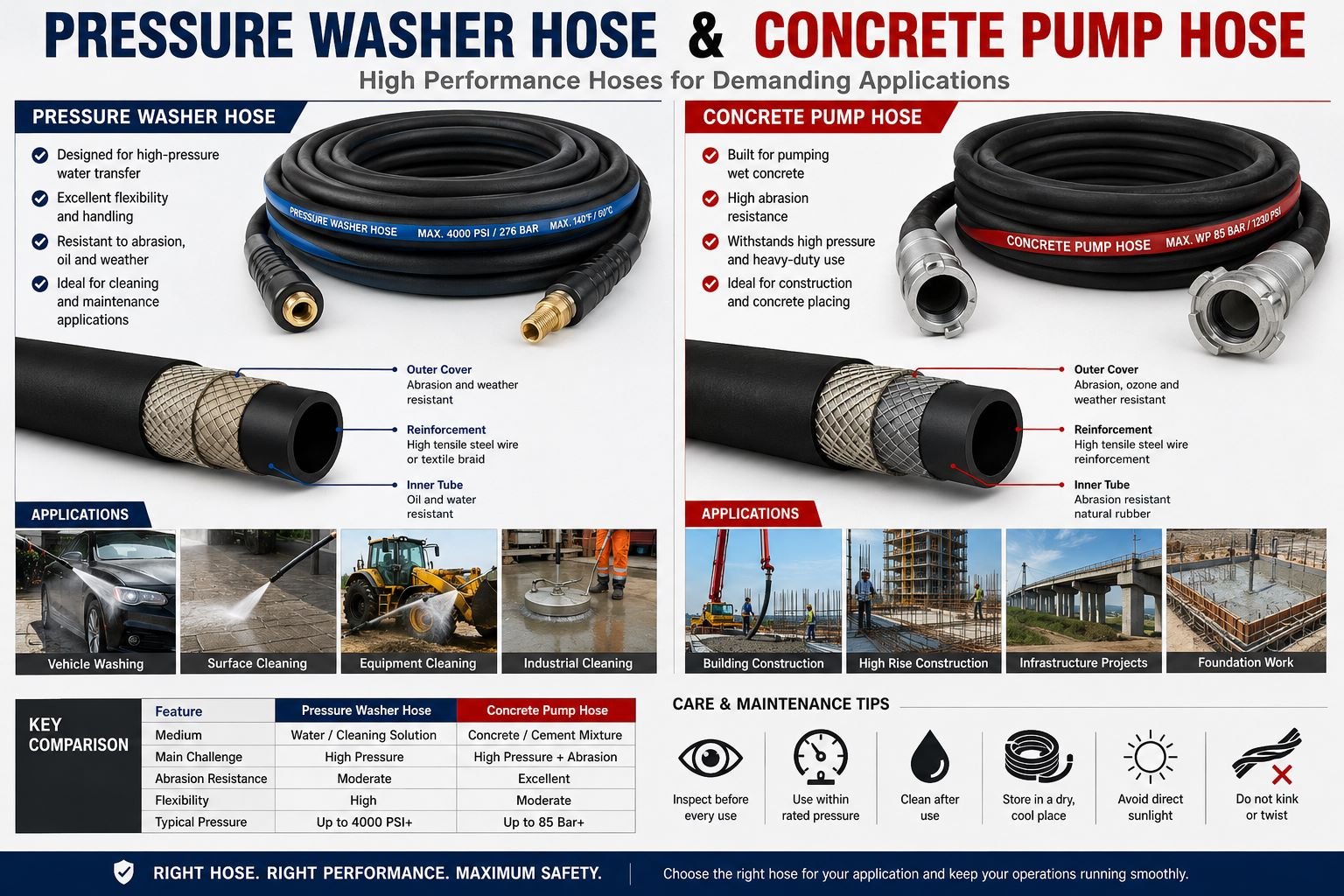
Walk onto a professional cleaning site and you may see powerful water jets removing stubborn dirt within seconds. Visit a construction project and you might watch wet concrete travel efficiently from a pump to an otherwise difficult-to-reach location. Behind both operations is a component that rarely gets much attention—the hose.
A Pressure Washer Hose is responsible for delivering high-pressure water reliably, while a Concrete Pump Hose must move heavy, abrasive concrete through demanding construction environments. Both perform critical jobs, yet their engineering requirements are completely different.
For contractors, equipment operators, maintenance teams, and industrial buyers, understanding these differences is essential for selecting a hose that delivers dependable performance rather than becoming a frequent maintenance problem.
The Hose Is Part of the System, Not Just an Accessory
It is easy to choose a hose according to length, diameter, or price. Professional applications require a much deeper evaluation.
A hose operates as part of a complete pressure system. Its performance can be influenced by the pump, transported material, operating pressure, temperature, fittings, movement, and surrounding environment.
Important characteristics include:
- Pressure capacity
- Reinforcement strength
- Internal diameter
- Abrasion resistance
- Flexibility
- Temperature tolerance
- Material compatibility
- Coupling quality
Matching these characteristics to actual operating conditions can improve both reliability and service life.
Why Pressure Washer Hose Construction Is So Important
A Pressure Washer Hose works on the high-pressure side of pressure washing equipment. Its purpose is to transfer pressurized water from the pump to the spray gun without compromising handling or performance.
This requires more engineering than an ordinary water hose.
The internal pressure continuously attempts to expand the hose. Reinforcement controls this expansion, while the outer cover protects the structure from everyday environmental damage.
Where Pressure Washer Hose Performs Best
Pressure washing has moved far beyond residential driveway cleaning.
Professional systems are now commonly used for:
- Industrial equipment cleaning
- Truck and fleet washing
- Agricultural machinery maintenance
- Construction equipment cleaning
- Factory floor washing
- Building exterior maintenance
- Workshop cleaning
- Surface preparation
In these environments, a Pressure Washer Hose may be dragged, bent, repositioned, and exposed to water, dirt, oil, and cleaning agents throughout the working day.
Three Layers That Define Hose Performance
Although construction varies between manufacturers and applications, reinforced pressure hoses generally contain several functional layers.
Inner Tube
The inner tube comes into direct contact with water and compatible cleaning solutions. It needs to maintain its properties under the intended pressure and temperature conditions.
Reinforcement
The reinforcement structure provides much of the hose’s pressure resistance. Depending on the design, manufacturers may use textile braids, steel wire, or other reinforcing materials.
Outer Cover
The exterior helps protect the reinforcement against abrasion and environmental exposure.
Why More Pressure Does Not Automatically Mean Better
Selecting the highest-pressure hose available is not always necessary. The goal should be matching hose specifications to equipment requirements while considering flexibility, weight, temperature, and operating conditions.
Concrete Pump Hose Has a Tougher Material to Handle
The operating challenge changes dramatically when the transported material is concrete rather than water.
A Concrete Pump Hose carries mixtures containing cement, sand, aggregates, water, and additives. These mixtures are dense and abrasive.
As concrete travels through the hose, aggregate particles create repeated friction against its internal surface. This means the hose must withstand pressure while resisting progressive internal wear.
How Concrete Pump Hose Supports Modern Construction
Concrete pumps make it possible to move material efficiently across construction sites, but the final delivery point often requires flexibility.
A Concrete Pump Hose can help direct material into areas such as:
- Foundations
- Concrete slabs
- Walls
- Columns
- Structural sections
- Residential buildings
- Commercial projects
- Infrastructure works
- Difficult-access locations
The hose becomes particularly useful where rigid delivery lines cannot conveniently reach the exact placement point.
What Happens Inside a Concrete Hose During Pumping?
Understanding what occurs internally explains why specialized construction is necessary.
Continuous Material Movement
Concrete is pushed through the hose under pressure. The mixture’s solid particles repeatedly contact the internal lining.
Progressive Abrasion
Every pumping cycle contributes to gradual wear. The rate can vary according to the concrete mixture, aggregate, operating conditions, hose construction, and usage.
Pressure Fluctuation
Concrete pumping does not necessarily create perfectly uniform flow. Pressure can change according to pumping conditions and material movement.
External Stress Happens Too
While internal abrasion receives considerable attention, the exterior may also experience dragging, bending, rough surfaces, construction debris, and contact with machinery.
This makes both internal and external durability important.
Pressure Washer Hose vs Concrete Pump Hose at a Glance
| Consideration | Pressure Washer Hose | Concrete Pump Hose |
| Transported medium | Pressurized water | Concrete and grout |
| Major challenge | High pressure | Pressure plus abrasion |
| Typical application | Cleaning | Construction |
| Internal abrasion | Usually moderate | Severe |
| Handling | Frequent movement | Controlled placement |
| Reinforcement | Depends on pressure class | Heavy-duty |
| Main wear concern | External damage and leaks | Internal wear and external damage |
| Cleaning need | Flushing when appropriate | Thorough cleaning after pumping |
This comparison highlights why appearance alone cannot determine hose suitability.
How to Choose a Pressure Washer Hose Without Guesswork
Start with your pressure washer specifications.
The rated working pressure of the Pressure Washer Hose should be appropriate for the machine’s maximum operating pressure.
Then consider temperature. A hot-water cleaning system requires a hose specifically suitable for elevated temperatures.
Internal diameter also matters because it influences water flow.
Finally, verify the connections. Fittings must be suitable for the hose, machine, and accessories.
What to Check Before Selecting Concrete Pump Hose
Concrete pumping requires a slightly different checklist.
Consider:
- Pump operating pressure
- Hose working-pressure rating
- Required internal diameter
- Concrete mixture characteristics
- Aggregate properties
- Abrasion resistance
- Hose length
- Reinforcement construction
- Connection requirements
- Site conditions
A Concrete Pump Hose should be selected according to the complete pumping application rather than dimensions alone.
The Working Pressure Rule You Should Never Ignore
One specification deserves particular attention: working pressure.
Working pressure indicates the pressure the hose is designed to handle during normal service.
Burst pressure is different. It relates to a substantially higher pressure associated with testing or structural failure.
Always Design Around Working Pressure
Neither a Pressure Washer Hose nor a Concrete Pump Hose should routinely operate near its burst-pressure value.
Manufacturer-specified working limits should guide normal equipment operation.
Small Handling Mistakes Can Create Big Problems
Hose life is influenced by what happens during everyday use.
Common mistakes include:
- Pulling hoses using their fittings
- Repeatedly creating sharp bends
- Allowing severe kinks
- Twisting the hose
- Dragging it over sharp edges
- Crushing it under equipment
- Exceeding temperature limits
- Operating above rated pressure
- Using incompatible materials
- Ignoring early signs of wear
Better handling practices can reduce unnecessary deterioration.
Five Minutes of Inspection Can Save Hours of Downtime
Before beginning work, inspect the complete hose.
Look for cuts, cracking, bulges, flattened areas, excessive abrasion, exposed reinforcement, leaking connections, or damaged fittings.
Pay particular attention to sections close to couplings.
Why Coupling Areas Need Attention
These locations often experience repeated bending and pulling.
Do Not Assume Surface Damage Is Cosmetic
The outer cover protects the reinforcement. Significant external damage may expose or compromise deeper structural components.
Damaged high-pressure hoses should be evaluated before continued use.
Cleaning Is Different for Each Hose
After pressure washing, a Pressure Washer Hose should be depressurized and stored correctly. When compatible detergents have been used, suitable flushing may help remove residues.
Concrete pumping creates a different maintenance challenge.
Concrete left inside a Concrete Pump Hose can begin to harden. Once this happens, internal restrictions may develop and the hose can become difficult or impossible to use.
Cleaning should therefore follow the pump and hose manufacturer’s recommended procedures immediately after operation.
Buying Cheap Can Become Expensive
Purchase price is only one part of hose cost.
Imagine saving money on a hose but replacing it several times because it is poorly suited to the application. Add labour, machine downtime, interrupted projects, and replacement expenses, and the initial saving can quickly disappear.
A technically suitable hose can provide better overall value through dependable service and reduced disruption.
Frequently Asked Questions
What makes a Pressure Washer Hose different from an ordinary hose?
A Pressure Washer Hose uses reinforced construction designed for the significantly higher pressure produced by pressure washing equipment.
Can I connect any pressure hose to my washer?
No. Pressure rating, diameter, temperature capability, fittings, and equipment specifications must all be compatible.
Does hose length affect pressure washing?
Yes. Length and internal diameter can influence pressure and flow characteristics depending on the system configuration.
What is Concrete Pump Hose mainly used for?
A Concrete Pump Hose provides flexible delivery of wet concrete, grout, and compatible cement-based mixtures at construction sites.
Why does Concrete Pump Hose wear internally?
Sand and aggregate continuously contact the internal tube, creating abrasive wear as concrete moves through the hose.
Are these two types of hoses interchangeable?
No. Their transported materials, construction requirements, abrasion resistance, and intended applications are substantially different.
What does exposed reinforcement mean?
It indicates significant outer-cover damage and may signal compromised hose integrity requiring professional assessment or replacement.
What is the correct pressure rating to consider?
Always consider the manufacturer’s specified working pressure rather than using burst pressure as an operating limit.
Why should concrete hoses be cleaned quickly?
Concrete can harden inside the hose, creating restrictions, blockages, and potential damage.
Can chemicals affect Pressure Washer Hose life?
Yes. Cleaning chemicals should be compatible with the hose materials according to manufacturer specifications.
What is the best way to store industrial hoses?
Keep them clean, properly coiled, and protected from sharp objects, extreme heat, chemicals, sunlight, and crushing loads.
When should I replace an industrial hose?
Replacement may be necessary when significant cracking, leakage, bulging, exposed reinforcement, coupling damage, deformation, or excessive wear appears.