The elevator industry is entering a new phase as building owners increasingly look beyond basic floor-to-floor transportation. Efficiency, space utilization, accessibility, safety, energy consumption, and long-term operating costs are becoming major considerations when selecting vertical mobility systems.
Against this backdrop, the dumbwaiter lift and passenger lift are serving two important but distinctly different requirements. Dumbwaiters are helping businesses automate the movement of goods, while passenger elevators continue to evolve as essential infrastructure for moving people safely and comfortably through multi-storey buildings.
The trend is particularly visible across hospitality, healthcare, residential, commercial, retail, and institutional developments, where vertical transportation can directly influence everyday building operations.
Small Service Lifts Find Bigger Role in Modern Businesses
Once viewed primarily as a restaurant convenience, the dumbwaiter lift is finding applications across a much broader range of properties.
The compact elevator is specifically designed to transport appropriate goods rather than passengers. Depending on the application, this can include meals, dishes, documents, medicines, packages, laundry, books, equipment, and other supplies.
Demand is being driven largely by businesses seeking to reduce repetitive manual movement between floors.
A hotel, for example, may have housekeeping or service operations spread across several levels. A restaurant may operate its kitchen separately from dining areas. Hospitals and offices can also have materials that need to move frequently between departments.
Instead of relying entirely on employees and staircases, businesses can create a dedicated vertical route for these items.
Restaurants Continue to Drive Dumbwaiter Applications
Food service remains one of the clearest examples of where a dumbwaiter lift can improve operations.
During busy service periods, restaurant employees may need to move hundreds of individual items between kitchen, storage, and dining areas.
The lift allows employees to:
- Place food or supplies inside the cabin.
- Close the landing door.
- Select the required destination.
- Send the cabin to another floor.
- Retrieve the materials at the destination.
This simple workflow can help reduce unnecessary staff movement while keeping food and service operations better organized.
Beyond restaurants, dumbwaiters are increasingly relevant for:
- Hotels and resorts
- Hospitals and clinics
- Offices
- Libraries
- Retail outlets
- Warehouses
- Laboratories
- Educational facilities
- Private residences
- Commercial kitchens
The required design varies according to what the lift will actually carry.
Custom Dumbwaiter Designs Address Different Operational Needs
Not every dumbwaiter lift requires the same cabin dimensions or configuration.
A restaurant may prioritize stainless-steel surfaces for easier cleaning. A library could require dimensions suitable for books, while a commercial facility may need a different loading height or greater carrying capacity.
This has made customization an important consideration.
Cabin size, load capacity, number of stops, door arrangement, finishes, shelves, loading height, and control configuration can be planned according to operational requirements.
The objective is to design the elevator around the workflow rather than forcing the workflow to accommodate an unsuitable lift.
Passenger Lift Demand Expands With Urban Development
While dumbwaiters are transforming goods movement, the passenger lift continues to play a much larger role in urban mobility.
As residential and commercial buildings rise vertically, convenient access to upper floors becomes essential.
Passenger elevators are now standard infrastructure across many:
- Residential apartments
- Office towers
- Hotels
- Shopping complexes
- Hospitals
- Educational campuses
- Public buildings
- Transportation facilities
- Mixed-use developments
- High-rise properties
The increasing focus on accessibility is also strengthening their importance. Buildings need to accommodate elderly people, visitors with limited mobility, families, wheelchair users, employees, and the general public.
Passenger Lift Engineering Goes Beyond Cabin Capacity
Selecting a passenger lift involves significantly more than deciding how many people the cabin should accommodate.
Engineers must evaluate traffic flow, travel height, speed, number of floors, door configuration, available shaft space, expected waiting periods, accessibility, and peak usage.
A small residential building may have moderate traffic distributed throughout the day. A large office tower can experience intense demand within a short period when employees arrive or leave.
Hotels and hospitals create entirely different traffic patterns.
The elevator specification must therefore reflect how the building actually functions.
New Technology Makes Passenger Travel Smoother
Modern passenger lift systems increasingly rely on intelligent electronic controls.
Controllers can process landing calls, determine cabin movement, manage doors, control acceleration, and coordinate stopping.
Variable-frequency drives can help regulate motor operation for smoother starts and stops.
Depending on building requirements, traction or hydraulic systems may be considered. Each technology has characteristics that can make it more appropriate for particular travel heights, capacities, speeds, and installation conditions.
Intelligent Control Becomes More Important
In buildings with multiple elevators, advanced control strategies can coordinate cabins and distribute passenger calls more efficiently.
This can help reduce unnecessary movement and improve traffic management during busy periods.
Elevator Safety Remains Under Constant Focus
As technology advances, safety remains fundamental to the industry.
A modern passenger lift can incorporate multiple systems designed to monitor operation and respond to different situations.
Depending on the design and applicable requirements, these may include:
- Door obstruction sensors
- Landing door interlocks
- Overload detection
- Emergency alarms
- Emergency communication
- Automatic rescue arrangements
- Safety braking mechanisms
- Speed monitoring
- Emergency lighting
- Accurate floor leveling
- Backup provisions
- Fire emergency functions
These systems demonstrate why passenger elevators must be specifically designed for people.
A goods-only dumbwaiter lift should never be used to carry passengers simply because its cabin appears large enough.
Dumbwaiter and Passenger Lift Serve Different Markets
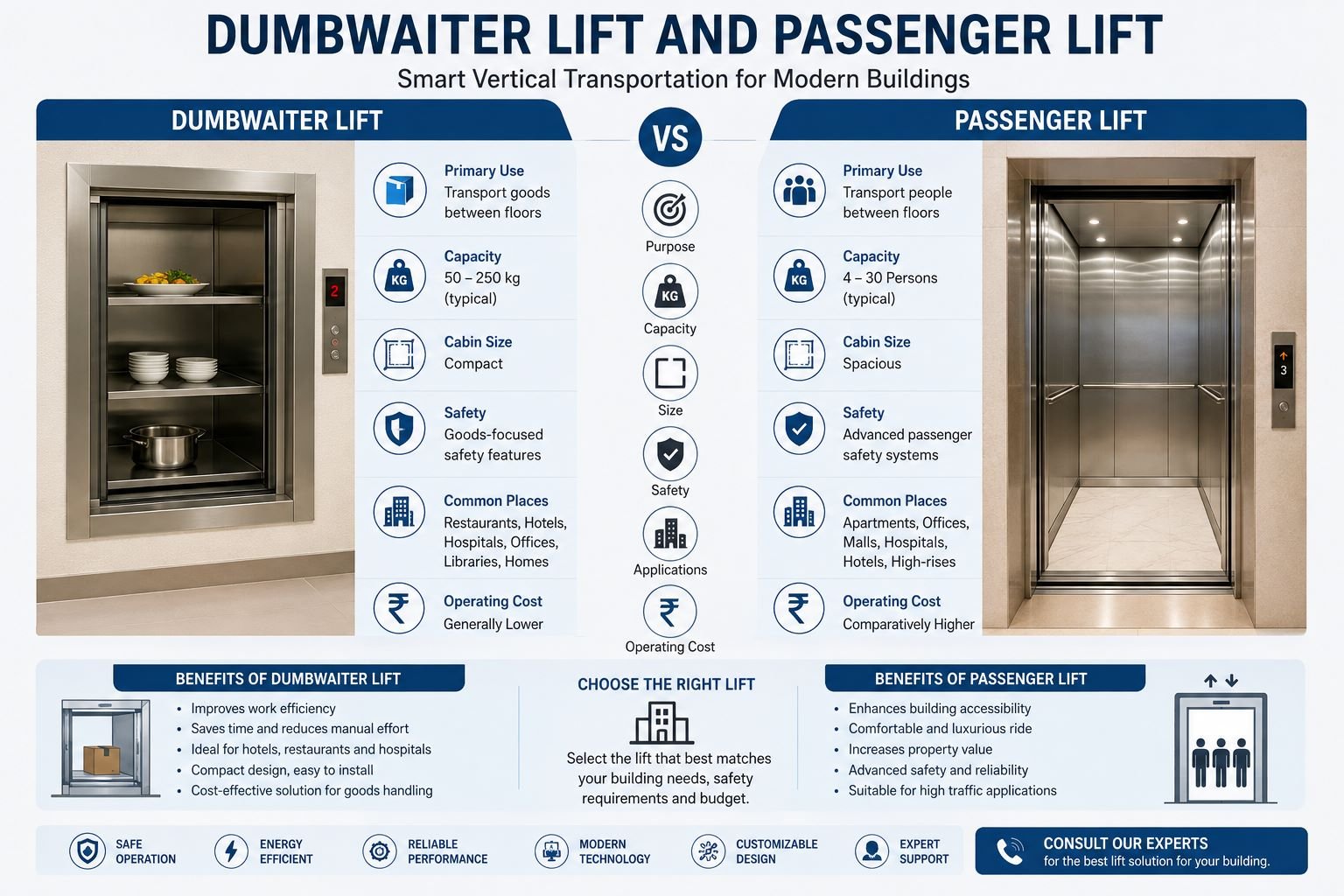
| Factor | Dumbwaiter Lift | Passenger Lift |
| Primary Role | Transport goods | Transport people |
| Typical Cabin | Compact | Passenger-sized |
| Human Travel | Not intended | Designed for passengers |
| Capacity Planning | Goods weight and size | Occupancy and traffic |
| Interior Focus | Practicality | Comfort and appearance |
| Control Type | Call-and-send | Passenger controls |
| Accessibility | Loading access | Human accessibility |
| Common Sector | Hospitality, food, services | Residential, commercial, public |
| Space Demand | Generally smaller | Generally greater |
| Safety Design | Goods-specific | Passenger-specific |
The distinction is becoming increasingly important as property owners look for systems designed precisely for their requirements.
Energy Consumption Moves Up the Priority List
Elevator buyers are also paying greater attention to what happens after installation.
Energy consumption can contribute to long-term building operating expenses, particularly when equipment receives heavy daily use.
Modern systems may improve efficiency through:
- Energy-efficient motors
- LED cabin lighting
- Automatic standby functions
- Variable-frequency drives
- Intelligent controllers
- Correct equipment sizing
A properly specified elevator avoids unnecessary capacity while still meeting expected demand.
This makes initial traffic and load analysis increasingly valuable for both performance and energy management.
Maintenance Becomes Part of the Buying Decision
Price and appearance may influence an elevator purchase, but maintenance can determine how well the equipment performs years later.
Regular preventive servicing can identify wear before it results in unexpected breakdowns.
Typical inspection areas include motors, doors, electrical connections, controllers, brakes, guide systems, switches, leveling equipment, and emergency functions.
Property owners considering either a dumbwaiter lift or passenger elevator are therefore increasingly evaluating after-sales support alongside the initial equipment specification.
Frequently Asked Questions
1. What is the primary purpose of a dumbwaiter lift?
It provides vertical transportation for suitable goods, supplies, food, documents, and other materials between floors.
2. Why are dumbwaiters popular in restaurants?
They simplify movement of food, dishes, utensils, and supplies between kitchens and dining areas on different floors.
3. Can a dumbwaiter transport a person?
No. A goods-only dumbwaiter is not designed for passenger transportation.
4. What makes a passenger lift different?
It is specifically engineered around human transportation, incorporating appropriate accessibility, controls, capacity, comfort, and safety systems.
5. What buildings commonly require passenger elevators?
Apartments, offices, hotels, hospitals, malls, educational institutions, and public buildings commonly use them.
6. Can dumbwaiter dimensions be customized?
Yes. Dimensions and configurations can be selected according to goods, available space, capacity, and loading requirements.
7. What determines passenger lift capacity?
Building population, traffic patterns, floors served, expected usage, cabin dimensions, and project requirements influence capacity.
8. Why is floor leveling important?
Accurate leveling provides convenient entry and exit by aligning the cabin correctly with the landing floor.
9. Do modern lifts offer energy-saving features?
Yes. Efficient motors, standby operation, intelligent controls, LED lighting, and modern drives can reduce unnecessary consumption.
10. Why is preventive maintenance necessary?
It helps identify developing problems, maintain performance, reduce unexpected downtime, and support long-term equipment reliability.
https://gosarkarijobs.com/how-escalator-companies-and-cargo-lifts-are-transforming-modern-buildings/
https://newsgrow.blogspot.com/2026/08/vertical-transportation-enters-new-era.html
https://bhoomijanatural.info/the-hidden-engineering-behind-moving-walkways-and-elevator-parts/
https://shopnets.com/infrastructure-growth-puts-moving-walkway-and-elevator-parts-in-focus/
https://blogstream.net/smart-mobility-systems-transform-how-modern-buildings-move-people/
https://newsgrow.blogspot.com/2026/08/new-era-of-passenger-mobility-brings.html