
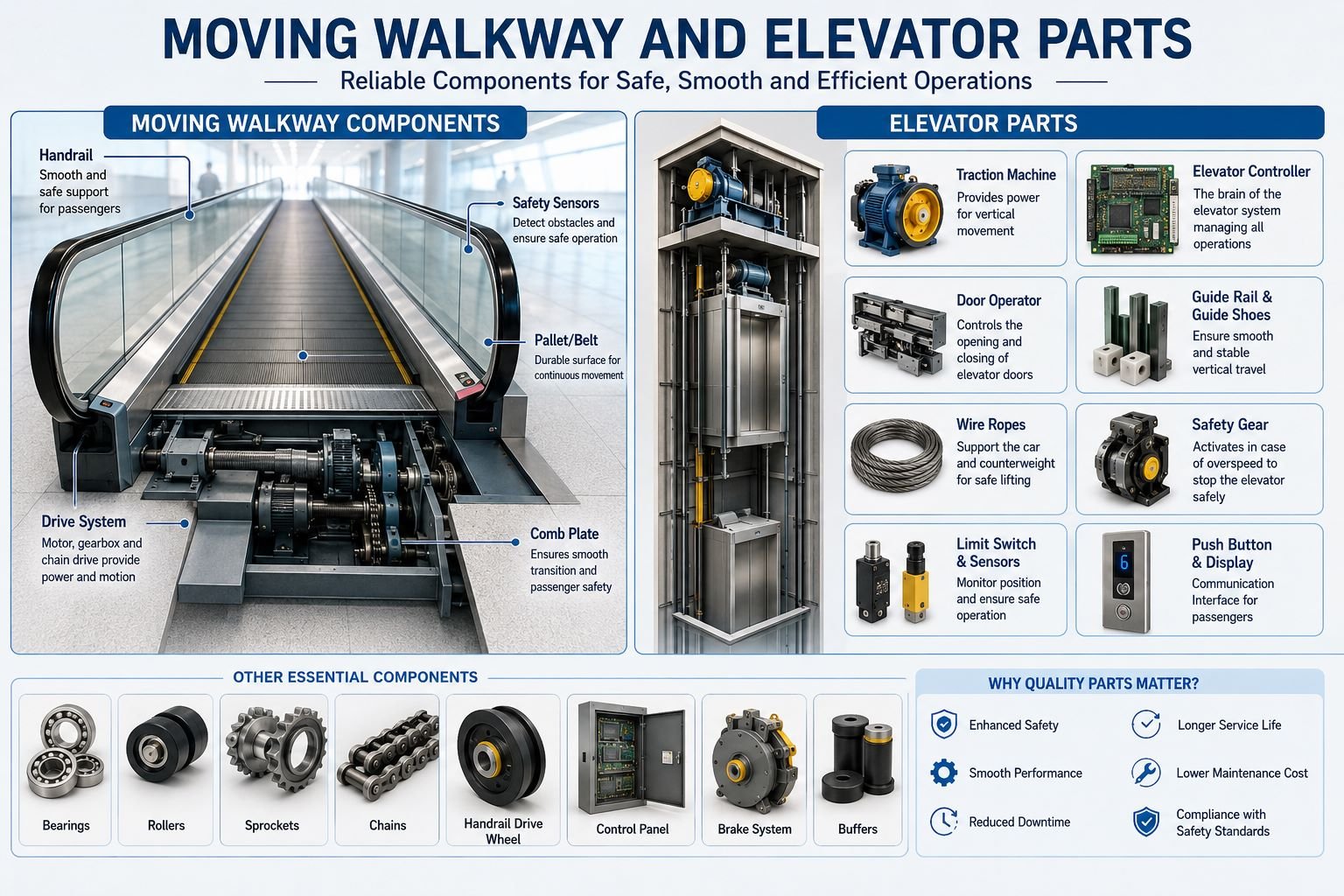
Every day, millions of people step onto a moving walkway or enter an elevator without thinking about the engineering beneath their feet. These systems have become such a normal part of airports, metro stations, shopping malls, hospitals, hotels, and office buildings that their complexity often goes unnoticed.
Behind every smooth journey is a network of motors, drives, sensors, controllers, rollers, safety mechanisms, and other specialized elevator parts. When these components are properly selected and maintained, passenger transportation feels effortless. When one begins to deteriorate, however, even a small component can affect an entire system.
This makes understanding mobility equipment increasingly valuable for building operators, maintenance contractors, engineers, and procurement professionals.
Modern Buildings Depend on Continuous Mobility
Buildings are becoming larger and passenger traffic is increasing. Airports can stretch across multiple terminals, metro stations connect different transportation networks, and commercial towers may contain dozens of floors.
Walking alone is not always practical.
A moving walkway solves the problem of horizontal distance by providing continuous transportation, while elevators solve the challenge of vertical movement.
Together, these technologies help:
- Improve passenger circulation
- Reduce walking fatigue
- Support accessibility
- Manage high-traffic environments
- Connect distant areas efficiently
- Improve the overall building experience
However, their effectiveness depends heavily on the condition of the equipment hidden behind the visible passenger interface.
What Happens When You Step Onto a Moving Walkway?
A passenger sees a flat travelling surface and handrail. An engineer sees an integrated mechanical system.
The moment a moving walkway operates, multiple components must work in synchronization.
Power Begins With the Drive System
The motor is responsible for generating mechanical power. That power is transferred through a transmission arrangement that can include gearboxes, chains, shafts, and sprockets.
The drive must maintain stable movement despite changing passenger loads.
Because these components operate repeatedly, lubrication, alignment, tension, temperature, vibration, and wear should be monitored as part of planned maintenance.
The Passenger Surface Is Continuously Circulating
Depending on equipment design, the travelling surface may consist of metal pallets or a reinforced belt.
Pallet systems circulate continuously around the equipment structure. Rollers and tracks guide their movement beneath the visible passenger area before returning them to the starting position.
Damage to rollers, tracks, pallets, or associated components can potentially create vibration, noise, or inconsistent movement.
Handrails Need Precise Coordination
Handrails are another important part of the system.
They move through their own mechanical arrangement containing rollers, guides, tensioners, and drive elements.
The handrail should move consistently in relation to the passenger surface. Significant differences in movement may indicate that inspection or adjustment is required.
Inside an Elevator: More Happens Than You Think
Now consider an elevator.
A passenger presses a button and expects the doors to open. Behind that simple action, several elevator parts begin communicating almost instantly.
The controller receives the request. Positioning equipment determines where the cabin is located. The drive system creates movement. Braking equipment manages stopping. Door components control passenger entry and exit.
Meanwhile, safety circuits continuously monitor operating conditions.
It is this coordination—not one individual component—that creates a reliable elevator journey.
Elevator Parts That Make Every Journey Possible
Elevator designs vary considerably, but several component categories are widely used across modern systems.
Controllers Coordinate the System
The controller functions as the operational management system of the elevator.
It can process floor calls, monitor cabin position, communicate with sensors, regulate movement, manage doors, and interact with safety circuits.
More advanced controllers can support fault diagnostics, group elevator management, access control integration, and building automation.
Motors and Machines Generate Movement
Traction elevators use a machine to move the elevator cabin and counterweight.
Depending on the design, this can involve geared or gearless technology.
These elevator parts must be selected according to important factors such as rated capacity, operating speed, travel distance, electrical requirements, and system configuration.
Doors Perform Thousands of Repeated Movements
Doors deserve special attention because they can operate multiple times during every elevator journey.
A typical door system may contain:
- Door operator
- Electric motor
- Rollers
- Hangers
- Tracks
- Belts
- Sensors
- Interlocks
Continuous opening and closing naturally exposes these components to wear.
For this reason, unusual door movement should not be ignored.
How Do Moving Walkways and Elevators Differ?
| Feature | Moving Walkway | Elevator |
| Travel pattern | Continuous | Individual journeys |
| Main direction | Horizontal/slight incline | Vertical |
| Passenger area | Open travelling surface | Enclosed cabin |
| Drive principle | Continuous belt/pallet movement | Traction or hydraulic lifting |
| Typical use | Airports, stations, malls | Multi-level buildings |
| Common wear areas | Chains, rollers, handrails | Doors, rollers, guides |
| Traffic handling | Continuous passenger flow | Controlled passenger groups |
Despite these differences, both systems share one requirement: components must function as an integrated system.
Why One Small Component Can Stop a Large System
Large equipment does not always fail because of large components.
Sometimes a relatively small sensor, switch, bearing, roller, contact, or interlock can cause operational problems.
Imagine a door sensor providing incorrect information. The motor and controller may be functioning correctly, but the elevator might still be prevented from operating normally.
This is why identifying compatible elevator parts is essential.
Before ordering replacements, confirm:
- Equipment manufacturer.
- Elevator or walkway model.
- Original component reference.
- Physical dimensions.
- Electrical specifications.
- Performance rating.
- Installation configuration.
- Applicable safety requirements.
A component should never be selected only because it looks similar to the original.
Preventive Maintenance Can Reveal Problems Earlier
Reactive maintenance begins after equipment develops a fault. Preventive maintenance attempts to identify deterioration beforehand.
The difference can significantly affect equipment availability.
For example, maintenance technicians may notice increasing vibration during inspection. Investigation could reveal deteriorating rollers or bearings before they cause more extensive mechanical problems.
Likewise, unusual elevator door noise could indicate roller, track, or alignment issues.
Regular inspections can therefore provide valuable early warning signs.
Maintenance Records Tell an Important Story
Good maintenance involves more than replacing components.
Every inspection can generate useful information about equipment condition.
Maintenance teams should document:
- Fault codes
- Component replacements
- Repeated problems
- Abnormal sounds
- Vibration observations
- Lubrication work
- Adjustments
- Safety tests
Over time, these records create a history of equipment behaviour.
If the same elevator parts repeatedly require attention, technicians can investigate the underlying cause rather than continually replacing the affected component.
Predictive Maintenance Is Changing the Industry
The next stage of mobility maintenance is increasingly data-driven.
Modern elevators and walkway systems can use sensors to monitor operating conditions continuously.
Data may include motor temperature, vibration, travel cycles, door operations, energy consumption, equipment speed, operating hours, and recorded faults.
Software can then help identify unusual trends.
Instead of asking, “Has the component failed?” maintenance teams can increasingly ask, “Is its performance beginning to change?”
That distinction represents an important shift toward predictive maintenance.
Efficiency Matters as Much as Reliability
Energy consumption is another reason mobility systems are evolving.
Modern moving walkway installations can incorporate variable-frequency drives and passenger detection. Depending on equipment configuration, the system may reduce operating speed during low-demand periods.
Elevators can also use intelligent dispatching, efficient motors, regenerative drives, LED lighting, and standby functions.
The objective is to provide passenger transportation without consuming unnecessary energy when demand is low.
Frequently Asked Questions
1. What is a moving walkway designed to do?
A moving walkway continuously transports passengers across horizontal or slightly inclined distances within large facilities.
2. Are moving walkways only used at airports?
No. They are also installed in railway stations, malls, metro systems, convention centres, and other large facilities.
3. What components drive a moving walkway?
Typical drive components include an electric motor, gearbox, chains, sprockets, shafts, and associated transmission equipment.
4. What are the main elevator parts?
Common elevator parts include controllers, motors, doors, brakes, guide rails, sensors, suspension equipment, switches, and safety devices.
5. Which elevator components experience frequent wear?
Door rollers, tracks, belts, guides, switches, and other repeatedly operated components can experience significant wear.
6. Why is elevator component compatibility important?
Correct compatibility helps ensure the component meets required dimensional, electrical, operational, and safety specifications.
7. What can cause moving walkway noise?
Worn rollers, bearings, chains, incorrect alignment, lubrication issues, or drive components can contribute to abnormal noise.
8. What is preventive elevator maintenance?
It involves scheduled inspection and servicing intended to identify wear or developing problems before significant equipment failure.
9. How does predictive maintenance differ?
Predictive maintenance uses equipment condition and operating data to help determine when inspection or intervention may be required.
10. Can older mobility systems be modernized?
Many systems can be upgraded with newer controls, drives, sensors, displays, or other components after professional technical evaluation.
https://gosarkarijobs.com/how-escalator-companies-and-cargo-lifts-are-transforming-modern-buildings/
https://newsgrow.blogspot.com/2026/08/vertical-transportation-enters-new-era.html