
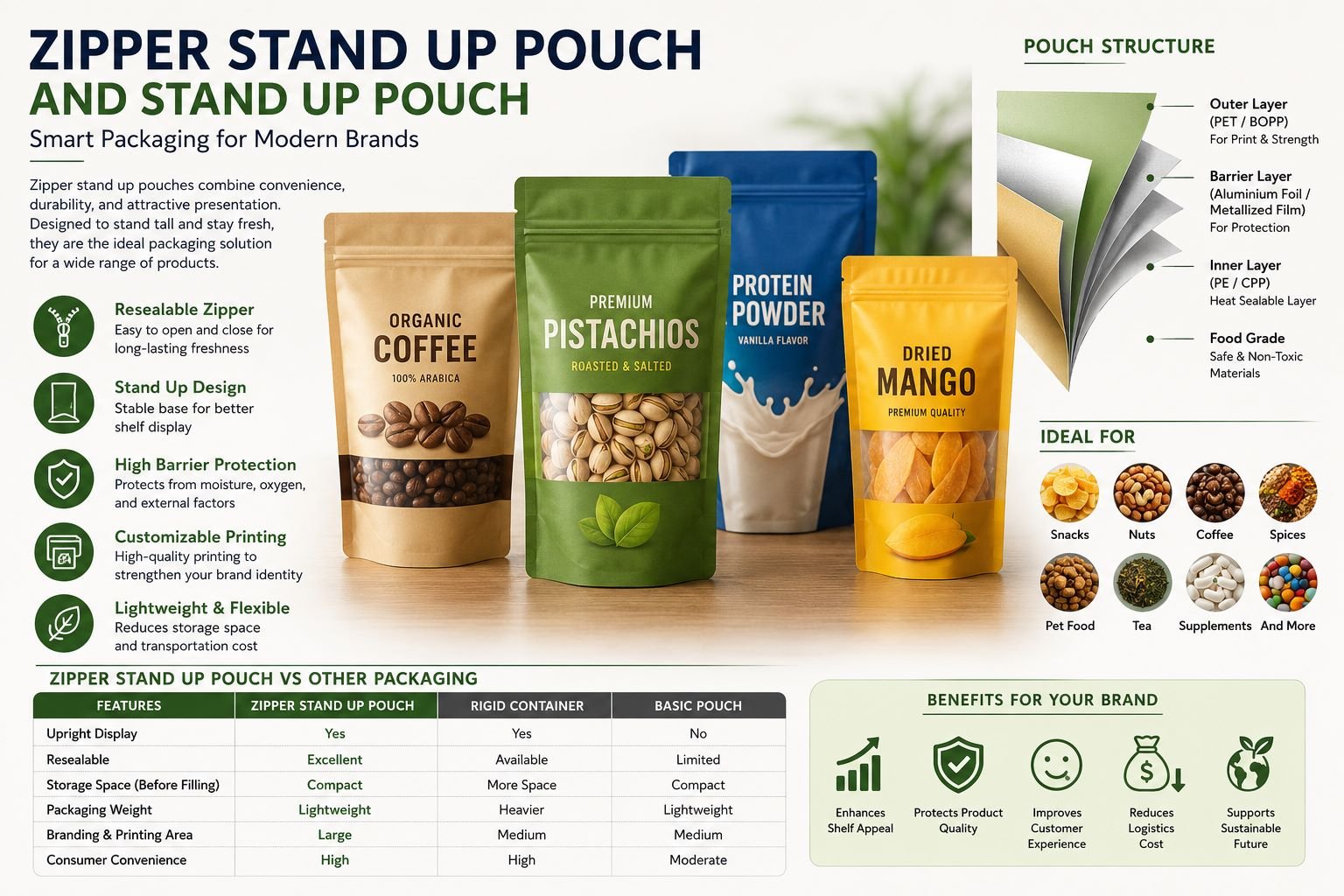
Packaging plays a much bigger role in modern business than simply holding a product. It influences product protection, storage, transportation, shelf visibility and the way customers interact with a brand. Among the flexible packaging formats attracting attention across different industries, the zipper stand up pouch and Stand Up Pouch offer a useful combination of functionality and presentation.
From coffee and dried fruit to pet food, spices, supplements and household products, stand-up packaging can be adapted to many applications. However, choosing an effective pouch involves understanding its structure, materials, barrier requirements and closure options.
This article explores how stand-up pouches work, where they are commonly used and what businesses should consider before selecting them.
What Is a Stand Up Pouch?
A Stand Up Pouch is a flexible package constructed with a bottom gusset that expands when the pouch is filled. This expanded section creates a base, allowing the package to stand upright when correctly designed for the product inside.
The format combines some of the benefits of flexible packaging with the shelf presence normally associated with rigid containers.
A typical pouch may consist of several functional areas:
- Front panel for branding
- Back panel for product information
- Bottom gusset for stability
- Top section for heat sealing
- Optional zipper or closure
- Tear notch for easier opening
The exact design depends on what the pouch needs to contain.
How Does a Zipper Stand Up Pouch Work?
A zipper stand up pouch adds a resealable closure to the basic stand-up design.
During packing, the product is placed inside the pouch and the upper section is normally heat-sealed. Consumers open the initial seal to access the zipper below it. Once opened, the zipper can be pressed together again after each use.
This is particularly valuable when a product is intended to be consumed gradually rather than all at once.
For example, someone purchasing 750 grams of nuts may open the package many times. A resealable zipper eliminates the need to transfer the remaining contents into another storage container.
The same convenience applies to coffee, tea, dried fruits, cereal, spices and pet treats.
Difference Between a Zipper Stand Up Pouch and Stand Up Pouch
Both packaging formats share the same basic upright structure, but their closure systems can differ.
| Feature | Zipper Stand Up Pouch | Stand Up Pouch |
| Bottom gusset | Yes | Yes |
| Upright display | Yes | Yes |
| Resealable | Yes | Optional |
| Heat sealing | Common | Common |
| Repeat-use convenience | High | Depends on closure |
| Custom printing | Available | Available |
| Transparent window | Optional | Optional |
| Tear notch | Common | Optional |
| Suitable for liquids | Design dependent | Design dependent |
| Branding space | Excellent | Excellent |
A zipper version is therefore a particular type of stand-up pouch rather than an entirely separate packaging category.
Why Are Stand-Up Pouches Used Across So Many Industries?
Versatility is one of the main reasons behind the adoption of the Stand Up Pouch.
The same basic format can be manufactured in different dimensions, material structures and finishes. This allows businesses to develop packaging around their products instead of adapting the product to a standard container.
Another advantage is presentation. Because the pouch remains upright, the front panel provides a prominent area for product branding.
Manufacturers can use this space for:
- Brand logos
- Product names
- Product photography
- Key selling information
- Net quantity
- Instructions
- Ingredients
- Nutritional information
- Regulatory information
This combination of functionality and branding makes stand-up packaging particularly relevant to consumer-facing products.
Materials Used to Manufacture Stand-Up Pouches
A pouch may appear to be made from a single sheet, but many flexible packages use carefully selected film structures.
Common materials include PET, PE, BOPP, CPP, nylon, aluminium foil and metallised films.
Different layers can perform different functions.
For instance, an outer film may provide printability and mechanical strength, while another layer offers barrier protection. The inner layer may be selected for sealing performance and product-contact suitability.
The correct combination depends on factors such as product sensitivity, storage environment and required shelf life.
Why Barrier Properties Matter
A good-looking zipper stand up pouch will provide little value if its material structure cannot adequately protect the product.
Environmental factors that may need to be controlled include:
- Moisture
- Oxygen
- Light
- External odours
- Aroma loss
- Contamination
Consider a dry powdered product. If excessive environmental moisture enters the package, its quality or handling characteristics may be affected.
Coffee has different requirements. Oxygen exposure, aroma retention and gas release can influence packaging selection, and certain coffee applications may benefit from a degassing valve.
Understanding the product is therefore the first step towards selecting the appropriate pouch material.
Advantages of a Zipper Stand Up Pouch
The resealable format provides several practical advantages when used for suitable applications.
Convenient Reclosing
Consumers can close the package after removing only the amount they need.
Strong Shelf Presence
An upright package provides a clear front-facing branding surface.
Flexible Size Options
Manufacturers can produce pouches in numerous dimensions for small and larger product quantities.
Custom Branding
The pouch surface supports detailed artwork, instructions and product communication.
Compact Unfilled Storage
Empty flexible pouches generally require less storage volume than many equivalent rigid packages.
Consumer-Friendly Design
Tear notches, windows and other features can make the package easier to identify and use.
Common Applications of a Stand Up Pouch
The format is used across numerous product categories.
Food Products
Stand-up packaging is commonly considered for snacks, cereals, rice, pulses, confectionery and dried foods.
Coffee and Tea
A zipper stand up pouch can provide convenient resealing for coffee beans, ground coffee and loose-leaf tea.
Nuts and Dried Fruits
These products are frequently consumed over multiple occasions, making a zipper particularly useful.
Spices and Seasonings
Resealable packaging can make frequent kitchen use more convenient.
Health and Nutrition Products
Protein powders and selected nutritional powders can use suitable high-barrier flexible packaging.
Pet Food and Treats
Larger resealable packages can help owners repeatedly access dry food or treats.
Household Products
Specially designed pouches can also package powders, concentrates and refill products.
Customisation Options for Modern Pouches
A Stand Up Pouch does not have to follow one standard appearance.
Manufacturers may offer features such as:
- Press-to-close zipper
- Tear notch
- Transparent window
- Matte finish
- Gloss finish
- Metallic finish
- Rounded corners
- Hang hole
- Spout
- Degassing valve
- Laser scoring
- Custom dimensions
- Custom printed graphics
The important point is to choose features for a reason.
A transparent window may help customers evaluate a visually attractive food product, whereas light-sensitive contents may require an opaque structure instead.
Similarly, a zipper provides value for repeated-use products but may add little benefit to a single-serving pack.
How to Select the Right Stand Up Pouch
Selecting the right packaging requires a systematic approach.
Start with the product itself.
Identify Product Characteristics
Determine whether the contents are solid, granular, powdered, oily, liquid or semi-liquid.
Determine Barrier Requirements
Understand whether moisture, oxygen or light could affect product quality.
Calculate Volume, Not Just Weight
Two products of the same weight can occupy very different amounts of space.
Consider Customer Usage
If the product will be opened repeatedly, a zipper stand up pouch may provide additional convenience.
Review Filling Requirements
Confirm whether the pouch will be manually or automatically filled and whether it works with the available equipment.
Conduct Sample Testing
Test the actual product in sample pouches before approving bulk production.
Importance of Correct Pouch Dimensions
One of the most common packaging mistakes is selecting dimensions based only on weight.
Imagine two 500-gram products: one consists of lightweight cereal and another consists of dense granules. They will not occupy the same volume.
Important sizing considerations include:
- Bulk density
- Filling quantity
- Product volume
- Required headspace
- Gusset depth
- Zipper position
- Heat-sealing area
- Filling equipment
A physical filling trial can provide more reliable information than assumptions based purely on weight.
Printing and Design for Better Shelf Visibility
The front of a Stand Up Pouch should communicate quickly.
Rather than filling every centimetre with text, brands should create a clear information hierarchy.
The most prominent elements normally include the brand name, product name, variant and important differentiating information.
Secondary information can be placed on the back panel.
Printing technologies can include digital printing, flexographic printing and rotogravure printing. The appropriate option depends on order quantity, artwork requirements, budget and production specifications.
Quality Checks Before Bulk Production
Packaging should be tested before a large commercial order is approved.
Important evaluations may include:
- Seal-strength testing
- Zipper opening and closing
- Leakage testing
- Drop testing
- Puncture resistance
- Print inspection
- Dimensional accuracy
- Filling trials
- Transportation simulation
- Storage evaluation
For products requiring extended shelf life, suitable barrier and shelf-life testing should also be considered.
Sustainability in Flexible Packaging
Sustainability has become an important consideration in packaging development.
Traditional multilayer structures can combine different films to deliver high barrier and sealing performance. However, mixed-material structures may present recycling challenges depending on local infrastructure.
This has encouraged the development of mono-material flexible packaging for suitable applications.
Sustainability should nevertheless be considered alongside product protection. Reducing packaging performance to save material can be counterproductive if it increases product damage or waste.
The goal should be to find an appropriate balance between material efficiency, performance, transportation and end-of-life considerations.
Frequently Asked Questions
What is a zipper stand up pouch?
It is a flexible stand-up package equipped with a resealable zipper that allows consumers to repeatedly open and close the pouch.
What is a Stand Up Pouch?
It is flexible packaging with an expandable bottom gusset designed to help the filled pouch remain upright.
Are all stand-up pouches supplied with zippers?
No. A zipper is optional. Some formats use only heat seals, while others incorporate spouts, caps or different closures.
What products can use zipper pouches?
Coffee, tea, nuts, dried fruits, spices, snacks, cereals, powders and pet treats are common applications.
Can a stand-up pouch hold liquids?
Yes, provided its material structure, seals and closure system are specifically designed for the liquid.
What is the purpose of a bottom gusset?
The gusset expands when filled and forms the base that helps support the pouch.
Can a zipper pouch have a transparent window?
Yes. Windows can be incorporated when they are compatible with the product’s barrier requirements.
How do I select pouch size?
Consider product volume, bulk density, filling quantity, headspace, gusset dimensions and sealing requirements.
Is a thicker pouch always stronger?
Not necessarily. Performance depends on material composition, laminate structure, sealing quality and application requirements.
Can stand-up pouches be custom printed?
Yes. Brands can customise artwork, colours, product information and other design elements.
Are stand-up pouches suitable for e-commerce?
They can be, but packaging should be tested for the handling and transportation conditions expected in the distribution process.
Should samples be tested before ordering?
Yes. Samples help verify size, sealing, zipper performance, filling compatibility and overall product suitability.
Read more – https://newsgrow.blogspot.com/2026/08/foil-lid-and-stand-up-pouch.html
https://newsgrow.blogspot.com/2026/08/spout-pouch-and-stand-up-pouch-with.html
https://newsgrow.blogspot.com/2026/08/stand-up-pouch-filling-machines.html
https://newsgrow.blogspot.com/2026/08/why-zipper-stand-up-pouch-packaging-is.html
https://blogstream.net/standing-pouch-and-lidding-film-a-deep-guide-to-modern-flexible-packaging/
https://gosarkarijobs.com/how-standing-pouch-and-lidding-film-are-changing-modern-product-packaging/
https://newsgrow.blogspot.com/2026/08/shrink-sleeve-and-stand-up-pouch.html