
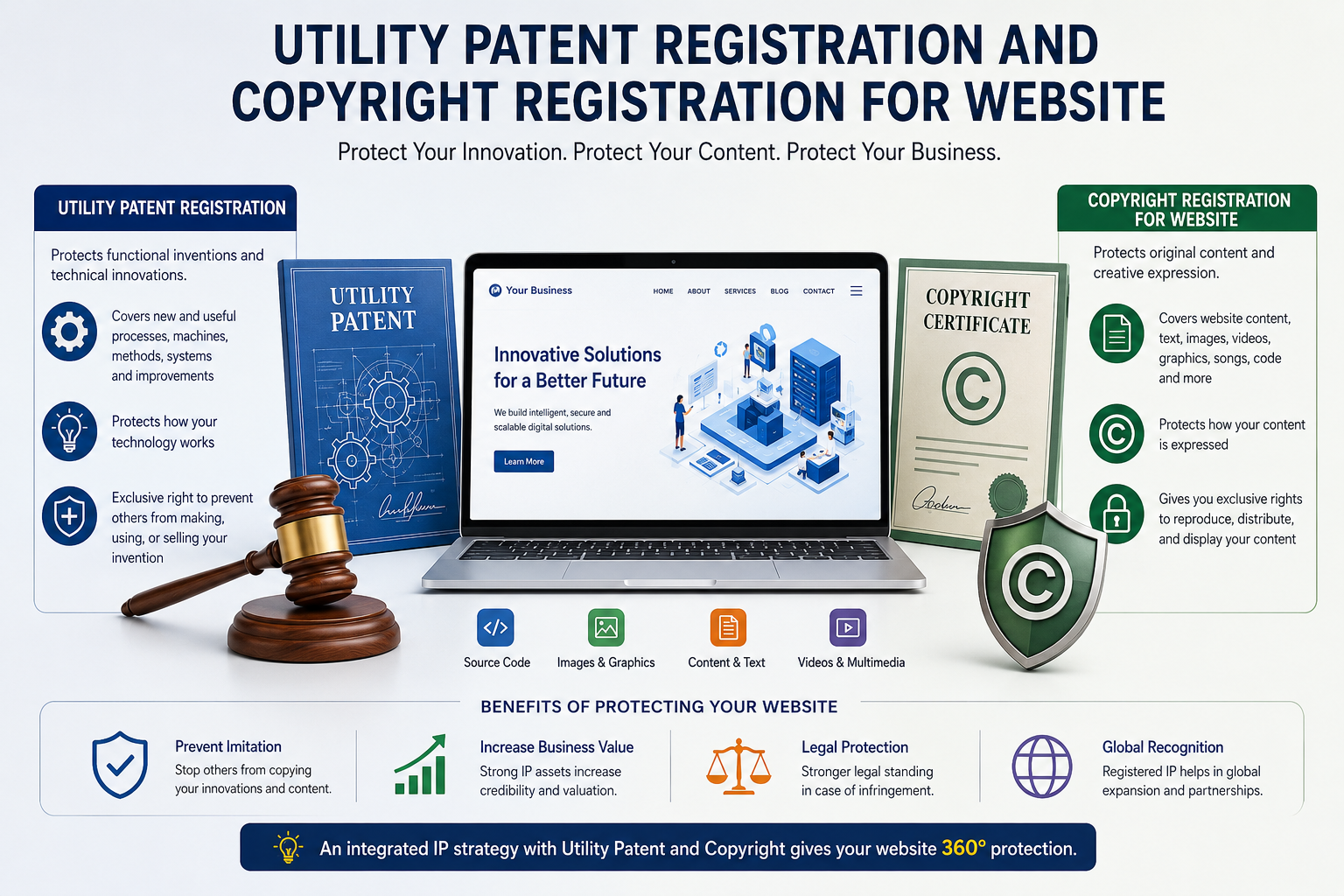
Digital businesses often rely on two very different types of intellectual property: innovative technology and original creative content. Utility Patent Registration can protect qualifying functional inventions, while Copyright Registration for Website can help protect original website materials such as text, graphics, photographs, videos, and certain software-related content.
Understanding the distinction is essential because copyright cannot substitute for patent protection, and a patent does not automatically protect website copy or artwork. In the United States, a utility patent may cover a new and useful process, machine, manufacture, composition of matter, or qualifying improvement.
What Is Utility Patent Registration?
Utility Patent Registration refers to the process of seeking patent protection for the functional aspects of an invention. Although people commonly use the term “registration,” U.S. utility patents are granted only after an application is filed and examined by the United States Patent and Trademark Office (USPTO).
A utility patent may potentially protect technological innovations such as software-related processes, mechanical systems, manufacturing methods, electronic devices, industrial equipment, or improvements to existing technology.
For an invention to qualify, it generally must be useful, adequately described, novel and non-obvious. Mere ideas and abstract concepts are not, by themselves, patentable inventions.
For example, creating an ordinary e-commerce website would not automatically justify a utility patent. However, developing a genuinely new technical process for secure transactions, data processing or another patent-eligible technological function could potentially warrant patent analysis.
Key Requirements for a Utility Patent
Before investing in Utility Patent Registration, inventors should evaluate whether the invention meets fundamental patentability requirements.
A practical patent preparation process usually involves:
- Clearly identifying the invention and its technical purpose.
- Reviewing similar inventions and relevant prior art.
- Determining what features appear novel.
- Documenting how the invention works.
- Preparing drawings where necessary.
- Drafting the specification and patent claims.
- Filing the application with the appropriate patent authority.
Claims are particularly important because they define the scope of protection sought. The USPTO explains that the claims in a non-provisional application identify the subject matter regarded as the invention and help determine the protection provided by the patent.
Poorly drafted claims may result in unnecessarily narrow protection or objections during examination, which is why professional patent drafting can be valuable for commercially important inventions.
What Is Copyright Registration for Website?
Copyright Registration for Website concerns original expression appearing on or associated with a website rather than the site’s underlying functional idea.
The U.S. Copyright Office explains that websites may contain copyrightable materials, including text, artwork, photographs, music and videos. A website itself is not automatically treated as one copyrightable work, although particular website content or qualifying compilations may be registrable.
Potentially protectable website materials can include original:
- Articles and landing-page copy
- Product descriptions
- Illustrations and graphics
- Photographs
- Videos and animations
- Blog posts
- Certain software or computer-program content
- Original compilations of eligible material
The Copyright Office specifically provides registration resources for digital content including computer programs, databases, blogs and websites.
Why Copyright Registration for Website Matters
Businesses spend significant resources producing online content. Without an effective intellectual-property strategy, competitors or unauthorised parties may copy valuable creative materials.
Copyright Registration for Website can create an official registration record and may provide important legal advantages, depending on the jurisdiction and timing of registration.
In the United States, copyright registration generally involves submitting an application, the applicable fee and a non-returnable deposit copy or copies of the work. Online applications can be submitted through the Copyright Office’s electronic registration system.
Registration should therefore be considered part of a broader website-IP strategy rather than merely an administrative formality.
Utility Patent Registration vs Copyright Registration for Website
| Factor | Utility Patent Registration | Copyright Registration for Website |
| Main purpose | Protect functional inventions | Protect original expression |
| Typical subject matter | Processes, machines, technology and functional improvements | Text, graphics, photos, videos and eligible digital content |
| Protects an idea alone? | No | No |
| Examination | Substantive patent examination generally applies | Different copyright registration review process |
| Best suited for | Technical innovation | Creative website assets |
| Rights involved | Excluding others from specified exploitation of patented invention | Rights relating to protected creative expression |
The most important distinction is functionality versus expression. An innovative technical system may raise patent issues, whereas the original written and visual materials used to explain that system normally raise copyright issues.
Can a Website Need Both Forms of Protection?
Yes. A technology company may potentially require both Utility Patent Registration and Copyright Registration for Website.
Consider an online platform that contains a newly developed patent-eligible technical process. Patent protection may potentially cover aspects of how that qualifying invention functions. Meanwhile, copyright may protect original articles, illustrations, videos and eligible software expression appearing on the platform.
Other IP rights may also matter. A company name or logo, for example, can raise trademark issues rather than patent or copyright issues.
Effective IP protection therefore starts by identifying each asset and matching it with the appropriate legal mechanism.
Common Mistakes Businesses Should Avoid
One common mistake is assuming copyright protects the functionality or business concept behind a website. Another is believing a patent application protects everything displayed on the website.
Businesses should also avoid publicly disclosing potentially patentable inventions without first considering how disclosure could affect patent rights, particularly when protection may be required in multiple countries.
Other risks include inaccurate ownership records, using third-party images without appropriate rights, failing to document contractor assignments and waiting until a dispute arises before organising an IP portfolio.
Because patent and copyright laws vary internationally, businesses operating across jurisdictions should obtain advice appropriate to each target market.
Benefits of an Integrated IP Strategy
Combining Utility Patent Registration with Copyright Registration for Website, where appropriate, can create broader protection around a digital business.
Patent rights may address eligible technological functionality, while copyright addresses original creative expression. Trademark protection may further safeguard branding, and trade-secret measures can protect qualifying confidential business information.
The goal should not be to register every possible asset blindly. Instead, businesses should identify commercially valuable intellectual property, understand ownership and prioritise protection according to risk, competitive importance and budget.
Frequently Asked Questions
1. What does Utility Patent Registration protect?
It can protect qualifying new and useful processes, machines, manufactured articles, compositions of matter and improvements that satisfy applicable patent requirements.
2. Can software receive a utility patent?
Certain software-related inventions may be patent eligible, but eligibility depends on the claimed invention and applicable patent law. An abstract idea alone is not patentable.
3. Can I patent my website design?
Utility patents focus on functionality. Other rights, including copyright or potentially design-related protection, may be more relevant depending on what you want to protect.
4. What does Copyright Registration for Website protect?
It may cover eligible original content such as website text, artwork, photographs, videos and certain digital works.
5. Does copyright protect my website idea?
Generally, copyright protects original expression rather than ideas, systems, concepts or methods themselves.
6. Can I copyright my website automatically?
Copyright may arise automatically when qualifying original expression is created and fixed, but formal registration can provide additional legal benefits in jurisdictions such as the United States.
7. Can one business use patents and copyright together?
Yes. Different IP rights can protect different elements of the same business or product.
8. Should I conduct a patent search before filing?
A prior-art search can help identify similar inventions and assess potential patentability before significant filing expenses are incurred.
9. Can website photographs be registered for copyright?
Original photographs may qualify for copyright protection, subject to ownership and registration requirements.
10. Does registering a domain name give copyright protection?
No. Domain registration and copyright protection are separate legal matters.