
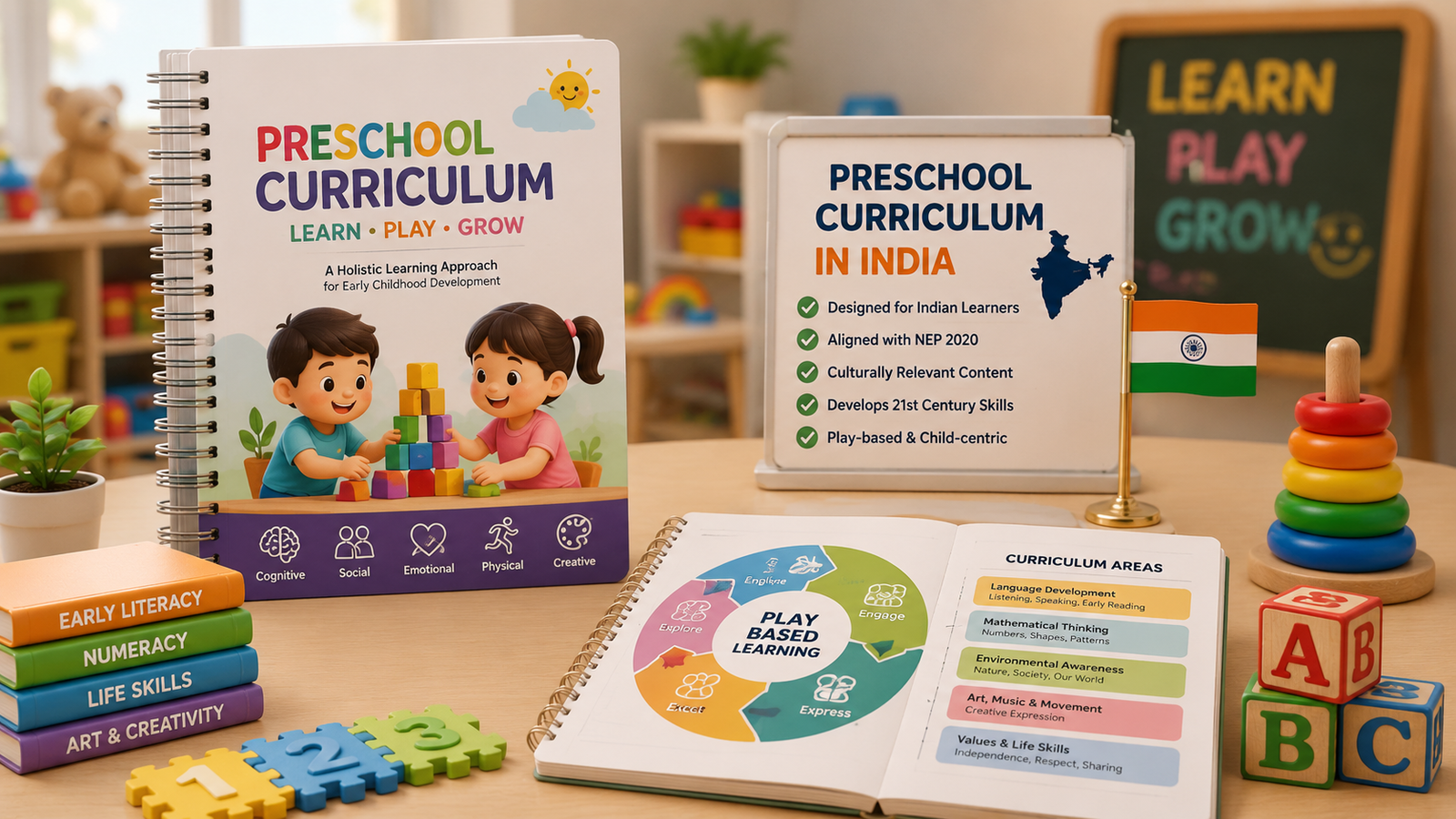
A thoughtfully designed preschool curriculum therefore goes far beyond teaching alphabets, numbers, colours, and shapes. It creates meaningful experiences that encourage curiosity, independence, creativity, confidence, and emotional development.
A modern preschool curriculum in India increasingly focuses on learning through play, activities, storytelling, movement, conversation, exploration, and hands-on experiences. Instead of pushing children into formal academics too early, quality preschool education gives them opportunities to discover concepts naturally.
For parents and educators, understanding how a preschool programme works can make it easier to select an environment where children enjoy learning while developing essential life skills.
What Is a Preschool Curriculum?
A preschool curriculum is a structured learning framework designed for children before they enter primary school. It defines the activities, concepts, experiences, teaching methods, and developmental goals that guide everyday learning.
A balanced curriculum usually addresses several areas:
- Language and communication
- Early literacy
- Pre-mathematical concepts
- Physical and motor development
- Social interaction
- Emotional development
- Creativity and imagination
- Environmental awareness
- Cognitive development
- Self-help and independence skills
The objective is not simply to make children academically advanced. It is to prepare them physically, emotionally, socially, and intellectually for future learning.
Learning Through Everyday Experiences
Young children understand concepts better when they experience them rather than memorise them.
For example, instead of simply telling children that an apple is red and round, teachers may allow them to observe, touch, smell, count, draw, and discuss apples. One activity can therefore support vocabulary, mathematics, sensory development, creativity, and communication.
Why Activity-Based Learning Matters
Activity-based learning encourages children to participate rather than remain passive listeners. Puzzles, building blocks, music, role-play, crafts, storytelling, outdoor games, and experiments help transform abstract ideas into experiences children can understand.
Key Elements of a Good Preschool Curriculum in India
An effective preschool curriculum in India should recognise that every child develops differently. The programme should provide guidance without creating unnecessary pressure.
Important curriculum components include:
- Language development: Stories, conversations, rhymes, picture reading, phonics exposure, and vocabulary activities.
- Numeracy readiness: Counting, sorting, matching, patterns, comparisons, shapes, and basic number recognition.
- Physical development: Running, balancing, jumping, drawing, threading, folding, and clay activities.
- Social development: Sharing, cooperating, taking turns, participating in groups, and respecting others.
- Creative development: Painting, music, dance, pretend play, craft, and imaginative storytelling.
- Environmental awareness: Plants, animals, seasons, family, neighbourhood, community helpers, and nature.
- Life skills: Cleaning up, organising belongings, eating independently, following routines, and making simple decisions.
Preschool Curriculum and Traditional Academic Learning
| Area | Modern Preschool Curriculum | Traditional Academic Approach |
| Learning style | Play and exploration | Instruction and repetition |
| Child participation | Highly interactive | Often teacher-led |
| Academic pressure | Age-appropriate | Can be higher |
| Creativity | Strongly encouraged | May receive less emphasis |
| Assessment | Observation-based | Worksheets or tests |
| Social skills | Integrated into activities | Limited focus |
| Learning environment | Flexible and engaging | More structured |
A developmentally appropriate approach generally gives children more opportunities to understand ideas through exploration rather than simply remember answers.
Importance of Play in Preschool Education
Play is one of the most powerful learning tools in early childhood.
When children build a tower with blocks, they are exploring balance, size, planning, spatial relationships, and problem-solving. When they participate in pretend shopping, they practise communication, counting, decision-making, and social interaction.
Play-based activities can include:
- Building blocks
- Role-playing
- Sand and water activities
- Puzzles
- Outdoor exploration
- Puppet shows
- Music and movement
- Drawing and painting
- Matching games
- Storytelling
A strong preschool curriculum combines guided activities with opportunities for children to explore independently.
Developing School Readiness Without Pressure
School readiness does not mean teaching primary-school textbooks during preschool.
Children are better prepared for formal education when they can listen, communicate, follow simple instructions, manage basic routines, interact with classmates, concentrate for appropriate periods, and express their needs.
A quality preschool curriculum in India develops these abilities gradually.
Teachers may introduce letters and numbers, but learning should remain engaging. Children can discover letters through stories, sounds, pictures, tracing activities, and games instead of repetitive writing exercises.
Role of Teachers in Early Childhood Learning
Even an excellent curriculum requires skilled implementation.
Preschool teachers observe how individual children learn and adjust activities accordingly. One child may understand a concept through pictures, while another responds better to movement or physical objects.
Teachers also create a safe atmosphere where children feel comfortable asking questions and making mistakes.
An effective preschool educator acts as:
- A facilitator
- A storyteller
- An observer
- A guide
- A motivator
- A positive role model
Teacher-child interaction is therefore just as important as curriculum content.
Role of Parents in Supporting the Preschool Curriculum
Learning does not stop when children leave the classroom.
Parents can reinforce preschool learning without turning home into another school. Everyday conversations and activities provide valuable learning opportunities.
Parents can:
- Read stories together.
- Encourage children to describe their day.
- Count household objects.
- Allow supervised independent tasks.
- Draw and colour together.
- Visit parks and discuss nature.
- Sing rhymes and songs.
- Encourage questions instead of immediately giving answers.
Consistency between home and preschool helps children develop confidence and positive learning habits.
How to Choose the Right Preschool Curriculum in India
Parents should look beyond colourful classrooms and attractive advertisements.
Consider whether the programme:
- Provides age-appropriate activities
- Balances structured and free play
- Encourages questioning and exploration
- Supports social-emotional development
- Includes outdoor and physical activities
- Avoids excessive worksheets
- Gives children opportunities for creativity
- Maintains healthy teacher-child interaction
- Communicates children’s progress with parents
- Respects different learning speeds
The best curriculum is one that helps children look forward to attending preschool.
Frequently Asked Questions
1. What is the main purpose of a preschool curriculum?
Its purpose is to support children’s overall development and prepare them socially, emotionally, physically, and cognitively for future education.
2. What should a preschool curriculum include?
It should include language, numeracy readiness, physical activities, creativity, social development, emotional learning, environmental awareness, and life skills.
3. Which preschool curriculum is best in India?
There is no single programme suitable for every child. A balanced, developmentally appropriate, play-based programme is generally preferable to one focused mainly on academic worksheets.
4. Is reading taught in preschool?
Early reading readiness may be introduced through phonics, storytelling, picture books, sounds, rhymes, and letter recognition.
5. Should preschool children receive homework?
Heavy homework is usually unnecessary. Simple activities such as reading with parents, drawing, observation, or conversational exercises are more suitable.
6. Why is play important in preschool?
Play develops problem-solving, creativity, language, motor skills, cooperation, imagination, and emotional confidence simultaneously.
7. How are children assessed in preschool?
Good programmes often use observation, portfolios, classroom participation, activities, and developmental milestones rather than formal examinations.
8. Does preschool help improve communication skills?
Yes. Conversations, storytelling, rhymes, group activities, pretend play, and teacher interaction provide regular opportunities for language development.
9. What is school readiness?
School readiness includes communication, independence, concentration, emotional regulation, social interaction, basic literacy and numeracy awareness, and the ability to follow routines.
10. How can parents support preschool education at home?
Parents can read stories, discuss daily experiences, encourage creativity, explore nature, practise counting naturally, and involve children in simple household responsibilities.