
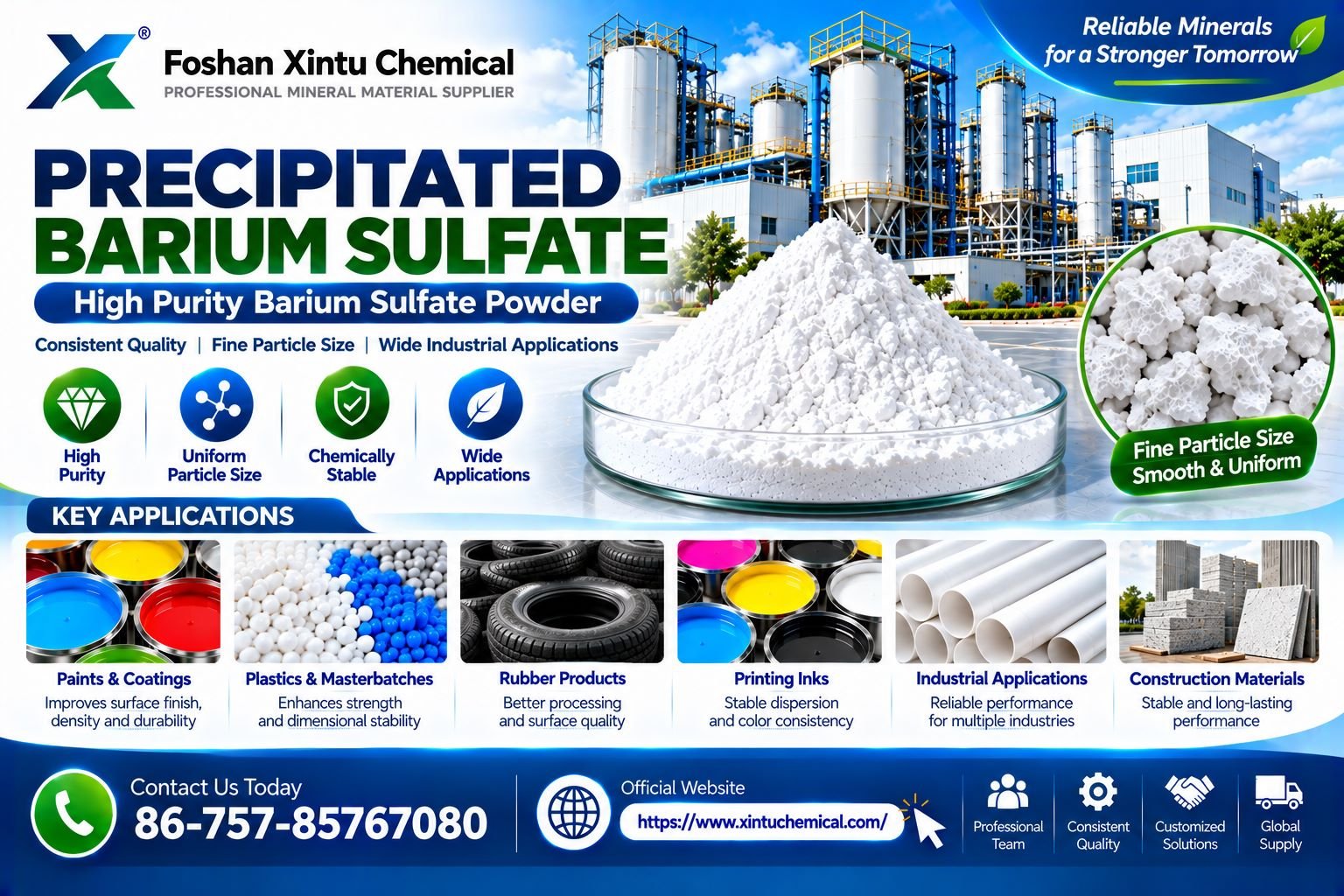
Consistency, processing efficiency, and material performance remain essential considerations for manufacturers working with industrial coatings, engineered plastics, printing inks, and specialty rubber products.
Among the inorganic materials used in these industries, Precipitated Barium Sulfate offers controlled particle characteristics and chemical stability, making it suitable for various specialized formulations.
At the same time, Barium Sulfate Powder continues to serve as a functional filler for manufacturers seeking specific density, surface properties, and processing characteristics.
Although the two terms are closely related, differences in manufacturing methods and particle specifications can significantly influence their performance.
For industrial buyers, selecting the appropriate grade requires understanding more than basic chemical composition.
What Makes Precipitated Barium Sulfate Different?
Precipitated Barium Sulfate is a synthetically manufactured inorganic compound with the chemical formula BaSO₄.
It is produced through controlled chemical precipitation, during which dissolved barium and sulfate sources react to form solid barium sulfate particles.
Subsequent processing may include washing, drying, particle classification, and surface treatment.
The manufacturing process allows producers to control selected material characteristics, depending on their equipment and production requirements.
Important properties include:
- Low solubility in water.
- Good chemical stability under suitable conditions.
- Relatively high density.
- Controlled particle size distribution.
- High whiteness in selected grades.
- Compatibility with appropriate industrial formulations.
- Consistent characteristics when manufacturing processes are properly controlled.
Understanding Barium Sulfate Powder and Its Commercial Grades
Barium Sulfate Powder refers to powdered barium sulfate available in different grades for industrial use.
It generally comes from two principal sources.
Natural Barium Sulfate: Produced by extracting and processing barite minerals through grinding, classification, and purification where necessary.
Synthetic Barium Sulfate: Manufactured through chemical precipitation to achieve specified physical and chemical properties.
Both materials contain barium sulfate, but particle morphology, impurity levels, and dispersion behavior may differ.
Manufacturers should evaluate available grades according to actual processing requirements rather than assuming identical performance.
Why Particle Characteristics Influence Industrial Results
The performance of inorganic fillers is strongly influenced by particle engineering.
Particle Size Distribution
Particle size affects dispersion, surface finish, and interactions with other formulation ingredients.
Fine particles can be useful in smooth coatings, although excessively fine materials may create additional processing challenges.
Particle Shape
Particle morphology can influence packing behavior, viscosity, and material interactions.
Surface Compatibility
Suitable surface modifications may help improve interactions between filler particles and selected polymer or resin systems.
Consistent Quality
Repeatable specifications help manufacturers maintain more stable processing conditions across production batches.
These properties should be evaluated through laboratory trials.
Where Is Precipitated Barium Sulfate Used?
Industrial Paints and Coatings
Suitable grades can function as extenders and influence coating appearance, gloss, and formulation consistency.
Powder Coating Formulations
Fine barium sulfate fillers may help adjust density, surface characteristics, and processing behavior.
Engineering Plastics
Selected grades can be incorporated into compatible polymer systems for density modification and specific formulation requirements.
Printing Inks
Particle characteristics can influence dispersion, texture, and finished printing properties.
Rubber Manufacturing
Barium sulfate may serve as an industrial filler where its properties are appropriate for the intended rubber compound.
The results depend on material compatibility, filler concentration, and processing conditions.
Precipitated Barium Sulfate vs Natural Barium Sulfate Powder
| Evaluation Factor | Precipitated Grade | Natural Grade |
| Production method | Chemical precipitation | Mineral extraction and processing |
| Particle control | Controlled through synthesis and finishing | Controlled through milling and classification |
| Purity | Depends on specified manufacturing process | Depends on mineral source and purification |
| Typical applications | Specialty coatings, plastics, inks | Coatings, plastics, rubber |
| Main buying priority | Particle consistency and performance | Suitability, availability, and cost |
Neither material is automatically superior. Selection depends on product specifications and application testing.
From Laboratory Evaluation to Commercial Production
A reliable material qualification process helps manufacturers reduce avoidable production problems.
Industrial buyers can follow these steps:
- Define Application Requirements: Identify the target physical and processing properties.
- Review Technical Data: Examine purity, particle size, whiteness, and moisture specifications.
- Obtain Samples: Request representative material for testing.
- Conduct Formulation Trials: Evaluate dispersion, viscosity, appearance, and finished-product performance.
- Compare Grades: Assess suitable alternatives using consistent test methods.
- Establish Acceptance Criteria: Document important specifications before bulk purchasing.
- Monitor Production Results: Verify that commercial batches meet agreed requirements.
Important Quality Specifications for Industrial Buyers
Before purchasing Barium Sulfate Powder, manufacturers should evaluate several technical parameters.
Chemical Purity: Verify that the composition meets the intended application’s requirements.
Whiteness: Check suitability for color-sensitive coatings and plastic products.
Moisture Content: Excess moisture may create difficulties in certain production processes.
Oil Absorption: Review its influence on coatings and other relevant formulations.
Particle Size: Evaluate the complete distribution when precision is important.
Dispersion Performance: Test whether the powder blends effectively with the intended system.
Suppliers should provide appropriate Certificates of Analysis, Safety Data Sheets, and technical specifications.
Common Mistakes When Purchasing Industrial Fillers
Purchasing decisions based exclusively on price can overlook important technical differences.
Common mistakes include choosing products without sample testing, ignoring moisture specifications, comparing incompatible particle-size measurements, and failing to establish written acceptance criteria.
Another mistake is assuming that all precipitated grades provide identical performance.
A structured evaluation process helps manufacturers identify materials that meet their actual requirements.
Storage, Handling, and Quality Preservation
Industrial chemical powders should be stored in suitable, clearly labeled packaging.
Facilities should protect materials against contamination and unwanted moisture exposure.
Airborne dust should be controlled through appropriate ventilation and protective measures.
Personnel should follow the supplier’s Safety Data Sheet and applicable occupational safety requirements.
Industrial-grade material should not be assumed suitable for pharmaceutical, medical, or food applications without appropriate qualification.
Frequently Asked Questions (FAQs)
1. What is Precipitated Barium Sulfate?
It is synthetic barium sulfate manufactured through a controlled chemical precipitation process.
2. What is Barium Sulfate Powder used for?
It is used in coatings, plastics, rubber, printing inks, and other industrial formulations.
3. What is the chemical formula of barium sulfate?
The chemical formula is BaSO₄.
4. Is precipitated barium sulfate the same as natural barite?
Both contain BaSO₄, but manufacturing processes and particle characteristics differ.
5. Why is barium sulfate used in paints?
It acts as a functional extender and can influence coating appearance and physical properties.
6. Can barium sulfate be used in plastic manufacturing?
Yes, suitable grades can be incorporated into compatible polymer formulations.
7. Does particle size affect filler performance?
Yes. Particle size influences dispersion, surface characteristics, and processing behavior.
8. Is barium sulfate soluble in water?
It has very low water solubility under ordinary conditions.
9. What affects barium sulfate powder pricing?
Purity, particle specifications, manufacturing process, packaging, order quantity, and transportation affect pricing.
10. How should buyers select a reliable barium sulfate supplier?
They should assess technical documentation, sample performance, batch consistency, product specifications, and commercial reliability.
Media Contact
Industry: Inorganic Chemicals, Functional Fillers & Industrial Materials
Service Enquiries: Precipitated Barium Sulfate, Barium Sulfate Powder, Industrial Coating Fillers & Specialty Chemical Raw Materials
Email: sales@xintuchemical.com
Contact Number: +86-757-85791959
Official Website: https://www.xintuchemical.com/