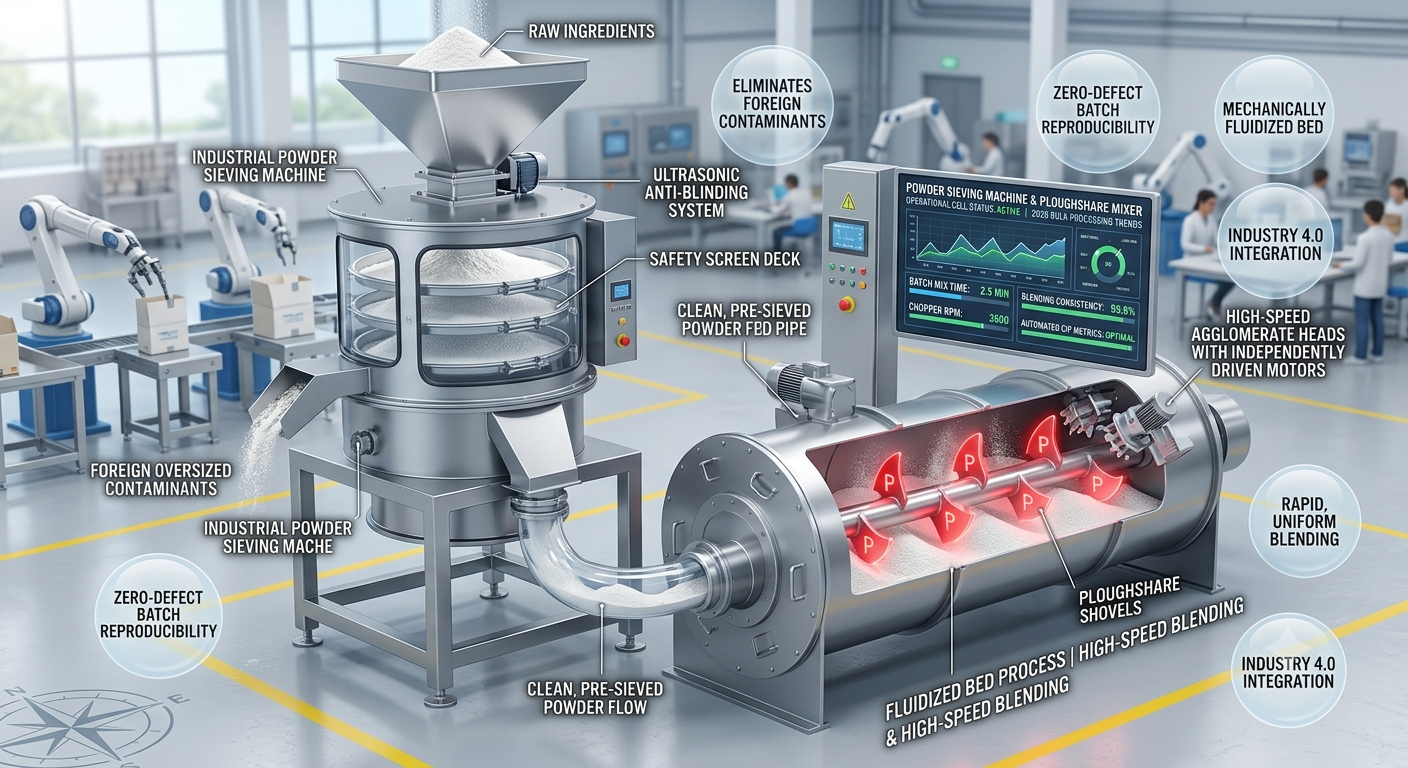
Modern manufacturing industries depend on reliable powder processing systems to achieve consistent product quality, reduce material waste, and improve production efficiency. Among the most important equipment used in powder handling and blending operations are the powder sieving machine and ploughshare mixer. While each machine performs a different function, together they can create a highly effective processing workflow for industries that require precise particle classification and uniform mixing.
From pharmaceuticals and food processing to chemicals, agriculture, construction materials, and specialty formulations, manufacturers are increasingly looking for equipment that delivers accuracy, flexibility, and dependable performance. The combination of efficient sieving and advanced mixing technology can help companies meet these demands while maintaining high standards of production.
Understanding the Role of a Powder Sieving Machine
A powder sieving machine is designed to separate powder particles according to size. During manufacturing, raw materials may contain lumps, oversized particles, or unwanted foreign matter that can affect the quality of the final product. Sieving helps remove these inconsistencies before the material moves into subsequent processing stages.
Modern sieving systems can be configured for different materials and production capacities. Depending on the application, manufacturers may use vibrating screens, rotary sifters, centrifugal sifters, or other specialized screening equipment.
The primary advantages include:
- Improved particle size consistency
- Removal of unwanted contaminants
- Better product uniformity
- Reduced manual screening requirements
- Increased processing efficiency
- Improved downstream equipment performance
By integrating a suitable powder sieving machine into a production line, manufacturers can establish better control over raw material quality and help ensure that only appropriately sized particles enter the next stage.
Why Ploughshare Mixers Are Gaining Attention
After powders have been properly screened, they may need to be blended with other dry ingredients or additives. This is where a ploughshare mixer can play an important role.
A ploughshare mixer uses specially designed plough-shaped mixing tools that move materials through a horizontal vessel. The mixing action creates a fluidized movement inside the chamber, allowing different powders and granular materials to blend efficiently.
Depending on the formulation, high-speed choppers can also be incorporated to break up agglomerates or improve dispersion. This makes the equipment suitable for applications where conventional mixing may not deliver the desired consistency.
Industries commonly using ploughshare mixing technology include:
- Pharmaceutical manufacturing
- Food and nutritional products
- Chemical processing
- Agricultural formulations
- Building materials
- Plastics and polymers
- Specialty powders
- Detergent production
The versatility of a ploughshare mixer makes it a valuable solution for manufacturers handling a wide range of dry and semi-dry materials.
How Sieving and Mixing Work Together
A production process often requires more than one stage to achieve the desired product characteristics. The combination of a powder sieving machine and ploughshare mixer can create a logical sequence for powder preparation.
First, raw materials are screened to remove oversized particles and unwanted impurities. The appropriately sized powder is then transferred to the mixer, where different ingredients are blended according to the required formulation.
This workflow can provide several benefits:
- Better raw material preparation
- More consistent particle distribution
- Improved mixing uniformity
- Reduced processing interruptions
- Greater control over final product quality
Manufacturers can also customize equipment configurations according to their material properties, batch sizes, production targets, and hygiene requirements.
Key Factors When Selecting Powder Processing Equipment
Choosing the right machinery requires careful consideration of the production environment and material characteristics. Businesses should evaluate several factors before investing in equipment.
Material Characteristics
Particle size, density, moisture content, flowability, and sensitivity to heat can influence equipment selection. Materials with different characteristics may require different screening or mixing configurations.
Production Capacity
The required batch size and throughput should be assessed before selecting a machine. A system designed for laboratory-scale production may not be appropriate for continuous industrial manufacturing.
Cleaning and Maintenance
For food, pharmaceutical, and sensitive chemical applications, hygienic design and easy cleaning are particularly important. Equipment with accessible internal components can help reduce cleaning time and simplify maintenance procedures.
Automation and Process Control
Modern production lines increasingly use automated controls to monitor processing parameters. Integration with automated feeding, discharge, and material handling systems can improve operational efficiency.
Customization Options
Depending on the application, manufacturers may require customized screens, mixing tools, dust-control systems, or specialized discharge mechanisms. Selecting equipment that can be adapted to production requirements can provide greater long-term value.
Powder Sieving Machine vs. Ploughshare Mixer
| Feature | Powder Sieving Machine | Ploughshare Mixer |
| Primary function | Particle separation and screening | Powder and granule mixing |
| Main objective | Achieve consistent particle size | Achieve uniform ingredient distribution |
| Typical input | Raw or processed powder | Multiple powders or granular materials |
| Key benefit | Removes lumps and unwanted particles | Produces homogeneous blends |
| Common applications | Screening, classification, impurity removal | Blending, homogenization, agglomerate breaking |
| Process position | Usually before mixing or packaging | Typically after material preparation |
Although these machines perform different tasks, they can complement each other in an integrated powder processing line.
Industry Applications and Market Demand
The growing demand for high-quality manufactured products is encouraging industries to improve their powder handling processes. In pharmaceutical production, accurate screening and uniform blending can be essential for maintaining formulation consistency. Food manufacturers also require reliable processing systems to handle ingredients efficiently while meeting hygiene expectations.
Chemical and construction material producers may use these machines for processing powders with varying densities and particle sizes. Meanwhile, agricultural manufacturers can benefit from consistent blending when producing fertilizers, soil additives, and other formulations.
As production facilities become more automated, the demand for efficient powder processing equipment is expected to remain strong. Manufacturers are increasingly focused on reducing material loss, improving batch consistency, and optimizing production workflows.
Frequently Asked Questions
1. What is a powder sieving machine?
A powder sieving machine is industrial equipment used to separate particles based on size and remove oversized materials, lumps, or unwanted contaminants.
2. What does a ploughshare mixer do?
A ploughshare mixer blends powders and granular materials to create a more uniform mixture. Its specialized mixing tools promote intensive movement within the mixing chamber.
3. Can these machines be used together?
Yes. Sieving can be performed before mixing to improve raw material consistency, while the mixer can then combine the prepared ingredients into a homogeneous blend.
4. Which industries use powder sieving machines?
Pharmaceuticals, food processing, chemicals, agriculture, construction materials, and specialty manufacturing industries commonly use powder screening equipment.
5. Are ploughshare mixers suitable for pharmaceutical applications?
They can be suitable for pharmaceutical powder blending when the equipment is designed according to the application’s hygiene, containment, cleaning, and process requirements.
6. Can a powder sieving machine remove lumps?
Yes. Depending on the machine configuration and screen selection, sieving systems can separate and remove oversized particles and agglomerated material.
7. How can manufacturers improve powder processing efficiency?
Companies can improve efficiency by selecting appropriate equipment, automating material handling, optimizing process parameters, and maintaining machines regularly.
8. What should businesses consider before buying a ploughshare mixer?
Important considerations include material properties, batch size, required mixing time, production capacity, cleaning requirements, and customization needs.
9. Is equipment customization possible?
Many industrial powder processing systems can be customized with different screens, mixing tools, discharge systems, controls, and other features based on application requirements.
10. Why is uniform powder processing important?
Uniform processing helps manufacturers maintain consistent product quality, reduce batch variations, improve downstream operations, and meet defined production specifications.
https://newsgrow.blogspot.com/2026/06/powder-sieving-machine-and-ploughshare.html