
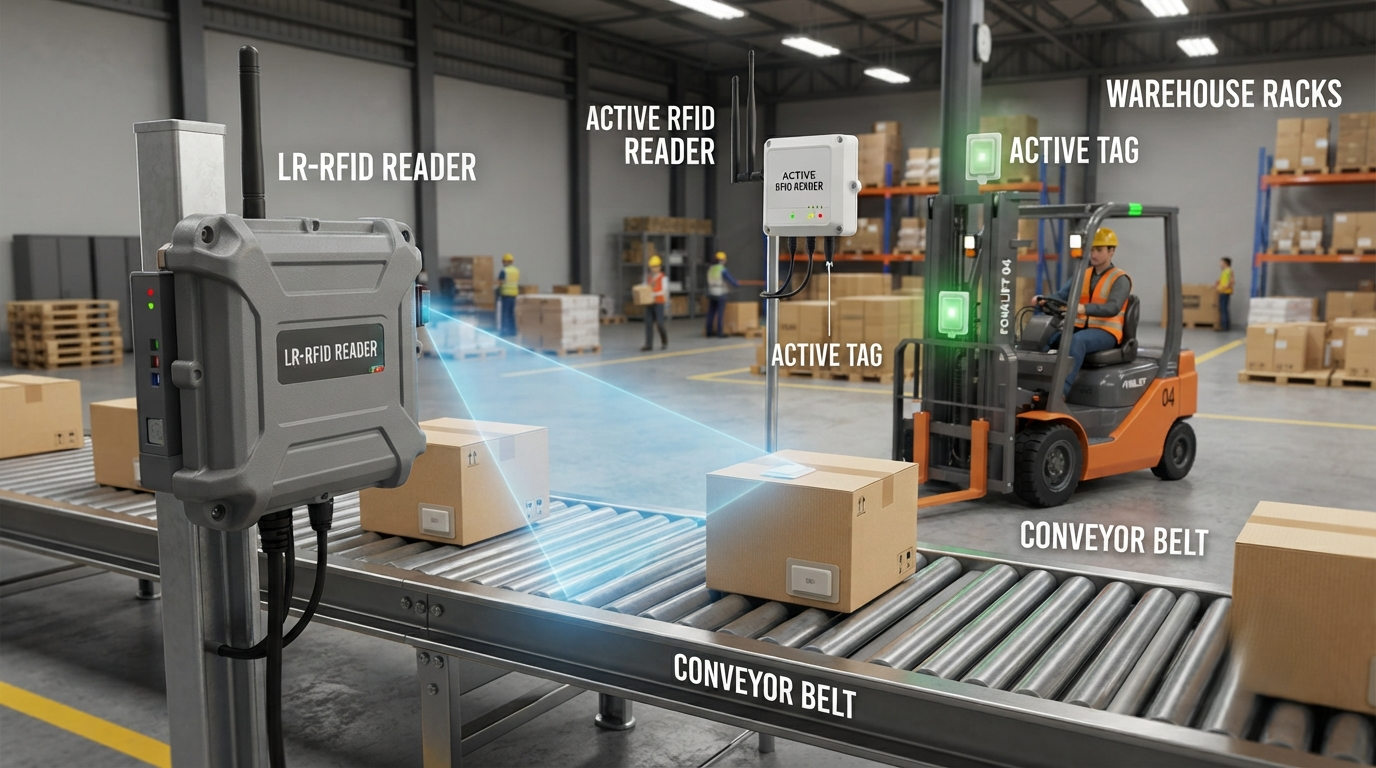
RFID technology makes this possible by identifying tagged objects without direct line-of-sight scanning. Two important solutions for wider coverage are Long Range RFID Reader systems and Active RFID Reader technology.
They serve different tracking needs, so understanding their capabilities helps organizations build efficient RFID systems across complex operational environments today.
What Is a Long Range RFID Reader?
A Long Range RFID Reader communicates with compatible RFID tags from a greater distance than standard short-range readers. Reading distance depends on frequency, antenna design, tag type, power settings, installation, and surrounding materials.
Many long-range systems use UHF RFID for fast identification and multiple-tag reading.
Common applications include:
- Vehicle identification
- Warehouse pallet tracking
- Parking management
- Asset movement monitoring
- Production line visibility
- Logistics automation
- Access control
Tagged objects can be detected while moving, reducing manual scanning.
How an Active RFID Reader Works
An Active RFID Reader communicates with active tags containing their own battery. Unlike passive tags, which obtain operating energy from a reader signal, active tags can transmit stronger signals over greater distances.
Active RFID is valuable for frequent location updates, zone monitoring, and real-time visibility.
Tags broadcast identification data that readers transfer to software for alerts, reporting, or automated actions.
Long Range RFID Reader vs Active RFID Reader
Although both support extended-distance identification, their use cases differ.
| Feature | Long Range RFID Reader | Active RFID Reader |
| Typical tag | Passive UHF | Battery-powered active |
| Tag cost | Lower | Higher |
| Maintenance | Minimal | Battery maintenance |
| Range | Medium to long | Long to very long |
| Real-time visibility | Limited | Strong |
| Best suited for | Inventory, vehicles | Assets, people, RTLS |
Passive RFID suits large tag volumes; active RFID suits high-value assets needing frequent location updates.
Key Benefits of Long Range RFID Technology
A Long Range RFID Reader improves speed by identifying tags without close manual scanning.
Faster Identification
Readers can capture tags at warehouse doors, loading bays, gates, checkpoints, or production areas, helping reduce manual handling.
Multiple Tag Reading
Compatible readers can identify many tags within a reading zone, improving throughput for pallets, cartons, tools, and components.
Better Automation
RFID data can connect with ERP, WMS, parking, access-control, attendance, or asset-management platforms. The system can update records, open gates, confirm movements, or trigger alerts.
Improved Accuracy
Automated data capture can reduce manual entry mistakes and missed identification events when readers, antennas, and tags are correctly configured.
Benefits of Active RFID Systems
The main strength of an Active RFID Reader system is frequent, long-distance communication with powered tags. This can support:
- Real-time asset visibility
- Personnel location monitoring
- High-value equipment tracking
- Zone-based alerts
- Reduced search time
- Equipment utilization analysis
- Automated movement history
These capabilities are useful across asset-intensive facilities.
Common RFID Applications
In warehouses, long-range readers can register pallets at dock doors, while active RFID can locate mobile equipment.
For parking, a Long Range RFID Reader can identify authorized vehicles before they reach an access barrier, enabling faster contactless entry.
Manufacturers use RFID to monitor components, work-in-progress, tools, and finished goods. Hospitals may use active RFID to locate medical equipment, beds, wheelchairs, or other valuable assets.
On campuses, RFID can support access, vehicles, visitors, and restricted zones.
How to Choose the Right RFID Reader
Selection should consider more than maximum reading distance. Important factors include:
- Required reading range
- Number of tags
- Tag movement speed
- Indoor or outdoor use
- Metal or liquid interference
- Real-time tracking requirements
- Software integration
- Tag cost
- Security needs
- Expansion plans
A site survey is highly valuable. Antenna position, tag orientation, obstacles, reflective surfaces, and reader power can strongly influence actual performance.
RFID Implementation Best Practices
Start by defining what must be tracked, where identification should happen, and what actions should follow each RFID event. Test several suitable tags because performance changes depending on mounting material and orientation.
Design controlled reading zones rather than simply maximizing reader power. Correct antenna placement can reduce missed reads and unwanted detections.
RFID data should integrate with useful business systems. APIs, dashboards, alerts, and automation rules turn raw reads into operational information. Organizations should also secure reader access, network communication, permissions, and tracking data.
Frequently Asked Questions
1. What is a Long Range RFID Reader?
It identifies compatible RFID tags from greater distances than standard short-range readers.
2. What is an Active RFID Reader?
It communicates with battery-powered active RFID tags used for longer-distance or frequent tracking.
3. Which RFID type offers longer range?
Active RFID generally supports greater distances because its tags have independent power.
4. Are passive RFID tags affordable?
Yes. Passive UHF tags are commonly selected for large-volume deployments because of their lower cost.
5. Can RFID identify moving vehicles?
Yes. Correctly designed systems can identify tagged vehicles at gates and controlled checkpoints.
6. Can active RFID provide real-time tracking?
Yes. Active RFID is widely used for real-time location and frequent status updates.
7. Does RFID need line of sight?
No. RFID communicates through radio waves rather than visual barcode scanning.
8. Can RFID operate outdoors?
Yes, when suitable outdoor readers, antennas, tags, enclosures, and installation methods are used.
9. Can RFID connect with existing software?
Yes. Readers can integrate through APIs, middleware, network protocols, or custom applications.
10. Which RFID system is suitable for asset tracking?
Passive RFID suits checkpoint identification, while active RFID fits frequent or real-time location monitoring.