Modern polymer manufacturing is no longer simply about melting plastic and forcing it through a die. Manufacturers are expected to achieve consistent quality, control production costs, handle increasingly complex formulations, and develop materials with specific performance characteristics. This is where the choice of extrusion technology becomes important.
The Twin Extruder and Single Extruder represent two different approaches to continuous material processing. Instead of asking which machine is better, manufacturers should ask a more practical question: what does the material need during processing?
Some production lines primarily need efficient melting and stable material flow. Others need intensive mixing, accurate additive incorporation, moisture removal, or controlled processing of fillers and reinforcing materials. Understanding these requirements makes it easier to identify an appropriate extrusion system.
Extrusion Starts With Understanding the Raw Material
Every successful extrusion process begins with the material rather than the machine.
Polymers can behave very differently when exposed to temperature, pressure, and mechanical shear. Some arrive as uniform pellets that are relatively easy to process. Others may contain powders, fibers, minerals, pigments, recycled flakes, or multiple additives.
Important material characteristics include:
- Melt behavior
- Moisture content
- Bulk density
- Particle size
- Heat sensitivity
- Filler percentage
- Abrasiveness
- Additive concentration
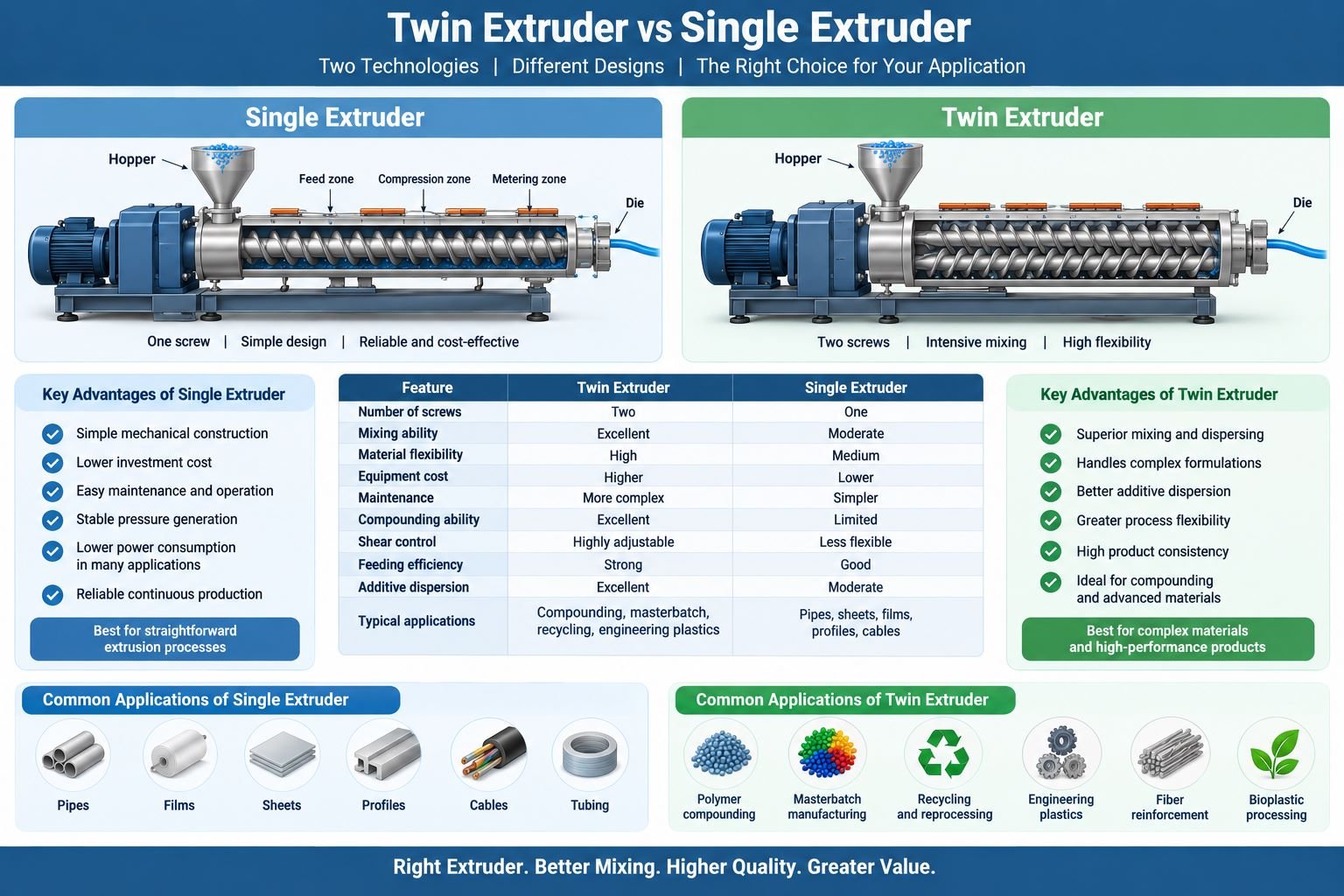
A Single Extruder can be highly effective when the feed material is consistent and extensive mixing is unnecessary.
A Twin Extruder, meanwhile, becomes particularly relevant when several materials must be incorporated and distributed during processing.
Why Single Extruder Technology Remains Important
Single-screw extrusion is one of the most established technologies in polymer processing.
Inside the machine, one rotating screw continuously transports material through a heated barrel. As the material travels forward, thermal and mechanical energy help transform it into a processable melt.
Pressure develops before the material reaches the die, allowing continuous product formation.
This straightforward processing concept makes a Single Extruder useful for numerous manufacturing operations, including pipes, sheets, films, profiles, tubing, and cable-related applications.
The important advantage is not simply that the machine has fewer components. Its strength comes from performing conventional continuous extrusion efficiently when the formulation does not demand sophisticated compounding.
Why Twin Extruder Technology Handles Complex Formulations
Modern polymer products often contain much more than a base resin.
Manufacturers may introduce pigments for color, minerals for specific properties, glass fibers for reinforcement, stabilizers for processing, or functional additives for specialized performance.
The challenge is distributing these ingredients consistently.
A Twin Extruder contains two screws that interact with the material as it passes through the barrel. Different screw elements can be arranged to create specific processing zones.
These zones may perform functions such as:
- Conveying
- Melting
- Kneading
- Mixing
- Dispersing
- Venting
- Homogenizing
- Pressure generation
This configurable processing environment explains why twin-screw technology is widely associated with polymer compounding.
The Real Difference Is More Than the Number of Screws
It is easy to describe the machines simply as one screw versus two screws, but industrially the difference is more meaningful.
| Production Consideration | Single Extruder | Twin Extruder |
| Conventional melt extrusion | Commonly used | Application dependent |
| Complex compounding | More limited | Widely used |
| Ingredient dispersion | Moderate | Highly configurable |
| Mechanical arrangement | Simpler | More complex |
| Formulation flexibility | Moderate | High |
| Maintenance complexity | Generally lower | Generally higher |
| Typical investment | Lower | Higher |
| Process customization | More limited | Extensive |
These are general characteristics rather than fixed rules. Screw design, machine configuration, material properties, and operating conditions ultimately determine performance.
Mixing Can Determine the Quality of a Compound
Consider a polymer compound containing resin, pigment, mineral filler, and several functional additives.
Simply moving these ingredients through a barrel does not guarantee a uniform product.
If pigment distribution is inconsistent, color variations can appear. Poor filler dispersion may influence mechanical characteristics. Improper additive distribution can create inconsistent processing behavior.
This is why mixing is an important consideration when choosing between a Twin Extruder and Single Extruder.
Twin-screw technology can provide controlled distributive and dispersive mixing. These mechanisms help distribute ingredients and address agglomerated components within appropriate processing conditions.
For materials that are already compounded and primarily need melting and shaping, the additional complexity may not always be necessary.
Where a Single Extruder Makes Practical Sense
A manufacturer should not choose more complicated machinery simply because it provides additional capabilities.
If the production process involves a stable thermoplastic formulation and the primary objective is continuous shaping, a Single Extruder can be a logical solution.
Common examples include:
- Pipe extrusion
- Profile manufacturing
- Film processing
- Sheet production
- Plastic tubing
- Wire coating
For these applications, manufacturers may prioritize consistent melt delivery, pressure stability, production capacity, and efficient downstream processing.
Where a Twin Extruder Becomes Valuable
The processing challenge changes when a manufacturer produces compounds rather than straightforward finished extrusions.
Suppose a company needs to combine a polymer with mineral filler and performance additives. The ingredients may have different densities, particle characteristics, and processing requirements.
A Twin Extruder allows the production line to be designed around these differences.
Certain ingredients can potentially be introduced through separate feeding systems. Venting zones may remove unwanted moisture or volatile components where the process requires it. Mixing elements can be arranged according to the formulation.
Typical areas include masterbatch, filled compounds, engineering polymers, reinforced materials, specialty blends, and selected recycling applications.
Production Capacity Should Not Be Viewed Alone
Extruder specifications frequently emphasize output in kilograms per hour. While capacity matters, the highest theoretical output does not automatically represent the most productive machine.
Real productivity includes:
- Consistent product quality
- Low rejection rates
- Stable operation
- Reasonable energy consumption
- Manageable maintenance
- Reduced unplanned downtime
- Repeatable formulation quality
A machine producing slightly less material but maintaining consistent specifications can sometimes deliver greater practical value than equipment operating at maximum capacity with frequent quality problems.
Manufacturers should therefore evaluate output using the actual material they intend to process.
Energy and Maintenance Affect Long-Term Economics
The purchase price is only one part of an extrusion investment.
Over several years, manufacturers will spend money on electricity, labor, replacement components, heating and cooling, cleaning, preventive maintenance, and downtime.
A Single Extruder generally has a simpler mechanical arrangement, which can make maintenance relatively straightforward.
A Twin Extruder contains additional processing components and may require greater technical attention. However, when complex compounding is necessary, its processing flexibility can justify the additional investment.
The correct economic comparison should therefore consider total production requirements rather than equipment price alone.
Extruder Selection Should Include Future Products
Manufacturers sometimes purchase machinery only around their current formulation.
This can become restrictive when market requirements change.
A company currently processing standard polymer may later introduce recycled materials, filled compounds, modified formulations, or specialty products.
Before purchasing equipment, decision-makers should consider:
- Current product requirements
- Expected production capacity
- Future formulations
- Available factory utilities
- Operator skill requirements
- Maintenance capabilities
- Downstream equipment
- Automation requirements
- Product quality standards
- Expansion possibilities
Planning for future requirements can reduce the risk of investing in equipment that becomes unsuitable too quickly.
Frequently Asked Questions
1. What is the purpose of a Single Extruder?
A Single Extruder continuously conveys, melts, homogenizes, and pressurizes suitable material before it passes through a die or subsequent processing equipment.
2. Why does a Twin Extruder use two screws?
Two screws provide additional control over material conveying, mixing, dispersion, and other processing functions.
3. Which technology is commonly used for masterbatch?
Twin-screw extrusion is widely used for many masterbatch and polymer compounding applications.
4. Can a Single Extruder process recycled material?
Yes. Suitability depends on the polymer, contamination level, moisture, feed preparation, and required final product.
5. Does a Twin Extruder provide better mixing?
Twin-screw configurations generally provide greater mixing flexibility, particularly for complex formulations.
6. Is a Single Extruder suitable for pipe production?
Yes. Single-screw extrusion is extensively used for suitable thermoplastic pipe manufacturing.
7. Why are fillers added to polymers?
Fillers may be introduced to modify cost, stiffness, dimensional behavior, processing characteristics, or other required properties.
8. Does screw design affect extrusion performance?
Yes. Screw geometry influences conveying, shear, mixing, pressure generation, melting, and residence time.
9. Is higher production capacity always better?
No. Stable quality, energy consumption, downtime, and rejection rates should also be considered.
10. How should manufacturers choose an extruder?
They should evaluate actual raw materials, formulations, production capacity, mixing requirements, final product specifications, operating costs, and future manufacturing plans.