
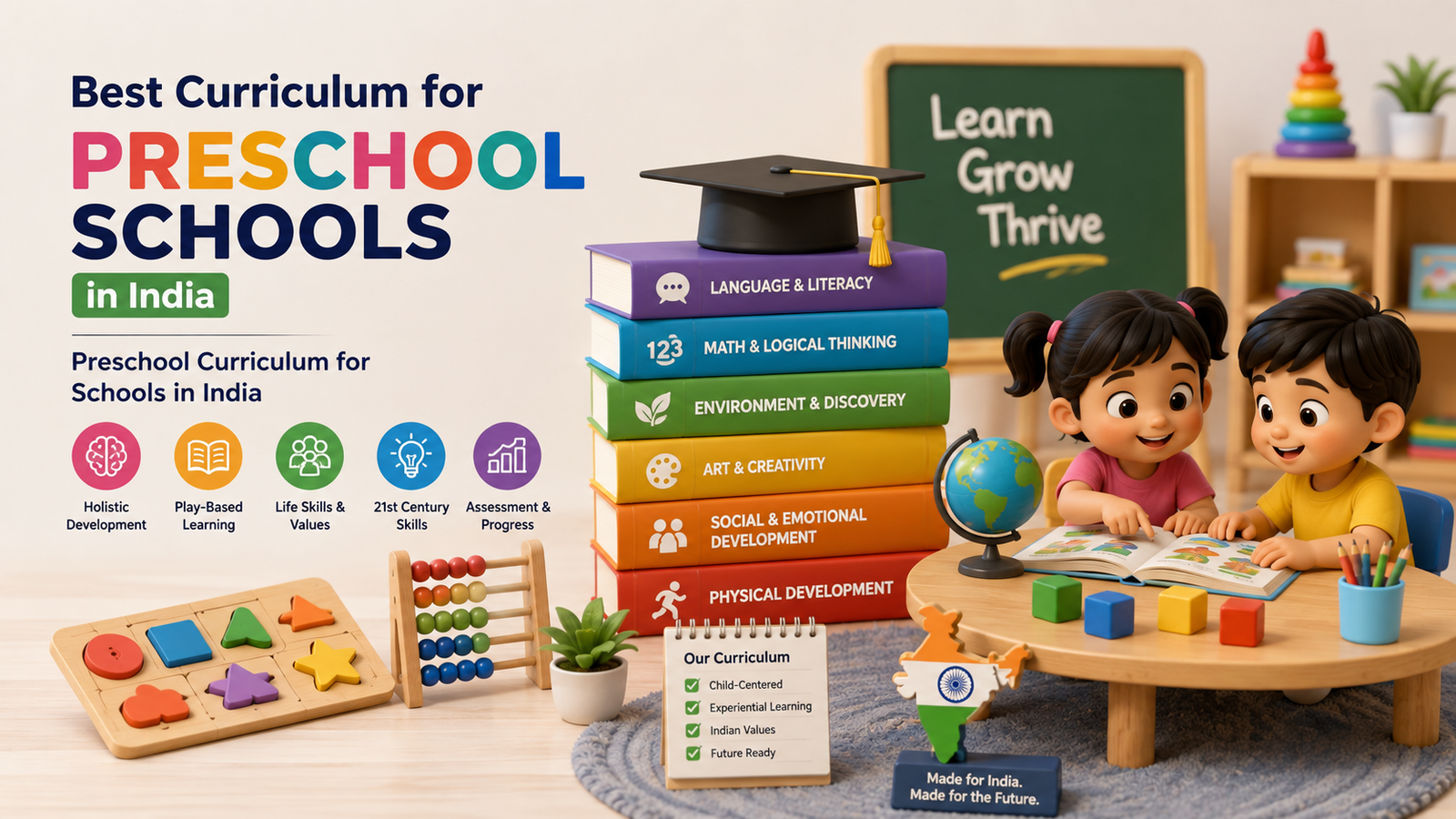
A preschool curriculum does far more than organise classroom activities. It shapes how young children communicate, explore, solve problems, build relationships and develop confidence before entering formal schooling.
For school owners, educators and early-years administrators, choosing the best curriculum for preschool schools therefore requires careful consideration. A strong programme should provide structure without making early education overly academic. It should help teachers create purposeful learning experiences while respecting the individual developmental pace of every child.
For Indian institutions, the challenge is even more specific. A suitable preschool curriculum for schools in India needs to work within diverse linguistic, cultural and social environments while preparing children for a smooth transition to primary education.
What Is the Best Curriculum for Preschool Schools?
The best curriculum for preschool schools is a developmentally appropriate, play-based and child-centred learning framework that supports the whole child rather than focusing only on early reading, writing and mathematics.
An effective curriculum typically develops:
· Communication and language
· Early literacy
· Numeracy and logical thinking
· Physical and motor skills
· Social and emotional development
· Creativity and imagination
· Environmental awareness
· Independence and everyday life skills
· Curiosity, observation and problem-solving abilities
Rather than expecting children to memorise large amounts of information, a well-designed curriculum encourages them to learn through stories, games, movement, conversation, music, art, exploration and practical experiences.
This approach makes learning meaningful because children understand ideas through participation rather than passive instruction.
Why Preschool Curriculum Quality Matters
The early years establish important foundations for later learning. However, school readiness should not be interpreted simply as knowing the alphabet, numbers or how to complete worksheets.
Children also need to develop the ability to listen, communicate their needs, interact with others, follow age-appropriate routines, manage emotions and approach unfamiliar tasks with confidence.
A thoughtful preschool curriculum for schools in India therefore considers several dimensions of development simultaneously.
For example, a simple classroom activity involving sorting colourful objects can support:
· Recognition of colours and shapes
· Counting and early mathematics
· Fine motor development
· Vocabulary building
· Comparison and classification
· Turn-taking and cooperation
The strongest preschool programmes recognise these connections instead of teaching every skill as an isolated subject.
Key Features of the Best Curriculum for Preschool Schools
When evaluating different curriculum options, schools should look beyond attractive books and activity kits. The underlying learning philosophy, classroom implementation and teacher support matter considerably more.
Play-Based and Experiential Learning
Young children naturally learn through exploration.
Building blocks can introduce balance, shapes and spatial relationships. Role play can develop language and social skills. Sand and water activities can introduce concepts such as volume, texture, floating and sinking.
The best curriculum for preschool schools uses play strategically so that enjoyable experiences also have clear developmental objectives.
Age-Appropriate Learning Outcomes
Expectations should change according to children’s age and developmental stage.
A nursery learner should not be expected to demonstrate the same literacy, concentration or writing abilities as a kindergarten learner.
Schools should therefore look for programmes with clearly defined progression across levels such as:
Nursery: sensory exploration, vocabulary, movement, routines and social interaction.
Lower Kindergarten: phonological awareness, early numeracy, pattern recognition, storytelling and fine motor development.
Upper Kindergarten: stronger literacy and numeracy foundations, communication, reasoning and preparation for primary-school routines.
Progression should be gradual rather than rushed.
Balanced Early Literacy and Numeracy
Early academic foundations are important, but they should be introduced appropriately.
Literacy activities may include storytelling, picture conversations, rhymes, sound awareness, vocabulary development and letter recognition.
Numeracy can be developed through counting physical objects, matching, sorting, patterns, shapes, comparisons and everyday problem-solving.
A balanced curriculum helps children understand concepts before expecting extensive written work.
What Should a Preschool Curriculum for Schools in India Include?
India’s educational environment is highly diverse. Schools may teach children from different linguistic, cultural and socioeconomic backgrounds, so a rigid one-size-fits-all programme may not work equally well everywhere.
A practical preschool curriculum for schools in India should allow teachers to contextualise learning while maintaining consistent developmental goals.
Important curriculum areas include:
| Learning Area | Examples of Preschool Experiences |
| Language & Literacy | Stories, rhymes, conversations, phonics and picture reading |
| Early Numeracy | Counting, sorting, patterns, shapes and comparisons |
| Physical Development | Outdoor play, movement and fine motor activities |
| Creative Development | Drawing, painting, craft, music and dance |
| Social-Emotional Learning | Sharing, routines, teamwork and emotional expression |
| Environmental Awareness | Plants, animals, family, community and surroundings |
| Cognitive Development | Puzzles, matching, sequencing and problem-solving |
| Life Skills | Hygiene, organisation, independence and personal responsibility |
The curriculum should also provide enough flexibility for local stories, festivals, languages, familiar objects and community experiences to become part of classroom learning.
Play-Based Learning vs Worksheet-Heavy Learning
One common mistake is assuming that more worksheets automatically mean better academic preparation.
Worksheets can have a place in preschool when used selectively. Problems arise when they dominate the school day.
A child may memorise how to write a number without understanding quantity. Conversely, counting ten physical objects, arranging them into groups and discussing which group has more helps develop conceptual understanding.
The best curriculum for preschool schools combines guided instruction with hands-on experiences rather than relying excessively on notebooks.
How to Evaluate a Preschool Curriculum Before Selecting It
School leaders should examine how a curriculum works in a real classroom before committing to it.
Consider these questions:
1. Are learning outcomes clearly defined for each age group?
2. Is the programme genuinely play-based and developmentally appropriate?
3. Does it balance literacy, numeracy, physical, creative and social-emotional development?
4. Are lesson plans practical for teachers to implement?
5. Does it provide teacher guidance and training?
6. Can activities be adapted to different learning abilities?
7. Does it include meaningful assessment methods?
8. Are classroom resources age-appropriate and safe?
9. Can the programme accommodate Indian cultural and linguistic contexts?
10. Does it support progression into primary education?
School owners should ideally review sample lesson plans, teacher manuals, classroom activities and assessment methods—not merely brochures.
Internal link opportunity: Explore Our Preschool Curriculum Programme
Teacher Support Is as Important as Curriculum Content
Even an excellent curriculum can produce inconsistent results when teachers do not understand how to implement it.
A strong preschool programme should therefore provide clear teacher guidance.
Educators need to understand the objective behind each activity, how to introduce concepts, what questions to ask, how to observe children’s responses and when to adapt an activity.
For example, during storytelling, a teacher should do more than read aloud. Asking children to predict what happens next, identify characters, describe illustrations and retell parts of the story can transform one activity into language, comprehension, imagination and communication practice.
When comparing curriculum providers, schools should investigate teacher training and implementation support alongside curriculum materials.
Suggested internal link: Preschool Teacher Training and Support
Assessment Should Measure Development, Not Just Marks
Traditional examinations are generally unsuitable as the primary method of assessing preschool children.
Observation-based assessment provides a broader understanding of development.
Teachers can monitor areas such as:
· Language development
· Number awareness
· Fine and gross motor abilities
· Classroom participation
· Social interaction
· Independence
· Problem-solving
· Creativity
· Confidence and communication
Portfolios, activity records, observation notes and periodic developmental reports can help schools communicate progress to parents without creating unnecessary academic pressure.
How Schools Can Improve Parent Engagement
Parents should understand what children are learning and why particular classroom activities matter.
For instance, parents may initially see clay modelling simply as entertainment. Teachers can explain that the activity can strengthen fine motor control, creativity, sensory awareness and hand-eye coordination.
Regular communication helps parents understand the philosophy behind a play-based curriculum.
Schools can support this through orientation sessions, parent-teacher meetings, progress reports and simple home-learning suggestions.
Internal link opportunity: Parent Engagement in Early Childhood Education
Choosing Between Ready-Made and Customisable Preschool Curricula
Some schools prefer a fully structured programme, while others need greater flexibility.
A ready-made curriculum can provide lesson plans, learning resources, assessments and teacher guidance, making implementation easier for growing preschool networks or newly established institutions.
A customisable programme gives experienced educators more freedom to adapt themes, activities and teaching approaches.
The right choice depends on teacher experience, class size, available resources, school philosophy and long-term expansion plans.
For many institutions, a structured framework with room for local adaptation offers a practical balance.
Curriculum Selection as a Long-Term School Decision
Curriculum choice also has commercial implications for preschool owners.
Parents increasingly want to understand how a school teaches, not merely what facilities it provides. A clearly defined learning methodology can therefore strengthen parent communication and help schools establish a consistent educational identity.
However, marketing claims should reflect actual classroom practice.
A school describing itself as child-centred or experiential should be able to demonstrate those principles through classroom routines, teacher interactions and learning activities.
CTA: If you are establishing a new preschool or reviewing your existing programme, request a curriculum demonstration and evaluate the actual lesson plans, teaching methodology, assessment framework and educator support before making your decision.
Frequently Asked Questions
1. What is the best curriculum for preschool schools?
The best curriculum is typically child-centred, developmentally appropriate and play-based, with balanced attention to language, numeracy, physical, cognitive, creative and social-emotional development.
2. What should a preschool curriculum include?
It should include early literacy, numeracy, communication, physical development, creativity, environmental awareness, social-emotional learning and practical life skills.
3. What makes a good preschool curriculum for schools in India?
A good Indian preschool curriculum combines developmental learning objectives with flexibility for local languages, culture, classroom environments and children’s individual learning needs.
4. Is play-based learning effective for preschool children?
Play can be highly valuable because it allows children to explore concepts actively while developing communication, reasoning, physical and social skills.
5. Should preschool children use worksheets?
Worksheets can be used selectively, but they should complement rather than replace stories, play, conversation, movement and hands-on learning.
6. How should preschool children be assessed?
Observation, portfolios, activity records and developmental progress reports are useful approaches for monitoring learning without depending entirely on formal examinations.
7. How important is phonics in preschool?
Phonics can support early reading development when introduced gradually alongside storytelling, vocabulary, listening and comprehension activities.
8. Should every preschool follow exactly the same curriculum?
Not necessarily. Schools differ in teaching philosophy, language, resources and learner needs. A strong framework should allow sensible contextual adaptation.
9. How can school owners compare preschool curriculum providers?
Compare learning objectives, lesson plans, teaching resources, assessment methods, teacher training, implementation support and opportunities for customisation.
10. Why is teacher training important when implementing a curriculum?
Teachers need to understand both what to teach and how children learn. Training helps them deliver activities purposefully and adapt instruction appropriately.
11. How does preschool curriculum prepare children for primary school?
It develops foundational literacy and numeracy alongside communication, independence, concentration, social interaction and learning routines needed for the next educational stage.
12. What should schools ask during a curriculum demonstration?
Ask to see actual lesson plans, classroom resources, learning outcomes, teacher manuals, assessment formats, training provisions and examples of age-wise progression.