
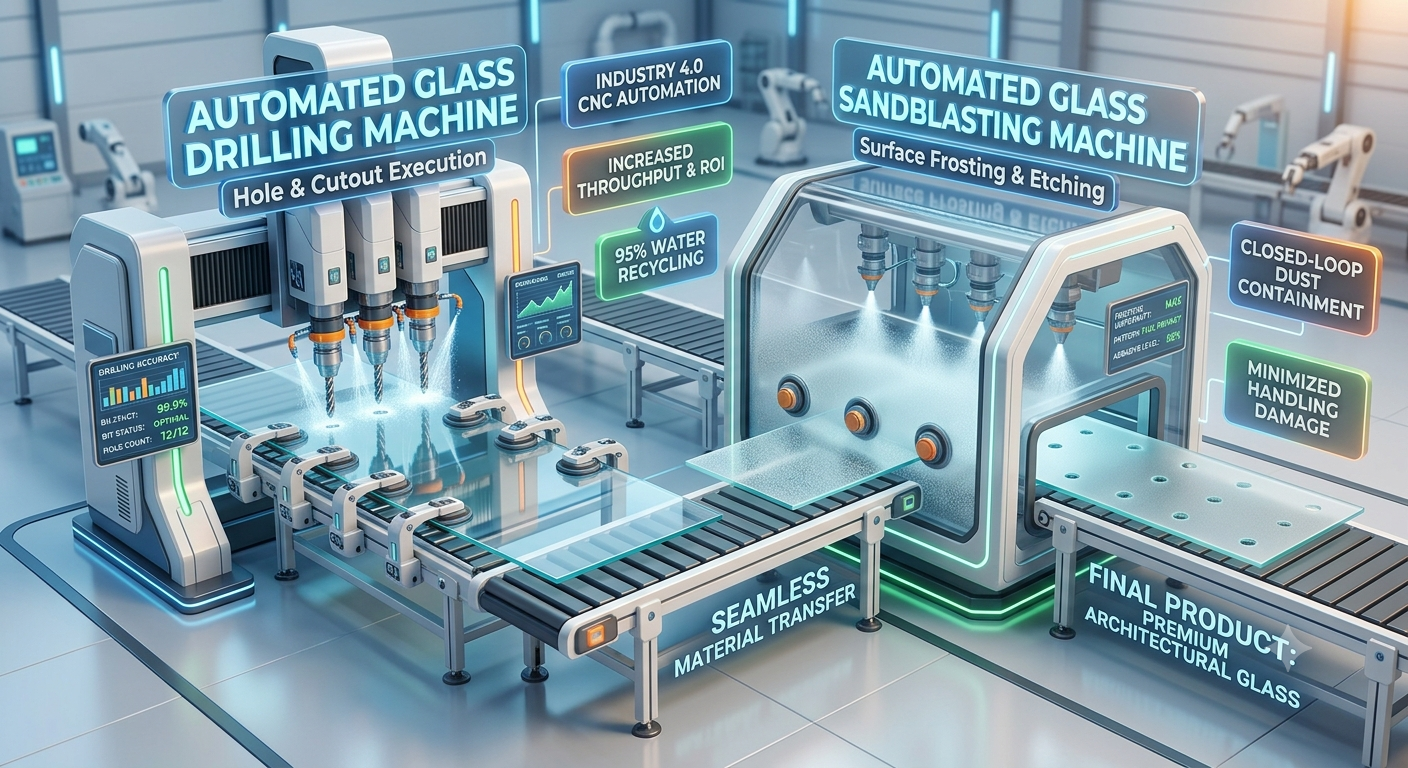
Whether manufacturers are creating decorative panels, architectural glass, mirrors, furniture components, shower enclosures, doors, or customized glass products, specialized machinery plays an important role. Two essential pieces of equipment used in professional glass fabrication are the Glass Sandblasting Machine and Glass Drilling Machine.
Although both machines work with glass, their purposes are completely different. A Glass Sandblasting Machine modifies the surface to create frosted, decorative, or privacy finishes, while a Glass Drilling Machine creates accurately positioned holes required for fittings, hinges, handles, pipes, and mounting hardware.
Understanding their working principles, applications, advantages, and selection criteria helps glass processors improve productivity and finished product quality.
What Is a Glass Sandblasting Machine?
A Glass Sandblasting Machine is specialized industrial equipment designed to create frosted or engraved effects on glass surfaces by directing abrasive material toward glass under controlled pressure.
During operation, fine abrasive particles strike the glass surface and remove a microscopic layer. This process transforms transparent glass into an opaque, textured, or decorative surface without significantly changing its basic dimensions.
Sandblasting equipment is commonly used for:
- Decorative architectural glass
- Privacy glass
- Shower partitions
- Office partitions
- Mirrors
- Glass doors
- Hotel interiors
- Furniture glass
- Signage
- Customized logos and patterns
Modern automatic systems provide significantly better consistency compared with manual blasting methods.
How Does a Glass Sandblasting Machine Work?
The glass sheet enters the blasting chamber through a conveyor system. Inside the enclosed chamber, blasting guns direct abrasive material toward selected areas of the surface.
The basic process includes:
- Loading the glass onto the conveyor.
- Adjusting blasting pressure and processing speed.
- Passing the sheet through the blasting area.
- Applying abrasive material evenly across the required surface.
- Removing residual dust and abrasive particles.
- Collecting the finished glass from the discharge section.
Advanced machines may include automatic gun movement, dust extraction systems, abrasive recycling, adjustable conveyor speed, and programmable controls.
The result is a uniform frosted finish suitable for both decorative and functional applications.
Major Benefits of Glass Sandblasting Technology
Using an automatic Glass Sandblasting Machine provides several important advantages.
Uniform finishing: Automated blasting creates more consistent frosting than traditional manual processing.
Higher productivity: Continuous conveyor-based systems can handle larger production volumes efficiently.
Design flexibility: Manufacturers can create full-surface frosting, partial frosting, logos, patterns, and customized decorative designs.
Improved privacy: Sandblasted glass allows light transmission while reducing visibility through the surface.
Controlled processing: Operators can adjust blasting intensity according to glass thickness and desired texture.
Cleaner production: Integrated dust collection helps control airborne particles and improves the working environment.
These benefits make sandblasting valuable for both architectural and decorative glass manufacturing.
What Is a Glass Drilling Machine?
A Glass Drilling Machine is designed to produce smooth and accurate holes in flat glass sheets. These holes are necessary when glass requires installation hardware or additional components.
Typical applications include holes for:
- Door handles
- Shower fittings
- Hinges
- Connectors
- Furniture mounting systems
- Glass railings
- Display fixtures
- Plumbing openings
- Architectural hardware
Glass drilling requires considerably more control than drilling metal or wood because incorrect pressure or excessive heat can produce cracks or edge damage.
Professional machinery helps minimize these risks.
How Does a Glass Drilling Machine Work?
A typical Glass Drilling Machine uses specially designed diamond drilling tools. The glass is carefully positioned and secured before drilling begins.
Water or coolant is continuously supplied to the drilling area. This performs several important functions, including cooling the drill, reducing friction, removing glass particles, and improving hole quality.
For improved results, many machines drill from both sides of the glass.
The general sequence is:
- Position the glass accurately.
- Set the required hole location and diameter.
- Secure the sheet.
- Start coolant circulation.
- Drill partly from one side.
- Complete the hole from the opposite side.
- Inspect the finished hole.
Double-sided drilling greatly reduces the possibility of chipping around the hole edge.
Important Features of Glass Drilling Equipment
When selecting drilling machinery, glass processors should evaluate several technical features.
Drilling diameter range: The machine should support the required minimum and maximum hole sizes.
Glass thickness capacity: Different machines are designed for different thickness ranges.
Spindle accuracy: Stable spindle rotation contributes to clean and precise holes.
Cooling system: Reliable water circulation prevents overheating.
Positioning accuracy: Proper guides and measurement systems help maintain consistent hole placement.
Machine structure: A rigid frame reduces vibration during drilling.
Modern CNC-controlled systems can also automate positioning for complex or repetitive production requirements.
Glass Sandblasting Machine vs Glass Drilling Machine
| Feature | Glass Sandblasting Machine | Glass Drilling Machine |
| Primary purpose | Surface treatment | Hole creation |
| Main result | Frosted or decorative finish | Precision holes |
| Processing method | Abrasive blasting | Diamond drilling |
| Typical application | Privacy and decoration | Hardware installation |
| Cooling requirement | Usually not required | Water cooling required |
| Automation | Conveyor and automatic blasting | Manual, automatic, or CNC |
| Common industries | Architecture and interiors | Construction and furniture |
Both machines can exist within the same glass processing facility because they perform complementary operations.
How to Choose the Right Glass Processing Machine
Choosing suitable equipment should be based on actual production requirements rather than machine price alone.
Consider:
- Maximum glass dimensions
- Glass thickness range
- Daily production capacity
- Required processing accuracy
- Automation level
- Maintenance availability
- Abrasive or tool consumption
- Energy consumption
- Operator safety
- Spare parts availability
Businesses handling large production quantities may benefit from automated systems, while smaller custom-processing workshops may prefer semi-automatic equipment.
Machine construction quality and after-sales technical support should also be carefully evaluated.
Safety and Maintenance Requirements
Routine maintenance is essential for reliable glass processing.
For sandblasting systems, operators should regularly inspect blasting guns, conveyor components, dust collectors, seals, filters, and abrasive circulation systems.
For drilling equipment, technicians should inspect drill bits, spindle bearings, water circulation systems, positioning guides, electrical components, and glass-supporting surfaces.
Operators should always use appropriate personal protective equipment and follow the machinery manufacturer’s safety instructions.
Proper maintenance reduces downtime while extending equipment life.
Future of Automated Glass Processing Machinery
Glass manufacturing is steadily moving toward smarter automation.
Future Glass Sandblasting Machine systems are expected to offer more precise digital control, automated pattern processing, efficient abrasive recycling, energy-saving motors, and intelligent dust management.
Similarly, advanced Glass Drilling Machine technology is increasingly integrating CNC positioning, automatic tool control, digital measurement, production monitoring, and computerized processing programs.
Smart manufacturing can help factories reduce manual errors while improving repeatability and productivity.
As customized architectural glass becomes more popular, flexible machines capable of processing different designs and dimensions will become increasingly valuable.
Frequently Asked Questions About Glass Processing Machines
1. What does a Glass Sandblasting Machine do?
It creates frosted, opaque, textured, or decorative finishes by blasting abrasive material against the glass surface.
2. What abrasive is used for glass sandblasting?
Different fine abrasive materials can be used depending on the required surface finish and machine specifications.
3. Can sandblasting create designs on glass?
Yes. Patterns, logos, decorative graphics, and partially frosted areas can be produced using controlled masking or automated processing.
4. What is a Glass Drilling Machine used for?
It creates precise holes required for handles, fittings, hinges, connectors, and other glass hardware.
5. Why are diamond tools used for drilling glass?
Diamond tools provide the hardness and cutting performance necessary to drill glass accurately.
6. Why is water required during glass drilling?
Water cools the drilling tool, reduces heat, removes glass particles, and helps prevent cracking.
7. Can thick glass be drilled?
Yes, provided the machine and drilling tools support the required glass thickness.
8. Why is glass sometimes drilled from both sides?
Double-sided drilling helps reduce breakout and chipping around the hole edges.
9. Can both machines be automated?
Yes. Modern sandblasting and drilling equipment is available in semi-automatic, fully automatic, and CNC-controlled configurations.
10. Which machine should a glass factory purchase first?
The choice depends on production requirements. Decorative glass manufacturers may prioritize sandblasting, while companies manufacturing doors, partitions, furniture, or hardware-ready glass may require drilling equipment first.