
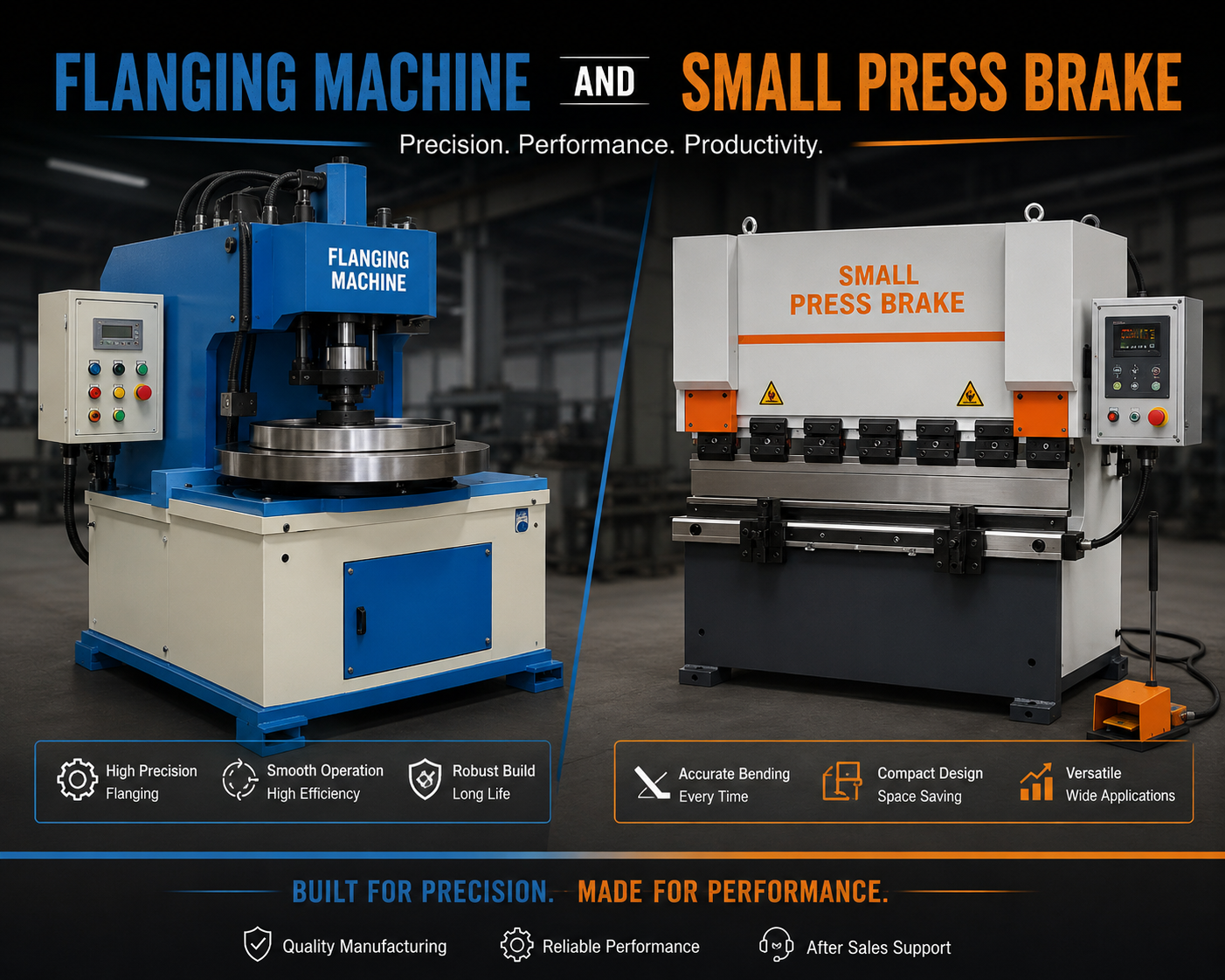
Metal fabrication has evolved significantly as manufacturers look for faster, more accurate, and more cost-effective ways to shape sheet metal and cylindrical components. Two machines that play an important role in this transformation are the flanging machine and the small press brake. Although both are used for metal forming, they serve different purposes and are selected according to the geometry, material, production volume, and precision requirements of a project.
Understanding the difference between these machines can help manufacturers, fabricators, and engineering businesses choose the right equipment for their applications.
What Is a Flanging Machine?
A flanging machine is specialized equipment designed to form or shape flanges along the edges of metal components. A flange is a projecting rim, collar, or edge that can be used for joining, strengthening, sealing, or connecting one component to another.
Flanging machines are commonly used in industries that manufacture:
- Metal ducts and ventilation systems
- Automotive components
- Pressure vessels
- Tanks and containers
- HVAC equipment
- Industrial piping
- Sheet metal assemblies
- Aerospace components
Depending on the machine design, flanging may be performed through mechanical forming, hydraulic pressure, or automated processes. The objective is to create a consistent flange with controlled dimensions and a clean finish.
How Does a Flanging Machine Work?
The basic operation depends on the machine configuration and the component being manufactured. Generally, the workpiece is positioned securely before forming tools apply controlled force to shape the metal.
A typical process involves:
- Preparing and positioning the metal workpiece.
- Aligning the component with the forming tool.
- Securing the workpiece to prevent unwanted movement.
- Applying forming pressure to create the flange.
- Checking the finished dimensions and surface quality.
Modern machines can incorporate programmable controls, automated positioning, and precision tooling to improve repeatability.
What Is a Small Press Brake?
A small press brake is a compact sheet metal bending machine designed to produce accurate bends in relatively small or lightweight workpieces. It uses a punch and die system to apply force to sheet metal and create a predetermined bend angle.
Unlike a flanging machine, which focuses specifically on forming flange features, a small press brake is a more versatile solution for general sheet metal bending.
Small press brakes are useful for:
- Electrical enclosures
- Small brackets
- Metal cabinets
- Control panels
- Automotive parts
- Appliance components
- Custom fabrication
- Prototype manufacturing
Their compact size makes them particularly attractive to workshops with limited floor space or manufacturers producing smaller components.
Why Choose a Small Press Brake?
A small press brake can provide an excellent balance between flexibility, precision, and operational efficiency. Manufacturers can use different punches and dies to create various bending profiles without requiring multiple specialized machines.
Key advantages include:
- Compact footprint
- Lower space requirements
- Flexible tooling options
- Accurate bending performance
- Suitable for prototypes and short production runs
- Easier integration into small fabrication workshops
Flanging Machine vs. Small Press Brake
Although both machines perform metal-forming operations, their applications are significantly different.
| Feature | Flanging Machine | Small Press Brake |
| Primary function | Forms flanges and edge profiles | Bends sheet metal |
| Typical workpiece | Specialized components and cylindrical parts | Flat sheet and plate |
| Main tooling | Flanging or forming tools | Punch and die |
| Application | Joining, sealing, reinforcement | General metal fabrication |
| Flexibility | Application-specific | Highly versatile |
| Best suited for | Repetitive flange production | Small and customized components |
The best choice depends on the desired geometry. If a manufacturer needs consistent flange formation, a flanging machine may be the more efficient option. For multiple bending operations and different component designs, a small press brake is generally more flexible.
Important Factors When Selecting a Flanging Machine
Choosing the correct flanging equipment requires more than comparing machine size or price. Manufacturers should evaluate several technical factors.
Material Compatibility
The machine must be capable of processing the intended materials. Stainless steel, aluminum, mild steel, and other alloys have different forming characteristics.
Component Dimensions
The diameter, thickness, and shape of the workpiece influence the required machine capacity. Selecting equipment with appropriate working limits can improve both productivity and safety.
Production Volume
For high-volume manufacturing, automated or CNC-controlled equipment may offer better repeatability. For smaller production requirements, a simpler machine may provide sufficient performance.
Precision Requirements
Industries such as aerospace and automotive manufacturing may require tight dimensional tolerances. In these situations, machine rigidity, tooling accuracy, and control systems become especially important.
Selecting the Right Small Press Brake
A small press brake should be selected according to the material thickness, bending length, and required force.
1. Bending Capacity
The machine should have enough tonnage to bend the required material without excessive strain. Overloading a machine can reduce accuracy and shorten equipment life.
2. Working Length
The maximum bending length determines the size of components that can be processed. A compact press brake is ideal for smaller parts, but manufacturers should consider future production requirements.
3. CNC Control
CNC systems can improve repeatability by automatically controlling bend sequences, angles, and positioning. This is particularly valuable when producing multiple identical components.
4. Tooling
The availability of compatible punches and dies directly affects machine versatility. A broader tooling selection allows manufacturers to perform different bending operations.
How These Machines Improve Manufacturing Efficiency
Modern metal fabrication depends heavily on precision and repeatability. Both flanging machines and small press brakes can help reduce production inconsistencies when correctly matched to the application.
The benefits may include:
- Reduced manual forming work
- Improved dimensional consistency
- Faster production cycles
- Lower material waste
- Better repeatability
- Reduced setup time
- Improved workplace productivity
Manufacturers can also combine these machines within a broader production workflow. For example, a sheet metal component may first be cut, then bent using a small press brake, while specialized flange-forming operations are completed using dedicated flanging equipment.
Maintenance and Safety Considerations
Regular maintenance is essential for reliable machine performance. Operators should inspect tooling, hydraulic or mechanical systems, electrical components, and safety mechanisms according to manufacturer recommendations.
Important practices include:
- Conducting routine inspections.
- Keeping forming tools clean and properly maintained.
- Checking hydraulic systems for leaks where applicable.
- Verifying machine alignment.
- Training operators in safe operating procedures.
- Using appropriate personal protective equipment.
- Following recommended load and capacity limits.
Preventive maintenance can reduce unexpected downtime and help maintain consistent forming quality.
Future Trends in Metal Forming Equipment
The metal fabrication industry is increasingly adopting automation, digital controls, and smart manufacturing technologies. CNC systems, automated material handling, real-time monitoring, and connected production environments are becoming more common.
For both flanging machines and small press brakes, future developments are likely to focus on:
- Greater automation
- Improved energy efficiency
- Faster setup
- Advanced CNC controls
- Remote diagnostics
- Higher precision
- Integration with smart factory systems
These developments can help manufacturers respond to increasingly demanding production requirements while maintaining cost efficiency.
Frequently Asked Questions
1. What is the primary purpose of a flanging machine?
A flanging machine is primarily designed to form flanges or specialized edge profiles on metal components for joining, sealing, or reinforcement.
2. What does a small press brake do?
A small press brake bends sheet metal into specific angles and shapes using a punch and die system.
3. Are flanging machines and press brakes interchangeable?
Not always. A press brake is versatile for general sheet metal bending, while a flanging machine is designed for specialized flange-forming operations.
4. Which machine is better for small workshops?
A small press brake can be an excellent option for workshops handling diverse sheet metal fabrication jobs because of its compact design and tooling flexibility.
5. Can a small press brake handle stainless steel?
Yes, provided the machine has adequate bending force, working capacity, and suitable tooling for the required stainless steel thickness.
6. Are CNC press brakes worth considering?
CNC press brakes can be valuable for businesses requiring accurate, repeatable bends and efficient production of multiple identical parts.
7. What industries use flanging machines?
Common industries include automotive, HVAC, pressure vessel, industrial equipment, aerospace, and metal fabrication.
8. Why is tooling important in press brake operations?
The correct tooling determines the type, angle, and quality of the bend and can significantly expand the machine’s capabilities.
9. How can manufacturers improve machine efficiency?
Proper operator training, preventive maintenance, optimized tooling, accurate programming, and suitable material handling can improve overall efficiency.
10. How should a manufacturer choose between these machines?
The decision should be based on the required component geometry, material, production volume, dimensions, precision, and available workspace.
https://newsgrow.blogspot.com/2026/06/flanging-machine-and-small-press-brake.html