
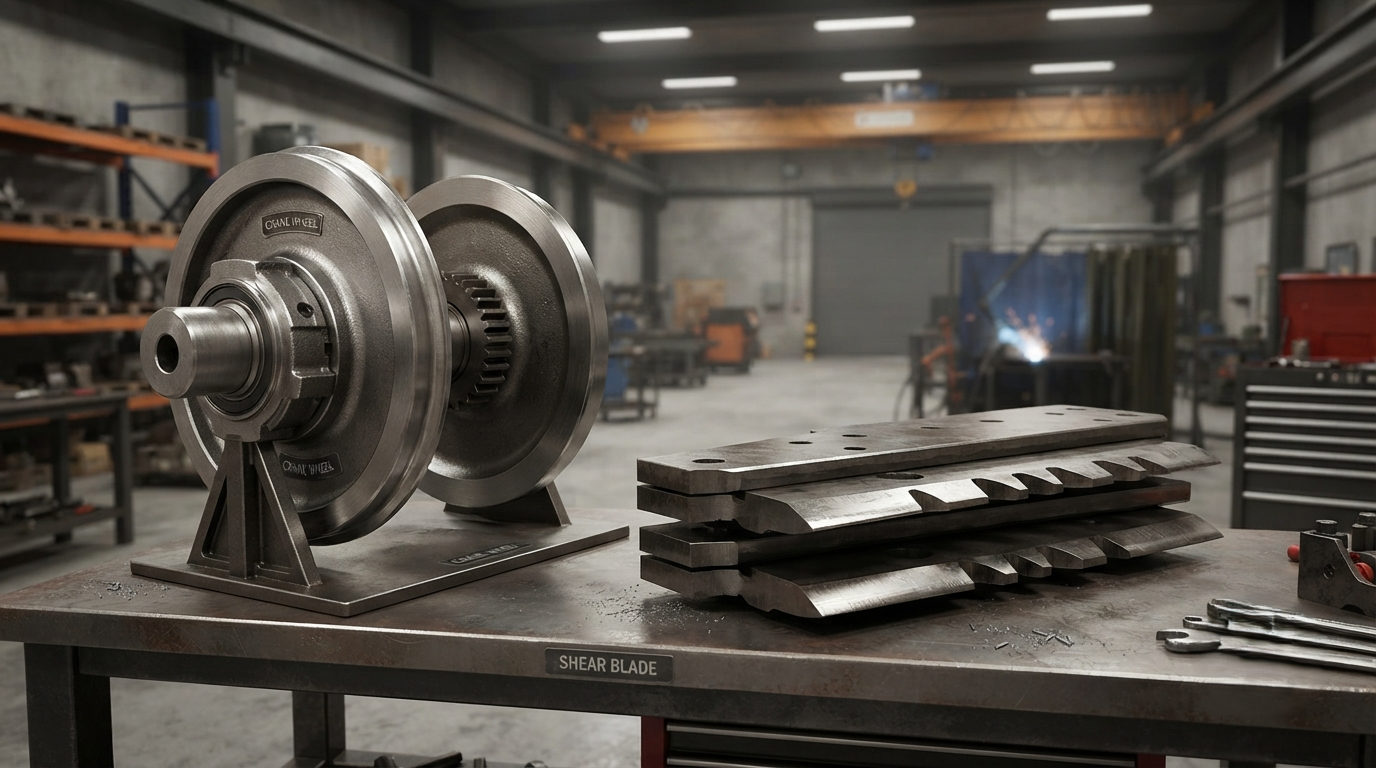
Although these parts belong to different categories of machinery, both require careful engineering, appropriate material selection, controlled heat treatment, accurate machining, and regular inspection.
A Crane Wheel transfers the load of cranes onto rails and enables controlled travel, while a Shear Blade converts machine force into a precise cutting action. Understanding the engineering behind these components helps plant engineers, maintenance teams, procurement professionals, and machine manufacturers select products that provide better service life and operating consistency.
Deep Understanding of Crane Wheel Engineering
A Crane Wheel operates as part of the crane travel mechanism. It supports vertical loads while simultaneously dealing with rolling contact, acceleration, braking forces, rail irregularities, and side thrust.
The wheel must therefore perform two important functions:
- Carry the structural and lifted load.
- Maintain controlled movement along the crane rail.
The load is concentrated over a relatively small contact area between the wheel tread and rail. This creates considerable contact stress.
If the wheel material is too soft, rapid tread wear may occur. If it is excessively hard or brittle, cracking and surface damage can become a concern.
The challenge is to achieve the correct balance between hardness, strength, toughness, and fatigue resistance.
How Crane Wheel Geometry Affects Performance
The geometry of a Crane Wheel is as important as the material itself.
Important dimensions include:
- Outside diameter
- Tread diameter
- Tread width
- Flange thickness
- Flange height
- Bore diameter
- Hub length
- Keyway dimensions
Even a small dimensional variation can affect alignment and load distribution.
For example, when wheels installed on the same crane have different effective diameters, one side may travel slightly faster than the other. Over time, this can contribute to skewing, flange contact, rail wear, and increased stress on the crane structure.
Proper machining accuracy therefore plays a major role in the overall performance of the crane travel system.
Single-Flange and Double-Flange Crane Wheels
Crane wheels are available in several configurations.
Single-flange wheels contain a flange on one side of the tread, while double-flange wheels contain flanges on both sides.
Double-flange wheels are often used where additional rail guidance is required. However, wheel flanges should not continuously rub against the rail during normal travel.
Continuous flange contact can indicate:
- Rail misalignment
- Incorrect wheel alignment
- Crane skewing
- Structural distortion
- Difference in wheel diameter
A properly aligned Crane Wheel should primarily roll on its tread rather than depending constantly on the flange for guidance.
Materials Used in Crane Wheel Manufacturing
Material choice depends on load, crane classification, travel speed, operating environment, and expected service life.
Common options include:
- Medium-carbon steel
- High-carbon steel
- Alloy steel
- Forged steel
- Cast steel
Forged steel is often selected for demanding applications because forging can refine the material structure and improve mechanical strength.
Alloying elements may be added to improve hardenability, wear resistance, toughness, and fatigue properties.
However, selecting the most expensive material does not automatically guarantee superior performance. The material must match the operating conditions.
Importance of Crane Wheel Heat Treatment
Heat treatment changes the mechanical properties of the wheel material.
For crane wheels, surface or tread hardening may be used to increase resistance to rolling wear while retaining a tougher internal structure.
An effective heat-treatment process aims to provide:
- Wear-resistant tread surfaces
- Adequate core toughness
- Improved fatigue strength
- Controlled hardness depth
- Consistent mechanical properties
Improper treatment can create excessive brittleness, uneven hardness, or internal stresses.
For this reason, hardness specifications should be considered together with material grade and operating requirements.
Understanding Shear Blade Cutting Mechanics
A Shear Blade works through a very different mechanical principle.
Two blades move relative to each other and apply concentrated force to the workpiece. The material first undergoes elastic deformation, followed by plastic deformation and fracture.
A successful shearing process depends on:
- Blade sharpness
- Blade clearance
- Cutting angle
- Material thickness
- Material tensile strength
- Blade hardness
- Machine rigidity
When these factors are correctly balanced, the cutting process becomes cleaner and more efficient.
Why Blade Clearance Is Critical
Blade clearance is one of the most important variables affecting Shear Blade performance.
The clearance is the gap between the upper and lower blades during cutting.
If the clearance is too small, cutting force may increase significantly. This can cause excessive wear, heat generation, and machine loading.
If the clearance is too large, the cut edge may become rough and produce excessive burrs or deformation.
The correct clearance depends on material thickness, material type, and machine specifications.
It is therefore incorrect to use the same clearance setting for every material.
Metallurgy Behind a High-Quality Shear Blade
A Shear Blade must retain a sharp edge while resisting impact and repeated loading.
This creates a metallurgical challenge.
Very high hardness improves wear resistance, but excessive hardness can reduce toughness. A blade that is too brittle may chip when encountering hard spots or unexpected material variations.
A quality blade therefore needs:
- Edge hardness
- Core strength
- Impact toughness
- Wear resistance
- Thermal stability
- Dimensional stability
Proper steel selection and heat treatment determine how well these properties are balanced.
Common Shear Blade Materials
Different applications require different materials.
| Material | Main Property | Typical Application |
| Carbon Tool Steel | Economical cutting performance | Light-duty work |
| Alloy Tool Steel | Strength and wear balance | General fabrication |
| D2 Tool Steel | High wear resistance | Continuous production |
| HSS | Strong edge retention | Harder materials |
| Special Alloy Steel | Application-specific performance | Heavy-duty processing |
D2 tool steel, for example, is commonly valued for wear resistance, while HSS may be considered where greater edge retention is required.
The final choice should depend on material type, thickness, production volume, and machine characteristics.
How Cutting Material Influences Blade Life
Blade life changes significantly according to the material being processed.
Cutting thin mild steel places different demands on a Shear Blade than cutting thick stainless steel.
Important variables include:
- Material hardness
- Tensile strength
- Sheet thickness
- Surface coatings
- Production volume
- Cutting frequency
Harder materials may increase edge wear, while thicker materials generate greater cutting forces.
Plant operators should therefore evaluate blade performance according to the actual workload rather than using a fixed service-life expectation.
Comparison of Crane Wheel and Shear Blade Engineering
| Engineering Factor | Crane Wheel | Shear Blade |
| Primary Function | Crane travel | Metal cutting |
| Main Load | Compression and rolling | Shearing and impact |
| Critical Surface | Tread and flange | Cutting edge |
| Primary Failure | Wear and fatigue | Dulling and chipping |
| Key Property | Strength and toughness | Hardness and edge retention |
| Maintenance Focus | Alignment and wear | Clearance and sharpening |
Although they perform different tasks, both require accurate metallurgy and machining.
Common Crane Wheel Failure Modes
Several types of damage can occur during long-term service.
Common problems include:
- Tread wear
- Flange thinning
- Pitting
- Surface cracking
- Diameter reduction
- Flat spots
- Bearing-related damage
Excessive flange wear should not automatically be treated as a wheel-quality issue.
It may indicate a larger alignment problem within the crane runway.
Replacing the wheel without correcting rail or structural misalignment can result in repeated damage.
Common Shear Blade Failure Modes
Typical blade problems include:
- Edge rounding
- Chipping
- Cracking
- Uneven wear
- Loss of straightness
- Excessive burr generation
A dull blade increases cutting resistance.
This means the machine may require more force to complete the same operation, increasing stress on hydraulic, mechanical, and structural components.
Timely sharpening can therefore protect both the blade and the machine.
Importance of Precision Manufacturing
Precision machining influences both component types.
For crane wheels, machining determines tread concentricity, bore accuracy, flange geometry, and fitment.
For shear blades, precision grinding determines straightness, edge geometry, parallelism, and dimensional consistency.
Accurate manufacturing can contribute to:
- Smooth operation
- Lower vibration
- Better load distribution
- Improved cut quality
- Longer component life
- Reduced maintenance requirements
In demanding industrial applications, dimensional accuracy should be treated as a performance requirement rather than merely a manufacturing specification.
Frequently Asked Questions
1. Why is a Crane Wheel heat treated?
Heat treatment improves tread hardness, wear resistance, and fatigue performance while maintaining adequate toughness.
2. What causes crane wheel flange wear?
Rail misalignment, crane skewing, wheel misalignment, and excessive side forces are common causes.
3. Are forged crane wheels suitable for heavy-duty applications?
Yes. Forged wheels are commonly used where high strength and repeated heavy loads are involved.
4. How is crane wheel size selected?
Selection depends on crane load, rail dimensions, duty class, travel speed, and existing equipment design.
5. Why does a Shear Blade become dull?
Repeated cutting gradually wears the edge, particularly when processing hard or thick materials.
6. What happens when blade clearance is too large?
The material may develop excessive burrs, deformation, and poor edge quality.
7. Can shear blades be sharpened repeatedly?
Many blades can be re-ground several times as long as sufficient material remains and correct geometry is maintained.
8. What is the best steel for a shear blade?
There is no universal best grade. The right steel depends on cutting material, thickness, machine conditions, and production volume.
9. Why is toughness important in a blade?
Toughness helps prevent cracking and chipping when the blade experiences impact or difficult cutting conditions.
10. How can component life be increased?
Correct installation, proper material selection, accurate alignment, suitable operating settings, and preventive maintenance can extend service life.