
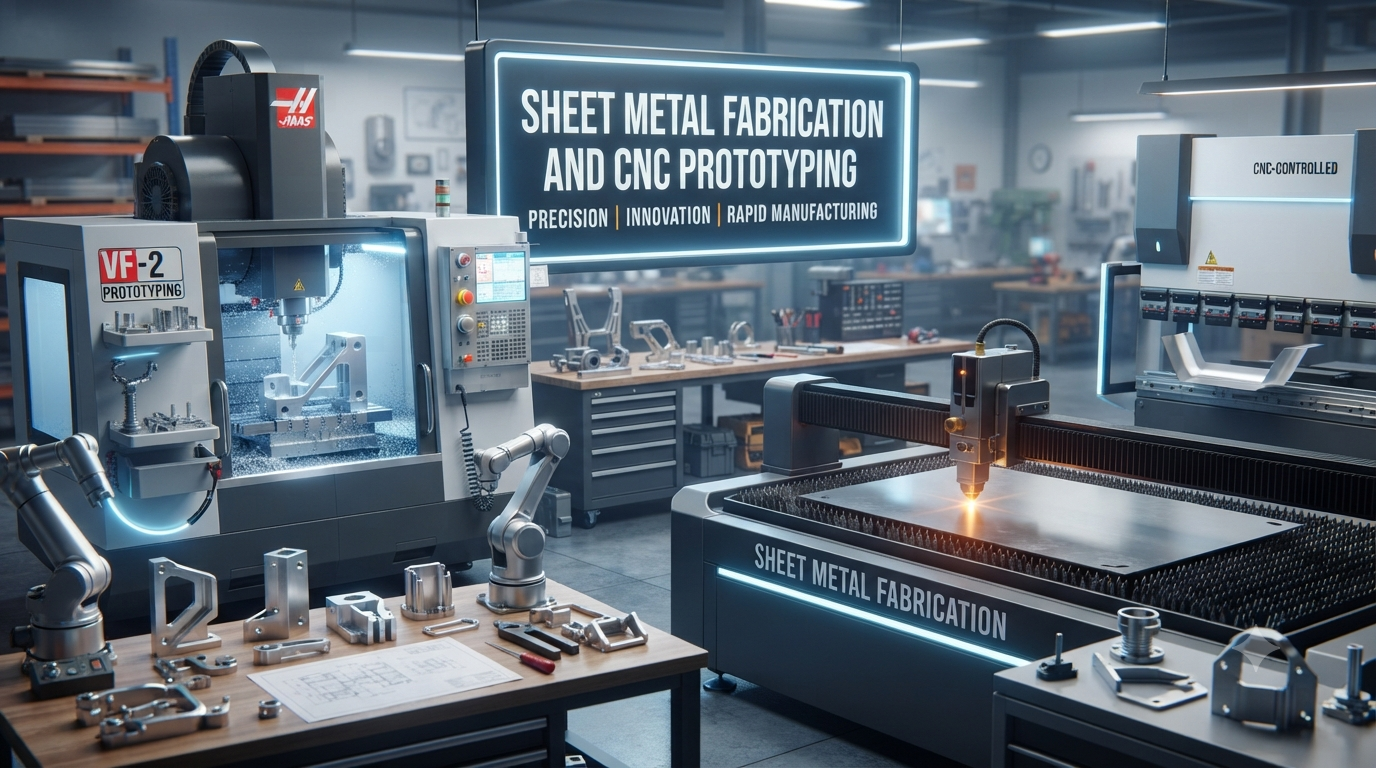
The global manufacturing landscape is entering a more agile era as companies rethink how quickly engineering concepts can be converted into testable, production-ready parts. Sheet metal fabrication and CNC prototyping are becoming central to this shift, helping manufacturers respond to customised designs, shorter development schedules and increasingly complex product requirements.
The change is particularly visible in industries where products contain a mixture of structural metalwork and precision mechanical components. Industrial automation, robotics, electric mobility, electronics, medical equipment and specialised machinery are among the sectors where combining fabrication and CNC machining can create a more efficient route from design to production.
Manufacturers Shift from Production-First to Prototype-First Thinking
One of the most notable changes in product development is taking place before full production even begins.
Traditionally, manufacturers could spend considerable time finalising drawings before producing physical components. Digital manufacturing now makes it more practical to manufacture early-stage parts, inspect them, test assembly and refine the design.
CNC prototyping plays a major role in this approach.
A CAD model can be translated into machining instructions, allowing CNC equipment to produce a physical component from aluminium, stainless steel, brass, engineering plastics and other suitable materials.
The prototype can then reveal practical issues that may not be immediately obvious on a computer screen.
These include:
- Incorrect mounting positions
- Insufficient component clearance
- Difficult assembly areas
- Thread compatibility problems
- Excessively thin walls
- Unnecessary machining features
- Mechanical interference
- Dimensional inconsistencies
Early identification gives engineering teams an opportunity to revise designs before larger quantities are ordered.
CNC Prototyping Moves Beyond Visual Models
The role of prototypes is also changing.
For many engineering applications, appearance alone is insufficient. Developers need to understand whether a component can be installed, assembled, moved, fastened or operated as intended.
This makes CNC prototyping particularly relevant for functional product validation.
Unlike a basic concept model, a CNC-machined prototype may contain actual holes, threads, pockets, slots, mounting faces and other engineering features.
Common CNC Prototype Applications
The technology is regularly considered for:
- Precision mounting components
- Machine parts
- Custom housings
- Mechanical interfaces
- Jigs and fixtures
- Robotics components
- Automotive development parts
- Electronic hardware
This ability to manufacture functional parts makes CNC machining useful throughout several stages of product development.
Sheet Metal Fabrication Evolves Alongside CNC Technology
While CNC machining is helping companies test detailed components, sheet metal fabrication is undergoing its own technological evolution.
Fabrication is no longer limited to manually cutting and forming metal. Modern production facilities can integrate CAD/CAM systems, CNC laser cutters, punching machines and programmable press brakes.
The process typically begins with a flat metal sheet.
The required profiles are cut before being bent, formed, welded or assembled into the final component.
Common fabricated products include:
- Electrical enclosures
- Industrial cabinets
- Machine covers
- Mounting brackets
- Control panels
- Metal frames
- Electronic chassis
- Equipment housings
- Battery enclosures
- Custom structural assemblies
Stainless steel, aluminium, mild steel and galvanised steel are among the commonly processed materials.
Digital Fabrication Brings Greater Flexibility to Custom Components
The connection between digital design and production is particularly important for customised manufacturing.
When a customer changes a dimension or feature, manufacturers can revise digital production data rather than necessarily creating an entirely new manufacturing method.
This makes modern sheet metal fabrication relevant for prototypes, customised components and repeat production.
However, engineering decisions remain important.
Fabrication Requires an Understanding of Material Behaviour
Metal behaves differently when it is cut, bent or welded.
Engineers need to account for:
- Bend radius
- Material thickness
- Springback
- Bend allowance
- Hole-to-bend distance
- Welding distortion
- Grain direction
- Fastening requirements
Digital Accuracy Alone Is Not Enough
A dimensionally accurate CAD file does not automatically guarantee a perfectly manufactured component. Successful fabrication depends on combining digital technology with an understanding of real material behaviour.
Two Processes, Different Strengths
Although sheet metal fabrication and CNC prototyping frequently appear within the same manufacturing project, they solve different engineering problems.
| Requirement | Sheet Metal Fabrication | CNC Prototyping |
| Starting material | Metal sheet | Solid stock |
| Core process | Cutting and forming | Material removal |
| Ideal for | Panels, brackets, enclosures | Detailed mechanical parts |
| Thin-wall structures | Excellent | Often inefficient |
| Complex 3D details | Moderate | Excellent |
| Prototype production | Suitable | Highly suitable |
| Common equipment | Laser cutter, press brake | CNC mill, CNC lathe |
| Materials | Metals | Metals and engineering plastics |
| Design changes | Digitally adaptable | Digitally adaptable |
The comparison highlights why many manufacturers are choosing to combine both processes rather than rely exclusively on one.
Hybrid Manufacturing Emerges as a Practical Strategy
A new industrial machine provides a straightforward example.
The machine may require a large protective enclosure produced through sheet metal fabrication. Inside that enclosure, however, there may be shafts, precision mounts, alignment blocks and mechanical interfaces requiring CNC machining.
Using solid CNC stock for the complete enclosure could waste material and increase machining requirements. Attempting to fabricate every precision component from sheet metal could create equally significant design limitations.
The more practical solution is to match each component with the manufacturing process best suited to it.
This strategy is increasingly relevant for:
- Robotics
- Electric vehicle equipment
- Automation systems
- Medical devices
- Renewable energy equipment
- Electronics
- Telecommunications
- Packaging machinery
- Laboratory systems
- Special-purpose industrial machines
Cost Engineering Begins at the Design Stage
Manufacturing cost is not determined only by labour and raw materials.
Design complexity can have an equally important influence.
A CNC component containing extremely deep pockets, sharp internal corners or unnecessary tolerances can require longer machining cycles and additional tooling.
Similarly, a fabricated component containing difficult bends or excessive welded sections can increase production complexity.
Design for Manufacturability, commonly called DFM, aims to identify these issues before production.
DFM Can Simplify Sheet Metal Fabrication
Designers may review:
- Bend locations
- Standard material thicknesses
- Hole dimensions
- Welding access
- Fastener selection
- Number of individual parts
DFM Can Improve CNC Prototyping
Machined components can be reviewed for:
- Tool accessibility
- Internal corner radii
- Pocket depth
- Wall thickness
- Undercuts
- Required tolerances
The objective is not simply to make a component cheaper. It is to manufacture it more efficiently while preserving its required performance.
Material Decisions Receive Greater Attention
The development of more specialised products is also making material selection increasingly important.
Aluminium can provide a useful combination of low weight, corrosion resistance and machinability. Stainless steel is often considered where corrosion resistance, cleanliness or durability is important.
Mild steel remains a practical choice for many structural applications.
Manufacturers must evaluate:
- Mechanical strength
- Weight limitations
- Environmental exposure
- Operating temperatures
- Machinability
- Weldability
- Corrosion resistance
- Surface appearance
- Finishing requirements
- Production economics
Selecting the appropriate material can simplify both manufacturing and long-term product performance.
Inspection Technology Supports Manufacturing Accuracy
As manufacturing becomes more automated, inspection is also becoming increasingly sophisticated.
Production teams can use digital callipers, micrometers, gauges, optical measurement systems and coordinate measuring machines to verify critical dimensions.
For CNC prototyping, inspection can confirm dimensions, bores, threads and geometric relationships.
For sheet metal fabrication, quality checks may cover bend angles, hole positions, flatness, welded assemblies and final dimensions.
Quality control becomes especially important when a prototype is approved and the same design is transferred into repeat production.
Flexible Manufacturing Becomes a Competitive Requirement
Companies developing specialised products increasingly need manufacturing systems that can accommodate changing quantities.
A project might begin with one prototype, progress to ten engineering samples and later require hundreds or thousands of components.
This is changing expectations surrounding manufacturing suppliers.
Businesses increasingly assess whether suppliers can provide:
- Engineering support
- DFM review
- Prototype manufacturing
- CNC prototyping
- Sheet metal fabrication
- Welding
- Surface finishing
- Assembly
- Inspection
- Production scaling
Having these capabilities within a coordinated supply chain can simplify communication throughout product development.
Frequently Asked Questions
1. What is sheet metal fabrication?
It is the manufacturing of components from flat metal sheets using processes such as cutting, bending, forming, welding and assembly.
2. Why is sheet metal fabrication widely used?
It provides an efficient way to manufacture brackets, panels, enclosures, frames and many thin-walled structural components.
3. What is CNC prototyping?
It is the use of computer-controlled machining equipment to produce accurate physical prototypes from digital designs.
4. What materials can be CNC machined?
Common materials include aluminium, steel, stainless steel, brass, copper and various engineering plastics.
5. Can CNC prototypes be functional?
Yes. CNC-machined prototypes can be used to evaluate dimensions, assembly, movement and other functional characteristics.
6. Is fabrication suitable for customised parts?
Yes. Digital cutting and bending equipment makes sheet metal fabrication suitable for many customised designs.
7. Can both manufacturing processes be used in one product?
Yes. Many industrial products combine fabricated structures with CNC-machined precision parts.
8. Why is DFM important?
DFM helps identify manufacturing difficulties before production and can simplify component design.
9. Which process is better for an enclosure?
Fabrication is generally more appropriate for thin-walled metal enclosures and cabinets.
10. Which process is better for complex solid parts?
CNC prototyping is typically better suited to detailed solid components requiring machined features.
https://newsgrow.blogspot.com/2026/08/rapid-injection-molding-and-china-rapid.html
https://newsgrow.blogspot.com/2026/08/aluminum-prototype-and-sheet-metal.html
https://newsgrow.blogspot.com/2026/08/deep-information-about-sheet-metal.html