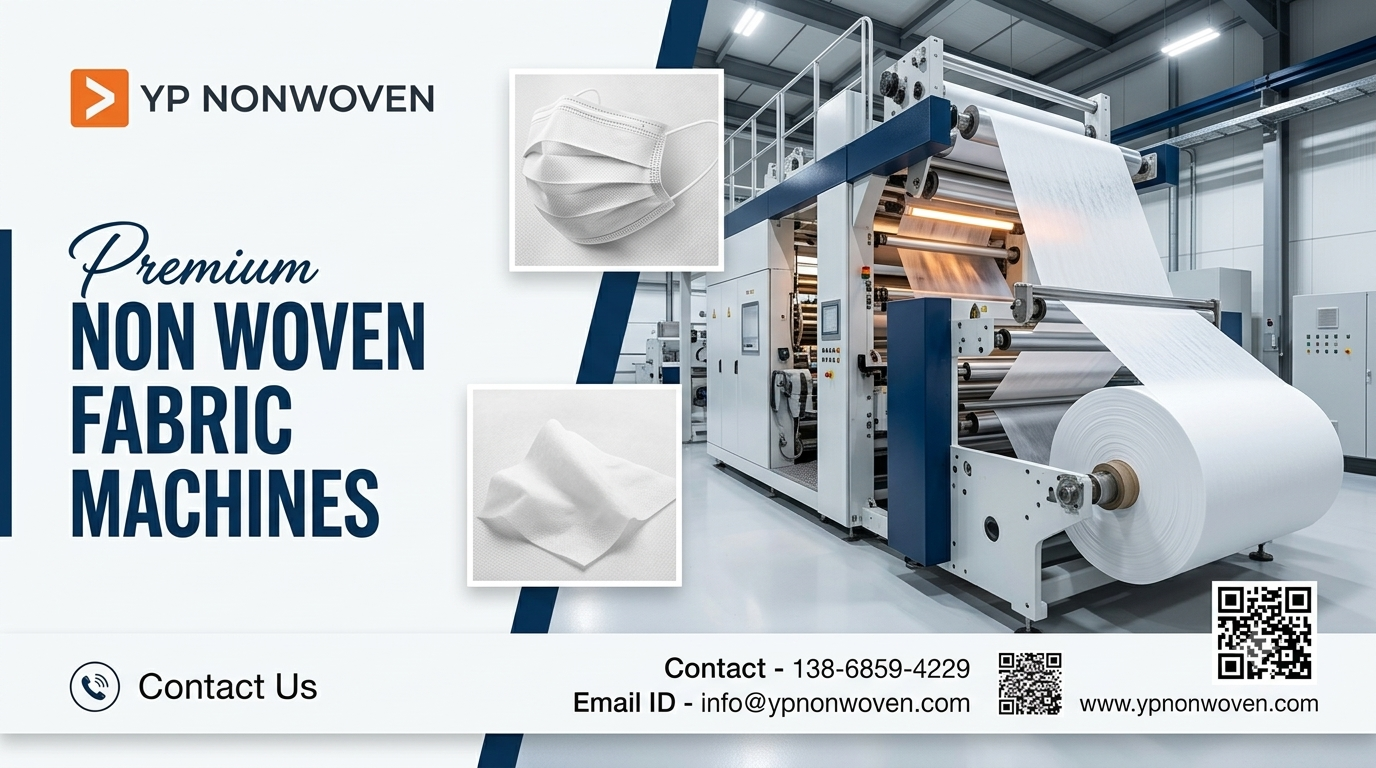
A non woven fabric machine is an industrial production system designed to manufacture fabric without traditional weaving or knitting. Instead of interlacing yarns, these machines convert polymer materials or fibers into a web and then bond them to create a continuous fabric structure. Modern equipment can produce materials with different weights, widths, strength levels, softness, filtration characteristics, and surface finishes for applications across hygiene, medical, agriculture, packaging, construction, filtration, and industrial markets. YPNONWOVEN provides customized nonwoven production solutions designed around production capacity, raw materials, fabric specifications, and end-use requirements. The company offers configurations including single-beam, double-beam, and three-beam spunbond lines, as well as spunmelt and PET spunbond systems.
What Is a Non Woven Fabric Machine?
A non woven fabric machine is a combination of interconnected processing units that transform raw materials into finished nonwoven rolls. In a typical PP spunbond system, polypropylene is melted and extruded through a spinneret to create continuous filaments. These filaments are stretched, cooled, distributed into a web, and subsequently bonded to form the finished fabric. Unlike conventional textile machinery, the process does not depend on yarn formation followed by weaving. This makes nonwoven manufacturing suitable for high-volume production where consistent fabric quality, efficient material utilization, and production flexibility are important.
How Does a Non Woven Fabric Machine Work?
The exact process depends on the technology and raw material, but a modern spunbond production line generally follows several key stages:
1. Raw Material Feeding
Polypropylene, PET, recycled polymers, or other suitable materials are prepared and fed into the extrusion system. Additives may be introduced when specific fabric characteristics are required.
2. Extrusion and Melting
The polymer is heated until it reaches the appropriate molten condition. The extruder then delivers the material under controlled pressure toward the spinning system.
3. Filament Formation
The molten polymer passes through a spinneret containing numerous fine openings. Continuous filaments are produced and subsequently stretched to achieve the required diameter and strength.
4. Web Formation
The filaments are cooled and distributed across the forming area. Controlled airflow and other process parameters help create a relatively uniform fiber web.
5. Bonding and Consolidation
The loose web must be consolidated into fabric. Depending on the technology, thermal, mechanical, chemical, or other bonding approaches can be used. In spunbond production, thermal bonding through calendering is commonly used to provide structural integrity.
6. Winding and Finishing
After bonding, the finished material is inspected and wound into rolls. Additional processes such as slitting, embossing, lamination, printing, or other converting operations may be added according to the final application.
Major Types of Nonwoven Machines
Not every manufacturer needs the same equipment. Selecting the appropriate technology depends on the required fabric properties and target market.
| Machine Type | Typical Raw Material | Common Applications | Key Advantage |
| PP Spunbond Machine | Polypropylene | Bags, agriculture, hygiene, packaging | High productivity and versatility |
| SMS Production Line | PP | Medical and hygiene products | Filtration and barrier performance |
| PET Spunbond Line | PET/RPET | Filtration, construction, automotive | Strength and temperature resistance |
| SMMS Line | PP | Hygiene and medical products | Multi-layer performance |
| SSS Line | PP | Hygiene, packaging, industrial products | Enhanced production flexibility |
| YPNONWOVEN’s current product range includes single-beam, double-beam, and three-beam PP spunbond systems, along with SMS, SMMS, SSMS, SSMMS, and PET spunbond production lines. |
Key Benefits of Modern Nonwoven Fabric Production
A properly engineered non woven fabric machine can provide several advantages for manufacturers:
- Continuous and automated production
- Consistent fabric weight and width
- Flexible material and product configurations
- High production efficiency
- Reduced manual intervention
- Compatibility with multiple downstream applications
- Precise PLC-based process control
- Opportunities for customized production lines
- Modern systems can also incorporate automation and touch-screen controls to simplify operation and improve process management. YPNONWOVEN states that its production solutions can be customized according to customer requirements and use PLC control and automated operation.
Applications of Nonwoven Fabric
The versatility of nonwoven materials is one of the primary reasons manufacturers invest in nonwoven production equipment. PP spunbond fabrics are used in packaging, agriculture, medical products, hygiene products, home textiles, and industrial applications.
Common Applications
- Hygiene: Diaper components, sanitary products, and related absorbent-product layers.
- Medical: Protective and filtration-related materials where appropriate specifications are required.
- Agriculture: Crop covers, plant protection materials, nursery applications, and ground-related products.
- Packaging: Shopping bags, packaging materials, and reusable fabric bags.
- Construction: Geotextile and building-related applications.
- Filtration: Selected nonwoven structures can be engineered for filtration applications.
- Industrial: Automotive, furniture, protective, and technical textile applications.
How to Choose the Right Non Woven Fabric Machine
Choosing equipment solely on purchase price can create problems later. Manufacturers should evaluate the complete production requirement before selecting a line.
Consider These Factors
- Target fabric GSM: Determine the required weight range before equipment selection.
- Fabric width: Choose a working width that matches current and projected orders.
- Annual capacity: Calculate expected production volume rather than relying only on maximum machine speed.
- Raw material: Decide whether PP, PET, recycled PET, PLA, or another material will be processed.
- Final application: Hygiene, agriculture, packaging, filtration, and industrial fabrics can require different configurations.
- Automation: Evaluate PLC systems, monitoring, process control, and operator requirements.
- Energy efficiency: Consider energy consumption as part of total operating cost.
- After-sales support: Installation, commissioning, spare parts, training, and technical assistance can significantly affect long-term productivity.
- For example, YPNONWOVEN publishes a standard 1600 mm line specification with a 10–150 GSM range, up to 150 m/min maximum speed, and stated capacity of 1,500 tonnes per year. Actual production results, however, depend on the machine configuration, raw material, GSM, operating conditions, and product specifications.
Why Choose YPNONWOVEN?
YPNONWOVEN focuses on the development and manufacture of nonwoven production equipment and offers customized solutions for different production requirements. Its portfolio covers PP spunbond, spunmelt, PET/RPET, and other specialized nonwoven technologies. The company also highlights engineering support covering installation, commissioning, and after-sales service. For manufacturers planning a new facility or expanding an existing plant, working with an experienced equipment supplier can help align machine configuration with fabric specifications, capacity targets, and long-term business objectives.
Frequently Asked Questions
1. What is a non woven fabric machine?
It is industrial equipment used to manufacture fabric without conventional weaving or knitting, commonly by forming and bonding fibers or polymer filaments.
2. What raw materials can be used?
Depending on the machine design, materials can include polypropylene, PET, recycled PET, PLA, and other suitable polymers or fibers.
3. What is a PP spunbond machine?
A PP spunbond machine converts polypropylene into continuous filaments and forms those filaments into bonded nonwoven fabric.
4. What is the difference between spunbond and spunmelt?
Spunbond primarily forms continuous filaments, while spunmelt systems combine spunbond and meltblown technologies to create multilayer structures.
5. What industries use nonwoven fabric?
Major sectors include hygiene, medical, agriculture, packaging, filtration, construction, automotive, and industrial manufacturing.
6. Can a nonwoven production line be customized?
Yes. Production lines can be configured according to fabric width, GSM range, output requirements, raw material, automation level, and intended applications.
7. Is automation important in nonwoven manufacturing?
Yes. Automated feeding, temperature control, web formation, winding, and PLC-based monitoring can improve process consistency and reduce manual intervention.
8. How do I select the correct machine capacity?
Start with expected annual demand, fabric GSM, working width, operating schedule, and product mix. Then select a configuration capable of meeting the required output with an appropriate production margin.
9. Can nonwoven machines produce different GSM fabrics?
Many modern systems are designed for a range of fabric weights, but the achievable GSM range depends on machine configuration, raw material, spinning technology, and process conditions.
10. Why is technical support important?
Installation, commissioning, operator training, maintenance guidance, and spare-parts availability can influence equipment uptime and long-term production performance.
Contact – 138-6859-4229
Email ID – info@ypnonwoven.com
Website – https://www.ypnonwoven.com/