
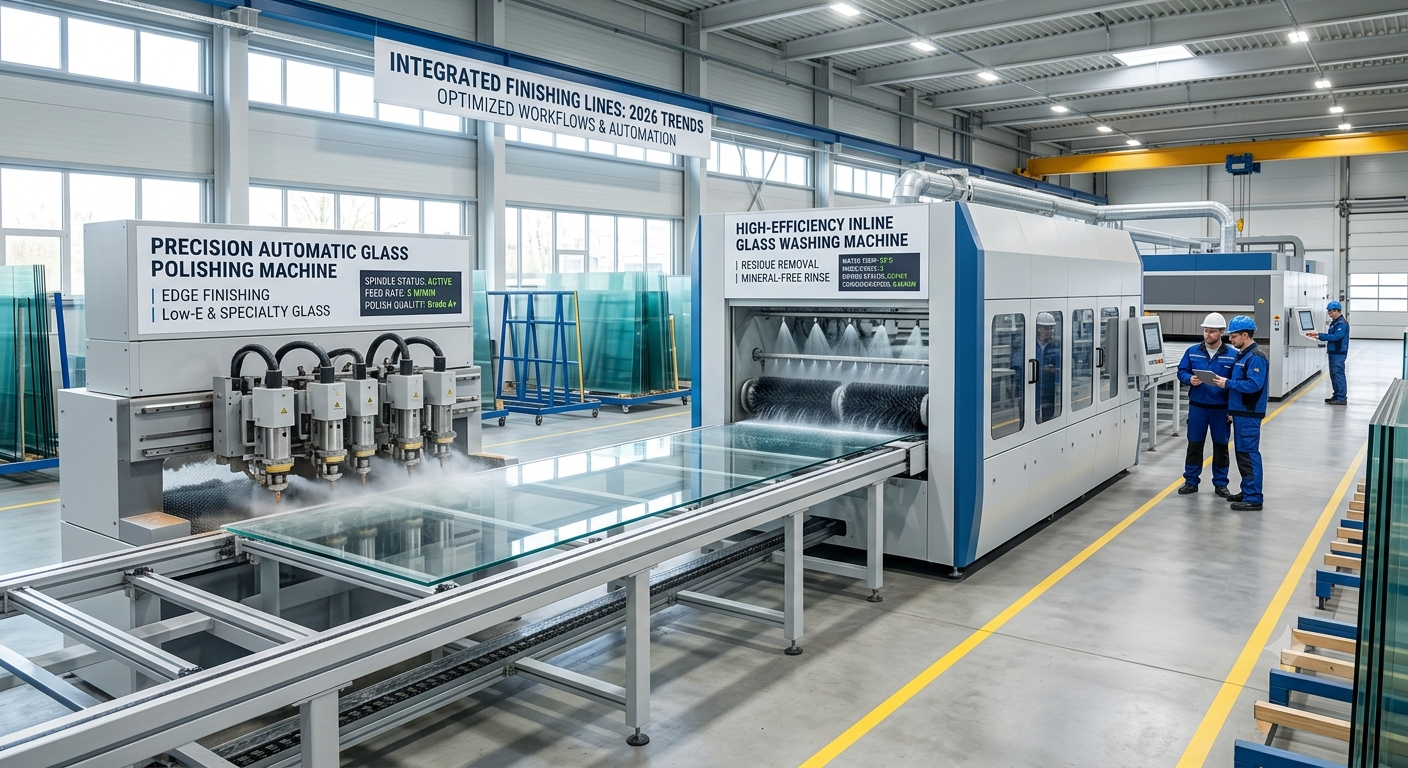
A high-quality glass polishing machine plays an important role in modern glass processing, particularly where clean edges, consistent finishing and efficient production are required. From architectural glass and furniture panels to mirrors, shower enclosures and industrial components, properly finished glass can improve both appearance and handling.
For many glass processors, polishing is only one part of the finishing process. After grinding or polishing, the glass often needs to be thoroughly cleaned before inspection, tempering, coating, laminating or packaging. This is where a glass washing machine becomes an important part of the production line.
Choosing the right equipment requires more than comparing machine prices. Glass thickness, edge profile, production volume, required finish, automation level and available factory space can all influence the right solution.
This guide explains how glass polishing machines work, what to look for before buying one, how glass washing equipment fits into the process, and which questions manufacturers should ask suppliers.
What Is a Glass Polishing Machine?
A glass polishing machine is industrial equipment designed to grind, smooth and polish the edges or surfaces of glass to achieve a specified finish.
Depending on the machine configuration, it may be used for:
- Straight-line edge polishing
- Flat glass edge processing
- Arris grinding and polishing
- Bevel edge polishing
- Seamed edge finishing
- Mirror edge processing
- Architectural glass processing
- Furniture and interior glass
- Shower enclosure glass
- Decorative and speciality glass
The main purpose is to remove sharp or rough edges created during glass cutting and grinding while producing a smoother, more consistent surface.
A professional glass polishing system can also help manufacturers achieve repeatable edge quality across larger production runs.
How Does a Glass Polishing Machine Work?
The exact process depends on the machine design and the type of glass being processed. However, a typical operation follows several stages.
1. Glass loading
The glass panel is positioned on the machine’s conveyor or support system. Automated equipment may use rollers, suction systems or other handling mechanisms to move the panel into position.
2. Edge grinding
Abrasive wheels remove irregularities and unwanted material from the glass edge. The grinding stage establishes the required edge geometry.
3. Fine grinding
Additional abrasive wheels refine the edge and prepare it for polishing. The selection of abrasive wheels depends on the glass type and desired finish.
4. Polishing
Polishing wheels or tools create a smoother and more visually refined edge. The number and type of polishing stages can vary according to the machine configuration.
5. Cooling and water management
Water is commonly used during glass grinding and polishing to control heat and remove glass particles. Proper water circulation and filtration are therefore important considerations when selecting equipment.
6. Inspection
The finished glass can then be checked for edge consistency, chips, scratches, haze and other surface defects.
For high-volume production, automation can reduce manual handling and help maintain consistent processing conditions.
Why Is Edge Polishing Important?
Glass edges can be sharp, uneven or visually unattractive after cutting. Edge processing addresses these problems while preparing the product for its intended application.
A properly processed edge can provide:
Improved appearance: Polished edges are particularly important for visible applications such as furniture, architectural interiors and decorative glass.
Better handling: Smoother edges can make finished panels easier and safer to handle when appropriate processing and workplace safety procedures are followed.
Consistent production: Automated machinery can provide more repeatable results than highly manual finishing processes.
Application-specific finishing: Different projects may require arrissed, seamed, flat-polished or bevelled edges.
The correct finish should always be determined by the product’s technical requirements rather than appearance alone.
Glass Polishing Machine vs Glass Grinding Machine
Although the terms are sometimes used interchangeably, grinding and polishing are not exactly the same operation.
Grinding primarily removes material and establishes the required edge shape.
Polishing follows grinding to refine the processed surface and improve its visual finish.
Many modern machines combine several grinding and polishing stages in one automated system. This allows a glass processor to complete multiple operations without repeatedly transferring the panel between separate machines.
When comparing equipment, ask the supplier which operations are included in the machine and what edge finishes it can actually produce.
What Is a Glass Washing Machine?
A glass washing machine is designed to clean glass after processing by removing particles, dust, coolant residue and other contaminants from the glass surface.
Washing is particularly important before processes where surface cleanliness affects the next production stage.
A typical glass washing system may include:
- Loading section
- Pre-washing area
- Brush cleaning section
- Rinsing stage
- Air-knife or drying system
- Inspection area
- Conveyor system
The machine configuration varies according to the glass application, dimensions, thickness range and required cleaning standard.
Why Combine Glass Polishing and Washing?
Glass processing often involves several interconnected operations. Grinding and polishing can leave fine particles or processing residues on the glass. If the glass is being sent to another production stage, those contaminants may need to be removed.
A typical workflow could look like:
Glass cutting → Edge grinding → Edge polishing → Glass washing → Drying → Inspection → Tempering/coating/assembly
Integrating polishing and washing equipment into a coordinated production process can make material movement more efficient and reduce unnecessary manual handling.
For larger manufacturers, automated glass processing lines can combine multiple stages to create a more streamlined workflow.
Key Applications of Glass Polishing Machines
A glass polishing machine can be used across a wide range of industries and products.
Architectural Glass
Large glass panels used in buildings often require carefully processed edges before installation or further fabrication.
Applications may include:
- Building façades
- Interior partitions
- Balustrades
- Doors
- Display areas
- Architectural features
Furniture Glass
Glass tables, shelves, cabinets and display furniture often require attractive, smooth edges because the edge is visible in the finished product.
Shower Enclosures
Shower doors and panels can require precise edge processing and finishing to meet design and fabrication requirements.
Mirrors
Mirror manufacturers may use edge processing equipment to prepare the perimeter of mirror panels before framing or installation.
Automotive and Industrial Glass
Specialised glass processing applications may require highly controlled grinding and polishing parameters. Machine selection should be based on the technical specifications of the particular product.
How to Choose the Right Glass Polishing Machine
Buying a machine is a significant production decision. Before requesting quotations, define your actual processing requirements.
1. Glass Thickness Range
Determine the minimum and maximum glass thickness you process.
A machine designed for a specific thickness range may not be suitable if your production includes significantly thinner or thicker material.
Ask the supplier for the machine’s confirmed processing range rather than relying on a general description.
2. Maximum Glass Size
Consider the largest glass panel you regularly process.
The machine should accommodate your production requirements without creating unnecessary handling challenges.
3. Required Edge Finish
Different products require different edge profiles and levels of finishing.
You may need:
- Flat polish
- Arrissed edge
- Seamed edge
- Bevelled edge
- Other specialised profiles
Clearly define the required finish before selecting the machine.
4. Production Capacity
Think about your current production volume as well as realistic future requirements.
A machine that is too small can become a bottleneck. However, buying significantly more capacity than your operation can use may unnecessarily increase capital expenditure.
The objective is to match machine capability with actual production demand.
5. Automation Level
Modern glass processing machinery can range from relatively manual systems to highly automated production lines.
Consider whether you need:
- Manual loading
- Automatic glass positioning
- Automatic thickness adjustment
- Digital controls
- Automated edge processing
- Automatic washing and drying
- Production monitoring
The right level of automation depends on your production volume, labour model and budget.
6. Abrasive and Polishing Wheel Configuration
The wheel configuration has a direct effect on the machine’s processing capability.
Ask suppliers about:
- Number of grinding wheels
- Number of polishing wheels
- Wheel compatibility
- Replacement frequency
- Availability of consumables
- Recommended operating parameters
A machine is only as practical as its long-term consumable and maintenance support.
7. Water Circulation and Filtration
Because glass grinding and polishing commonly involve water, the water management system deserves careful attention.
Look at:
- Water circulation
- Filtration
- Tank capacity
- Pump arrangement
- Cleaning requirements
- Waste management
Poor water management can affect production efficiency and increase maintenance requirements.
8. Maintenance and Spare Parts
Before purchasing, ask:
- Are spare parts readily available?
- What routine maintenance is required?
- How quickly can technical support respond?
- Are replacement wheels and components easy to source?
- Does the supplier provide installation and operator training?
A machine’s purchase price is only one part of its total ownership cost.
How to Choose a Glass Washing Machine
If your production process requires washing equipment, evaluate it separately as well as considering how it integrates with your polishing system.
Important factors include:
Glass Thickness Compatibility
Confirm that the washing machine can handle your complete range of glass thicknesses.
Cleaning Performance
Ask what types of contaminants the system is designed to remove and how the washing, rinsing and drying stages operate.
Brush Configuration
Brush selection and configuration can affect cleaning performance and suitability for different glass types and coatings.
Drying System
An effective drying section is important when clean, dry glass must move directly to inspection or another manufacturing process.
Low-E and Coated Glass Compatibility
If your factory processes coated or specialised glass, confirm machine compatibility with the exact products you handle. Never assume that a general-purpose washing machine is suitable for every coating.
Common Mistakes When Buying Glass Processing Equipment
Several avoidable mistakes can lead to higher costs or production problems.
Choosing Based Only on Price
The cheapest machine is not necessarily the most economical solution over its working life.
Consider machine reliability, energy and water use, maintenance, consumables, technical support and expected production requirements.
Ignoring Future Production
If production is expected to increase, machine capacity should be considered during the initial investment decision.
Not Testing Your Actual Glass
A machine may perform well in demonstrations but still require adjustments for your particular glass type, thickness, edge profile or production conditions.
Where possible, ask the supplier to process samples representative of your actual products.
Overlooking After-Sales Service
A production machine requires ongoing support. Clarify warranty conditions, installation, training, spare parts and technical assistance before placing an order.
Buying Without Defining the Edge Finish
“Polished glass” can mean different things depending on the application. Specify the exact edge profile and finish you require.
Glass Polishing Machine Maintenance Tips
Regular maintenance can help keep glass processing equipment operating consistently.
A practical maintenance programme may include:
- Cleaning glass particles from machine areas
- Checking water circulation systems
- Inspecting pumps and filters
- Checking abrasive and polishing wheels
- Monitoring conveyor components
- Inspecting belts and moving parts
- Checking lubrication points where applicable
- Cleaning washing brushes
- Inspecting drying systems
- Following the manufacturer’s maintenance schedule
Operators should always follow the equipment manufacturer’s instructions and appropriate workplace safety procedures.
Questions to Ask a Glass Machine Manufacturer or Supplier
Before requesting a quotation, prepare a clear list of technical questions.
- What glass thickness range can the machine process?
- What is the maximum glass size?
- Which edge profiles can it produce?
- How many grinding and polishing stages are included?
- What production speed is achievable for our specific glass?
- Can the machine process coated or specialised glass?
- What washing and drying options are available?
- What consumables are required?
- What are the recommended maintenance intervals?
- Are installation and operator training included?
- What spare parts are readily available?
- Can you conduct a sample test using our glass?
- What electrical and water requirements does the machine have?
- What warranty and technical support are provided?
These questions can make supplier comparisons much more meaningful than comparing headline prices alone.
When Should You Invest in a Glass Polishing Machine?
Investing in dedicated equipment may make sense when glass processing has become a regular part of your production workflow and manual or outsourced finishing is limiting efficiency, consistency or capacity.
It can be particularly relevant when you need:
- Higher production consistency
- Repeatable edge finishing
- Greater processing capacity
- Reduced manual handling
- Integration with other glass processing equipment
- Better control over production schedules
However, the business case should be evaluated against your actual production volume, labour costs, available factory space, maintenance requirements and expected return on investment.
Glass Polishing Machine Buying Checklist
Before making a purchase, review the following:
- [Control]Required glass thickness range
- [Control]Maximum glass dimensions
- [Control]Required edge profile
- [Control]Required polishing quality
- [Control]Expected daily/monthly production
- [Control]Machine automation level
- [Control]Water and electrical requirements
- [Control]Glass washing requirements
- [Control]Consumables and abrasive wheels
- [Control]Spare-parts availability
- [Control]Installation and training
- [Control]Warranty and technical support
- [Control]Factory space and machine layout
- [Control]Sample testing with your glass
Frequently Asked Questions
What is a glass polishing machine used for?
A glass polishing machine is used to grind, smooth and polish glass edges to achieve a specified edge profile and finish. It is commonly used for architectural, furniture, mirror, shower and industrial glass applications.
What is the difference between glass polishing and glass washing?
Glass polishing processes the glass edge or surface to achieve the required finish, while glass washing cleans contaminants and particles from the glass after processing. The two machines can form complementary stages in a glass processing line.
Is a glass washing machine necessary after polishing?
It depends on the production process. If the glass needs to be clean before inspection, coating, tempering, laminating or another downstream operation, washing can be an important part of the workflow.
How do I select the right glass polishing machine?
Start with your glass thickness, maximum dimensions, edge profile, production volume and required finish. Then compare machine configuration, automation, consumables, maintenance requirements and supplier support.
Can one machine process different glass thicknesses?
Many industrial machines are designed to process a defined range of glass thicknesses. However, the actual range varies by model, so it should be confirmed with the manufacturer before purchase.
What should I consider when buying a glass washing machine?
Consider glass thickness, maximum panel dimensions, brush configuration, washing and rinsing performance, drying system, compatibility with coated glass, production capacity, maintenance and after-sales support.