
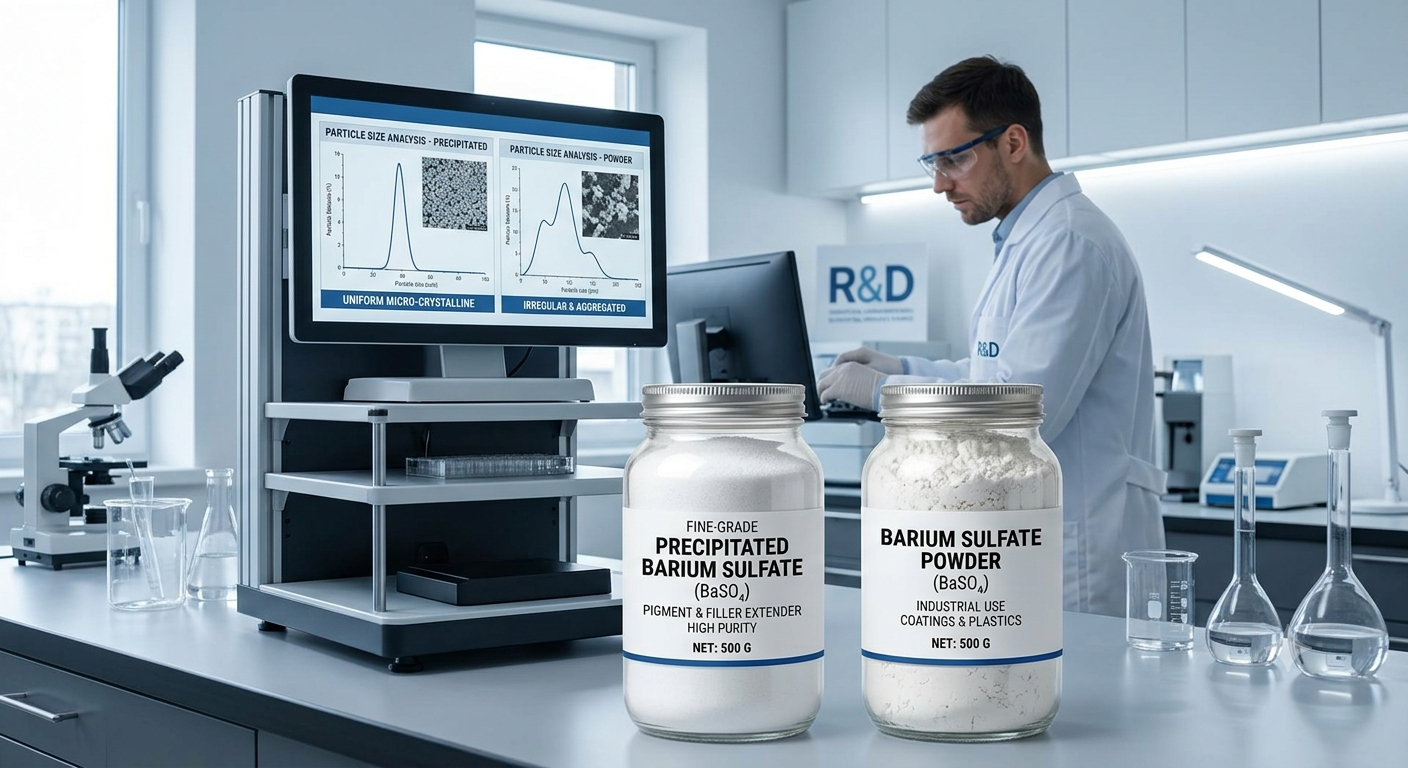
Precipitated Barium Sulfate is a high-purity, finely engineered form of barium sulfate (BaSO₄) produced through a controlled precipitation process. Compared with naturally occurring baryte, precipitated grades can offer tighter control over particle size, purity, morphology and dispersion—properties that make them useful in coatings, plastics, rubber, inks, paints, adhesives and other industrial formulations.
For manufacturers, formulators and procurement teams, selecting the right grade is not simply a matter of choosing a Barium Sulfate Powder with the highest purity. Particle-size distribution, surface treatment, oil absorption, moisture, whiteness, dispersibility and compatibility with the final formulation can all affect performance.
This guide explains what precipitated barium sulfate is, how it differs from natural barium sulfate, where it is used, what specifications matter and how to evaluate a supplier.
What Is Precipitated Barium Sulfate?
Precipitated barium sulfate is a synthetic inorganic compound manufactured by chemically precipitating barium ions with a sulfate source under controlled processing conditions.
Its chemical formula is BaSO₄. The resulting material is typically a white, fine powder with high chemical stability and low solubility in water.
The precipitation process allows manufacturers to engineer characteristics such as:
- Particle size and particle-size distribution
- Particle morphology
- Purity
- Whiteness and brightness
- Surface characteristics
- Oil absorption
- Dispersion behaviour
- Moisture content
These characteristics are particularly important when barium sulfate is being used as a functional filler rather than simply as a bulk mineral extender.
Precipitated Barium Sulfate vs Natural Barium Sulfate
The main difference is how the material is produced.
Natural barium sulfate, commonly associated with the mineral baryte or barite, is obtained from mineral deposits and then processed, refined and milled.
Precipitated barium sulfate is chemically manufactured. Because the production conditions can be controlled, synthetic grades can be designed to provide more consistent physical and chemical characteristics for specific industrial applications.
| Property | Precipitated Barium Sulfate | Natural Barium Sulfate |
| Source | Chemically precipitated | Mined mineral |
| Particle engineering | Highly controllable | Dependent on processing |
| Purity | Can be engineered to high levels | Varies with mineral source |
| Particle-size control | Generally precise | Depends on milling/classification |
| Morphology | Can be controlled during production | Determined largely by mineral structure |
| Typical role | Functional filler/performance additive | Extender, filler and industrial mineral |
The appropriate choice depends on the formulation and required technical specifications rather than on the product name alone.
Key Properties of Precipitated Barium Sulfate
Understanding the material’s properties helps formulators determine whether a particular grade is suitable for their application.
1. High Chemical Stability
Barium sulfate is known for its chemical stability and extremely low water solubility. This makes it useful in formulations where resistance to many chemical environments is important.
2. Fine Particle Size
Precipitated grades can be manufactured with controlled particle dimensions. Fine particles may improve surface characteristics, opacity, texture and dispersion when the material is properly incorporated into a formulation.
3. High Whiteness
High-quality grades can provide a clean white appearance, making them valuable in paints, coatings, plastics, inks and other products where colour and appearance matter.
4. High Density
Barium sulfate has a relatively high specific gravity compared with many conventional mineral fillers. This characteristic can be useful when density is an important formulation parameter.
5. Low Oil Absorption in Selected Grades
Oil absorption varies according to particle characteristics and grade. A lower oil absorption value can be desirable in certain coatings, plastics and masterbatch formulations because it may influence resin demand, viscosity and processing behaviour.
6. Controlled Surface Characteristics
Surface treatment or engineered morphology can influence how barium sulfate interacts with polymers, resins, solvents and other formulation components.
Major Applications of Precipitated Barium Sulfate
Precipitated barium sulfate is used across several industrial sectors. The required specification can differ significantly from one application to another.
Paints and Coatings
In coatings, barium sulfate can function as a functional extender and filler.
It may contribute to:
- Whiteness and brightness
- Surface smoothness
- Opacity
- Gloss characteristics
- Chemical resistance
- Filler loading
- Formulation stability
The correct grade should be selected according to the resin system, pigment package, desired gloss and processing method.
Plastics and Masterbatch
Fine barium sulfate powder can be incorporated into selected thermoplastics and polymer systems.
Depending on grade and formulation, it may be used to influence:
- Density
- Stiffness
- Surface appearance
- Dimensional characteristics
- Filler loading
- Processing performance
Compatibility and dispersion are especially important in polymer applications. A technically suitable powder can still produce poor results if it is not dispersed properly.
Rubber Products
Barium sulfate may be used as a functional or reinforcing-type filler in certain rubber formulations.
The appropriate grade depends on the polymer, processing conditions, filler loading and desired mechanical properties.
Printing Inks
In printing ink formulations, fine barium sulfate may be selected for its whiteness, particle characteristics and ability to contribute to the physical properties of the finished ink.
The exact grade should be evaluated against the ink vehicle, pigment system, viscosity requirements and printing process.
Adhesives and Sealants
Selected grades can be incorporated into adhesive and sealant formulations as mineral fillers.
Important considerations include particle size, moisture, surface treatment, viscosity impact and compatibility with the binder system.
Industrial and Speciality Formulations
Barium sulfate is also used in various speciality applications where high density, chemical stability, whiteness or controlled particle characteristics are required.
Because formulation requirements differ substantially, suppliers should provide technical documentation for the specific grade rather than relying only on a generic product description.
Why Particle Size Matters
Particle size is one of the most important considerations when selecting Precipitated Barium Sulfate.
A finer powder can behave differently from a coarser material in terms of:
- Dispersion
- Surface area
- Oil absorption
- Viscosity
- Gloss
- Settling behaviour
- Packing characteristics
- Interaction with resins and polymers
However, “finer” does not automatically mean “better”.
For example, a coating manufacturer may prioritise surface finish and optical performance, while a plastic compounder may be more concerned with dispersion, processing behaviour and the effect on mechanical properties.
The correct specification is therefore application-dependent.
How to Choose the Right Barium Sulfate Powder
Before purchasing a Barium Sulfate Powder, technical and procurement teams should review the following parameters.
Chemical Purity
Check the stated BaSO₄ content and impurity profile. Depending on the application, levels of elements such as iron or other trace impurities may be relevant.
Particle-Size Distribution
Ask for the full particle-size specification rather than relying on descriptions such as “fine powder”.
A technical datasheet may provide values such as D50 or other particle-size measurements.
Whiteness and Brightness
For paints, plastics, inks and visually sensitive products, whiteness can be a critical purchasing specification.
Oil Absorption
Oil absorption can affect resin demand, viscosity and formulation behaviour. Compare this value between grades rather than assuming products with the same chemical composition will perform identically.
Moisture
Moisture content can influence storage stability, dispersion and processing in moisture-sensitive formulations.
Specific Gravity
Because barium sulfate is a high-density material, specific gravity should be considered when calculating formulation loading and final product density.
Surface Treatment
Some applications may benefit from treated or modified barium sulfate grades. Ask whether the product is untreated or surface-modified and determine whether the treatment is compatible with your formulation.
Dispersion
Good dispersion is essential for achieving consistent performance. Request application-specific recommendations where available.
What Should a Technical Datasheet Include?
A reliable supplier should be able to provide a technical datasheet covering relevant specifications.
Depending on the product, this may include:
- Chemical composition
- BaSO₄ content
- Whiteness
- Particle-size distribution
- Specific gravity
- Oil absorption
- Moisture
- pH
- Residue on sieve
- Surface treatment information
- Packaging details
- Storage recommendations
- Applicable quality standards or test methods
For commercial purchasing, also ask for a Certificate of Analysis (CoA) for the relevant production batch where appropriate.
Precipitated Barium Sulfate for Different Industries
Different industries require different performance priorities.
Paint manufacturers may focus on whiteness, gloss, particle size, oil absorption and dispersion.
Plastic manufacturers may prioritise particle distribution, polymer compatibility, processing behaviour and final physical properties.
Rubber manufacturers may evaluate dispersion, filler loading and effects on compound performance.
Ink manufacturers may focus on particle fineness, optical characteristics, viscosity and compatibility with the ink system.
This is why a supplier offering multiple grades can be advantageous: the most suitable product depends on the end-use formulation.
Precipitated Barium Sulfate: Quality Control Considerations
Consistent raw-material quality is important for manufacturers producing products in large batches.
A supplier evaluation process should consider:
- Batch-to-batch consistency
- Specifications should remain within agreed tolerances.
- Testing procedures
- Ask how particle size, purity, whiteness and other critical parameters are measured.
- Traceability
- Batch identification and documentation can make quality investigations easier.
- Packaging quality
- Packaging should protect the powder from contamination and moisture during transportation and storage.
- Technical support
- A knowledgeable supplier should be able to discuss grade selection rather than simply quote a price.
Storage and Handling
Barium sulfate powder should be stored in suitable, dry conditions and protected from contamination and excessive moisture.
When handling fine powders, manufacturers should follow the relevant workplace safety procedures, including appropriate dust-control measures and personal protective equipment where required.
The supplier’s Safety Data Sheet (SDS) should be reviewed before handling, storage or processing.
Is Precipitated Barium Sulfate Suitable for Your Product?
It can be a strong option when your formulation requires a combination of controlled particle characteristics, high density, chemical stability and a white mineral filler.
However, suitability should be established through technical evaluation.
A practical approach is to compare a candidate grade against your current material using a controlled trial. Evaluate factors such as:
- Dispersion
- Viscosity
- Surface appearance
- Gloss
- Whiteness
- Processing behaviour
- Filler loading
- Final product performance
- Cost per finished unit rather than cost per kilogram alone
This approach provides a more meaningful basis for supplier selection.
Frequently Asked Questions
What is precipitated barium sulfate used for?
Precipitated barium sulfate is commonly used as a functional filler or extender in paints, coatings, plastics, rubber, printing inks, adhesives and other industrial formulations. Its controlled particle characteristics can make it suitable for applications where consistency and performance are important.
Is precipitated barium sulfate the same as baryte?
No. Both are barium sulfate, but baryte is a naturally occurring mineral whereas precipitated barium sulfate is synthetically produced through a controlled chemical precipitation process.
What is the difference between barium sulfate powder and precipitated barium sulfate?
“Barium sulfate powder” is a broad product description and may refer to material produced from natural mineral sources or synthetic processes. Precipitated barium sulfate specifically refers to barium sulfate produced through precipitation, allowing greater control over properties such as particle size and morphology.
How do I select the right grade?
Start with your application requirements. Compare chemical purity, particle-size distribution, whiteness, oil absorption, moisture, specific gravity, surface treatment and dispersion characteristics. For demanding applications, conduct a formulation trial before making a large-scale purchase.
Can barium sulfate be used in plastics?
Yes. Selected barium sulfate grades are used in polymer and plastic formulations. The appropriate grade depends on the polymer system, required loading, dispersion, processing conditions and desired finished-product properties.
Is finer barium sulfate always better?
No. Finer particles can provide advantages in certain applications, but they can also influence viscosity, surface area, dispersion and formulation requirements. The ideal particle size depends on the intended application.
What documents should I request from a supplier?
For industrial purchasing, consider requesting a technical datasheet, Safety Data Sheet and, where appropriate, a Certificate of Analysis. For critical applications, also discuss batch consistency, testing methods, packaging and traceability.