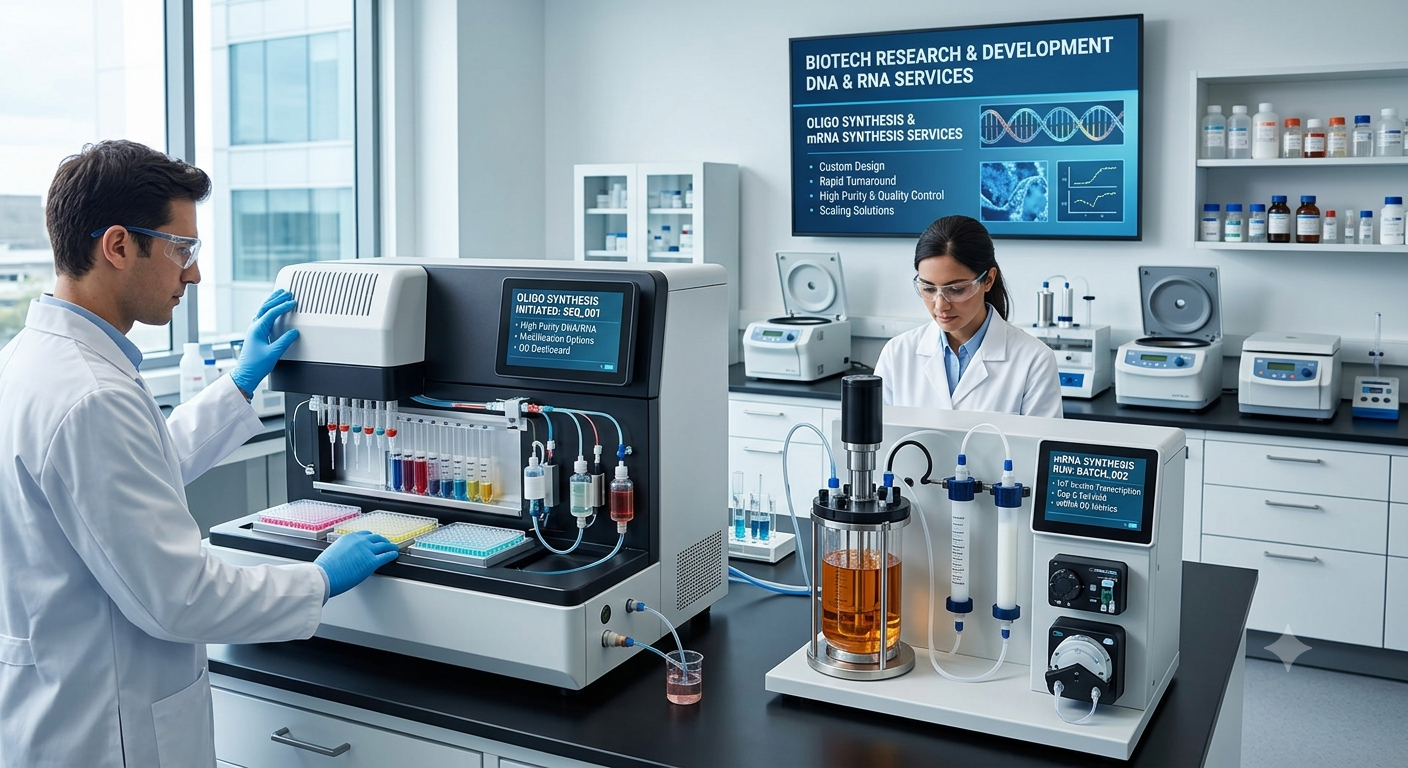
Oligo synthesis is the process of chemically producing short, custom-designed DNA or RNA sequences according to a specified nucleotide sequence. Depending on the application, researchers may require standard primers, modified oligos, probes, antisense sequences or more specialised constructs.
Choosing the right synthesis approach is not simply about ordering a sequence. Length, purity, scale, modifications, intended application and quality requirements all need to be considered before production.
This guide explains what oligo synthesis involves, how the process works, which factors affect quality and how it relates to broader services such as mRNA synthesis services.
What Is Oligo Synthesis?
Oligo synthesis is the laboratory production of short, custom DNA or RNA molecules with a defined nucleotide sequence.
The term “oligo” is short for oligonucleotide, a relatively short chain of nucleotides. Synthetic oligonucleotides can be designed for specific research purposes, including:
- PCR and RT-PCR primers
- DNA sequencing
- qPCR probes
- Gene cloning
- Site-directed mutagenesis
- Gene knockdown research
- Antisense research
- Molecular diagnostics
- Hybridisation assays
- CRISPR-related workflows
- Synthetic biology
- Molecular biology research
The required sequence and specifications depend heavily on the intended application. A primer designed for PCR, for example, has different requirements from an RNA oligonucleotide designed for gene regulation research.
How Does Oligo Synthesis Work?
Modern oligonucleotide production generally involves automated chemical synthesis, followed by purification and quality-control processes.
At a high level, the workflow includes:
- Sequence design – The desired nucleotide sequence is selected according to the research application.
- Chemical synthesis – Nucleotides are added sequentially to build the requested oligonucleotide.
- Cleavage and deprotection – The newly synthesised molecule is released from the synthesis support and processed to remove protecting groups.
- Purification – Depending on the application, the oligo may undergo desalting or more advanced purification.
- Quality control – The product is analysed using appropriate analytical methods.
- Final formulation and delivery – The oligonucleotide is prepared according to the requested specifications.
The exact manufacturing workflow can vary according to sequence length, chemistry, scale, purification method and modifications.
What Types of Oligos Can Be Synthesised?
A major advantage of custom oligo synthesis is flexibility. Researchers can order sequences designed specifically for their experiments rather than relying only on off-the-shelf products.
Common categories include:
DNA Oligonucleotides
Synthetic DNA oligos are widely used as primers, probes, cloning components and sequencing-related reagents.
Typical applications include PCR, sequencing, mutagenesis and synthetic biology.
RNA Oligonucleotides
RNA oligos can be used in applications involving gene regulation, RNA research and molecular biology.
Their production may require additional considerations because RNA chemistry and handling can differ from standard DNA oligonucleotide synthesis.
Modified Oligonucleotides
Chemical modifications can be incorporated to alter properties such as stability, binding behaviour or detection characteristics.
Depending on the application, researchers may consider modifications such as fluorescent labels, affinity tags or other specialised chemistries.
Long Oligonucleotides
As sequence length increases, synthesis and purification can become more challenging. Longer oligos may therefore require specialised production and quality-control strategies.
For complex projects, it is useful to discuss sequence requirements with a technical team before placing an order.
What Affects Oligo Synthesis Quality?
Not every oligo requires the same manufacturing specifications. The appropriate quality level depends on how the product will be used.
Key considerations include:
Sequence Length
Longer sequences generally present greater synthesis and purification challenges than shorter oligos. If a project requires a long or complex sequence, production specifications should be reviewed carefully.
Purity
Purification removes unwanted synthesis-related products and truncated sequences.
Common approaches can include:
- Desalting
- Cartridge purification
- HPLC
- PAGE
The appropriate option depends on the oligo and its intended use.
Synthesis Scale
Oligonucleotides may be produced at different synthesis scales depending on the quantity required.
A small-scale order may be suitable for routine research, while larger quantities may be appropriate for projects requiring repeated experiments or downstream development.
Chemical Modifications
Some applications require specialised modifications, such as fluorescent labels or other chemical groups.
Because modifications can affect synthesis complexity and cost, they should be specified at the design stage.
Quality Control
Quality-control requirements should match the intended application. Depending on the product, analytical information may include measurements related to identity, purity and quantity.
For research teams working on sensitive or highly reproducible assays, appropriate QC documentation can be an important part of supplier selection.
Oligo Synthesis vs. mRNA Synthesis Services
Although both involve nucleic acids, oligo synthesis and mRNA synthesis services are not interchangeable.
Oligo synthesis generally focuses on relatively short synthetic DNA or RNA molecules. mRNA production involves generating messenger RNA molecules suitable for specific research or development applications and typically requires additional processes and quality considerations.
Key Difference
| Feature | Oligo Synthesis | mRNA Synthesis |
| Typical product | Short DNA/RNA sequences | Messenger RNA |
| Common uses | Primers, probes, gene regulation, molecular biology | Protein-expression research and RNA-based development |
| Production complexity | Depends on sequence and modifications | Generally involves additional RNA production and processing requirements |
| Typical considerations | Sequence, length, purity, modifications | Template design, transcription, capping, poly(A), purity and RNA integrity |
| Applications | PCR, sequencing, diagnostics and research | Research, therapeutic development and other RNA applications |
For projects involving RNA-based development, a supplier offering both custom oligo capabilities and mRNA synthesis services may provide a more streamlined workflow.
What Are mRNA Synthesis Services?
mRNA synthesis services are specialised services designed to produce messenger RNA from a defined template or construct.
Depending on the project, an mRNA workflow may involve considerations such as:
- DNA template preparation
- In vitro transcription
- 5′ capping
- Poly(A) tailing or template-encoded poly(A)
- RNA purification
- RNA integrity assessment
- Concentration and yield
- Endotoxin or other project-specific quality requirements
The exact specifications should be selected according to the intended research or development application.
For example, a researcher investigating protein expression may have different requirements from a team developing an RNA-based therapeutic candidate.
Related resource: [mRNA synthesis and production guide]
Common Applications of Oligonucleotide Synthesis
Custom oligos support a wide range of laboratory workflows.
PCR and qPCR
Primers are among the most common synthetic oligonucleotides. Correct sequence design and appropriate purity are important for reliable amplification and downstream analysis.
DNA Sequencing
Sequencing primers can be designed for specific templates and experimental workflows.
Gene Cloning
Synthetic oligos can support cloning strategies by introducing specific sequences, mutations or regulatory elements.
Site-Directed Mutagenesis
Custom primers can be designed to introduce defined sequence changes into DNA constructs.
Molecular Diagnostics
Probes and primers are important components of many molecular detection methods. Diagnostic applications may require particularly careful attention to sequence design and validation.
Synthetic Biology
Researchers can use custom DNA sequences as building blocks in engineered biological systems.
Gene Regulation Research
RNA oligos and modified nucleic acids can be used in research investigating gene expression and cellular pathways.
How to Choose an Oligo Synthesis Provider
Selecting a synthesis provider should involve more than comparing the lowest quoted price.
Consider the following factors before ordering:
1. Technical Capabilities
Check whether the provider can produce the sequence types, lengths, scales and modifications your project requires.
2. Purification Options
Ask which purification methods are available and whether they are appropriate for your application.
3. Quality Control
Understand what QC testing and documentation are provided with the product.
4. Turnaround Time
If your project has fixed experimental timelines, confirm realistic production and delivery schedules before placing an order.
5. Scalability
For projects that may progress from research to larger-scale development, it can be useful to work with a provider capable of supporting changing requirements.
6. Technical Support
Complex sequences, modifications and RNA projects can involve design and production questions. Access to knowledgeable technical support can help identify potential issues before synthesis begins.
7. Customisation
A suitable provider should be able to accommodate project-specific requirements rather than forcing every sequence into a standard product format.
How Much Does Oligo Synthesis Cost?
There is no single price for custom oligo synthesis.
The final cost can depend on:
- Sequence length
- DNA or RNA chemistry
- Synthesis scale
- Purification method
- Chemical modifications
- Number of sequences
- Quantity required
- Quality-control requirements
- Delivery requirements
A short, standard DNA oligo may have very different pricing from a longer, modified or highly purified RNA oligo.
For an accurate quotation, provide the sequence, intended application, required quantity, modifications and preferred purification level wherever possible.
How to Prepare an Oligo Synthesis Order
Providing complete information at the beginning can make the quotation and production process more efficient.
Before requesting a quote, prepare:
Sequence: The exact nucleotide sequence.
Molecule type: DNA or RNA.
Scale: Approximate quantity required.
Purification: Standard or application-specific purification requirements.
Modifications: Any fluorescent labels, chemical modifications or other specialised requirements.
Application: PCR, sequencing, cloning, diagnostics, gene regulation or another intended use.
Delivery requirements: Desired formulation, concentration and shipping requirements, where applicable.
If you are unsure about the appropriate specifications, explain the intended application to the supplier. A technical team can then help determine which production options are appropriate.
Oligo Synthesis for Research and Development
For research organisations, biotechnology companies and academic laboratories, custom oligos can become an important part of the experimental workflow.
The most effective approach is to select specifications based on what the molecule needs to do, rather than automatically choosing the highest-cost option.
For example, a routine PCR primer may not require the same purification strategy as an oligonucleotide intended for a more demanding application. Similarly, a modified RNA molecule may require a different production workflow from a standard DNA primer.
Matching manufacturing specifications to the downstream application can help balance performance, quality requirements and project cost.
Frequently Asked Questions About Oligo Synthesis
What is oligo synthesis used for?
Oligo synthesis is used to produce custom DNA or RNA sequences for applications such as PCR, sequencing, cloning, gene regulation research, molecular diagnostics and synthetic biology.
What is the difference between an oligo and a primer?
An oligo is a short synthetic nucleic acid molecule. A primer is a type of oligonucleotide specifically designed to initiate DNA synthesis in applications such as PCR or sequencing.
Can RNA oligos be synthesised?
Yes. Custom RNA oligonucleotides can be synthesised using RNA-specific chemistry and processing methods. Requirements vary according to sequence, length, modification and intended application.
What purification method should I choose?
The appropriate purification method depends on the oligo’s sequence, length, modifications and downstream application. Routine applications may require simpler purification, while demanding applications can require higher-purity products.
What are mRNA synthesis services used for?
mRNA synthesis services are used to produce messenger RNA for applications such as protein-expression research, RNA biology and certain stages of RNA-based therapeutic development.
Can I order modified oligonucleotides?
Many synthesis providers support a range of modifications, including labels and specialised chemical modifications. Availability depends on the specific chemistry and supplier capabilities.
How do I get a quote for custom oligo synthesis?
Provide the required sequence, molecule type, quantity or synthesis scale, purification requirements, modifications and intended application. A technical quotation can then be prepared based on the project’s specifications.