
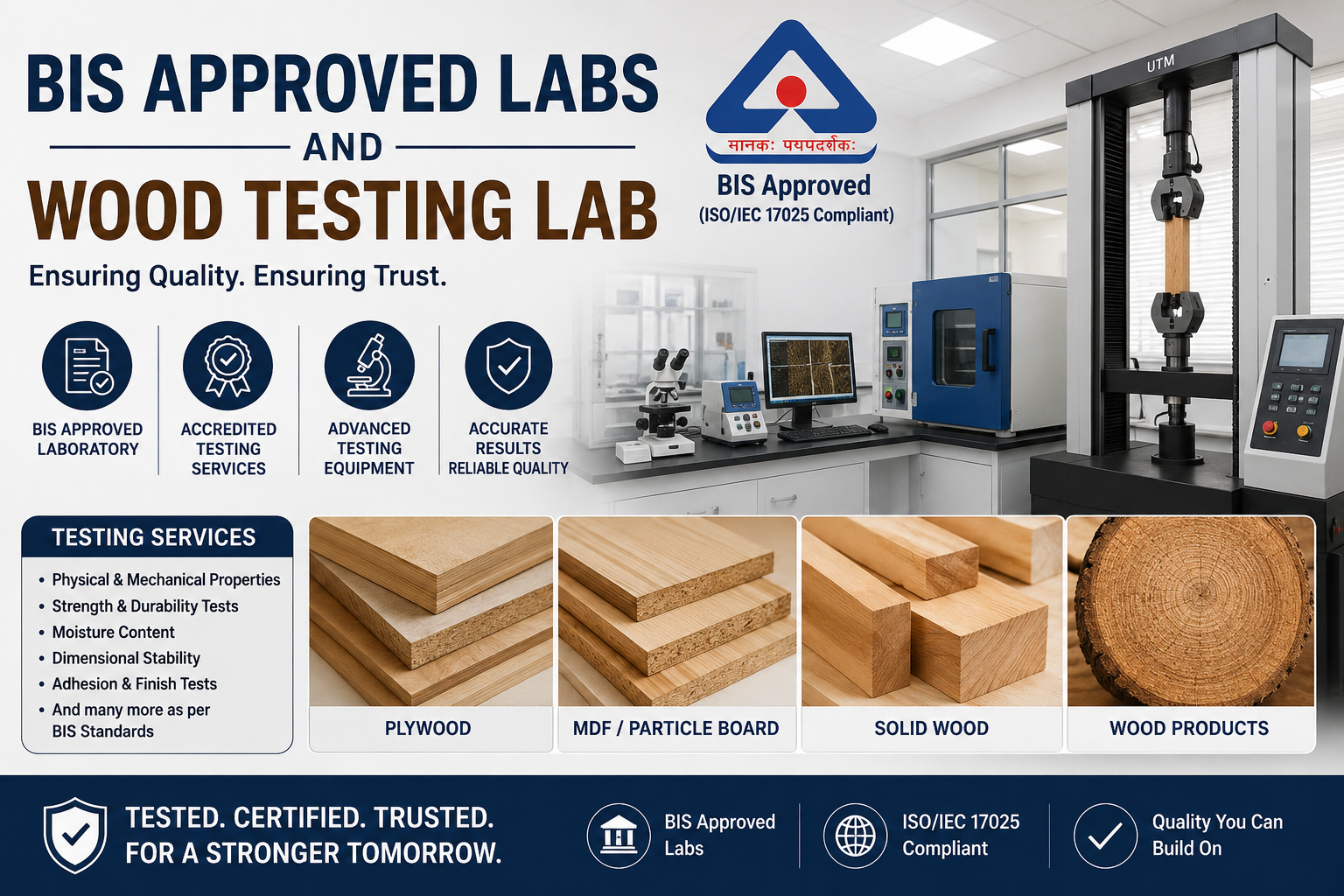
Choosing the right testing facility is an important step for manufacturers, exporters, importers and businesses that need to demonstrate product quality and regulatory compliance. When a product falls under an applicable Indian Standard, working with a competent laboratory can make the testing and certification process much more straightforward.
A BIS approved lab is a laboratory recognised by the Bureau of Indian Standards (BIS) for carrying out specified testing activities under defined standards and scopes. For businesses dealing with wood, timber, furniture or wood-based products, selecting the right Wood Testing lab is particularly important because different products require different test methods and performance parameters.
This guide explains what BIS-approved laboratories do, how testing works, what to check before selecting a laboratory, and how wood testing can support quality assurance and compliance.
What Is a BIS Approved Lab?
A BIS approved lab is a testing laboratory recognised by BIS for conducting particular tests within its approved scope.
The key point is that approval is scope-specific. A laboratory may be authorised to conduct certain tests for particular products or Indian Standards, but that does not automatically mean it can test every type of material or product.
Before sending samples, businesses should therefore verify:
- The relevant Indian Standard
- The product or material covered by the standard
- The specific test methods required
- Whether the laboratory’s scope covers those tests
- Sample requirements and quantity
- Expected testing timelines
- The format and details provided in the test report
This verification can prevent delays caused by submitting samples to a laboratory that does not cover the required test.
Why Do Businesses Use BIS Approved Laboratories?
Testing is often a critical part of demonstrating that a product meets specified technical requirements.
Depending on the product and applicable regulatory framework, laboratory testing may help businesses:
- Evaluate product performance
- Verify conformity with an Indian Standard
- Identify manufacturing or material defects
- Maintain consistent quality
- Support BIS certification or licensing processes where applicable
- Meet customer or procurement requirements
- Provide technical documentation for business transactions
- Investigate product failures or quality complaints
- Support product development and quality improvement
Testing should not be viewed simply as a compliance formality. A properly designed testing programme can also provide useful information for improving materials, manufacturing processes and finished products.
What Should You Check Before Selecting a BIS Approved Lab?
Not every laboratory is suitable for every testing requirement. The most important consideration is whether the laboratory’s recognised scope covers the exact test you need.
1. Check the Applicable Indian Standard
Start by identifying the relevant IS standard for your product.
For example, testing requirements for a wood-based product can differ substantially from those for metal, plastics, electrical equipment or construction materials.
If you are unsure which standard applies, discuss the product specification with a qualified testing professional before submitting samples.
2. Verify the Laboratory’s Scope
Do not rely only on a laboratory describing itself as a “BIS approved lab.”
Check whether the laboratory is recognised for the specific product, parameter and test method relevant to your requirement.
This is especially important when several tests are required under one standard.
3. Understand the Sample Requirements
Laboratories may require specific sample dimensions, quantities, conditioning or packaging.
Ask for sample-submission instructions before dispatching material. Incorrect or insufficient samples can result in additional work and unnecessary delays.
4. Ask What the Test Report Contains
A professional test report should clearly identify relevant details such as:
- Sample description
- Identification or reference number
- Applicable test standard or method
- Test conditions, where relevant
- Individual test results
- Units of measurement
- Laboratory information
- Date or period of testing
- Applicable observations or conclusions
The exact contents will depend on the testing requirement.
What Is a Wood Testing Lab?
A Wood Testing lab specialises in evaluating timber, wood products and, depending on its scope, wood-based materials.
Wood is a natural material, so its properties can vary according to species, moisture content, density, grain direction, processing and storage conditions. Laboratory testing helps convert these characteristics into measurable technical data.
A wood testing laboratory may support manufacturers and buyers working with products such as:
- Timber
- Sawn wood
- Wooden boards
- Plywood
- Veneer
- Fibreboard
- Particleboard
- Furniture components
- Structural wood products
- Other wood-based materials
The exact tests available depend on the laboratory’s recognised scope and equipment.
Common Tests Performed on Wood and Wood-Based Products
The appropriate test depends on the product and the applicable standard. Common areas of wood testing can include:
Moisture Content Testing
Moisture can significantly influence the performance and dimensional stability of wood.
Testing moisture content can help manufacturers determine whether material is within the required range for its intended application.
Density Testing
Density is an important physical characteristic of wood. It can be measured to support material identification, quality assessment and product evaluation where required by the applicable standard.
Bending Strength Testing
For products used in applications where mechanical performance matters, bending-related testing can help evaluate how the material behaves under specified loading conditions.
Compression Testing
Compression tests evaluate how a wood specimen performs when subjected to compressive forces under defined test conditions.
Tensile Testing
Where relevant to the product and standard, tensile testing can provide information about the material’s resistance to pulling forces.
Hardness Testing
Hardness testing can be useful for evaluating resistance to indentation or other defined forms of surface deformation.
Water Absorption and Related Tests
For certain engineered wood products, exposure to moisture can be an important performance consideration. Tests may evaluate water absorption, thickness changes or related properties according to the applicable standard.
Dimensional Stability
Wood products can respond to changes in moisture and environmental conditions. Dimensional-change testing can therefore be relevant for products where dimensional stability is an important performance characteristic.
Why Wood Testing Matters for Manufacturers
For manufacturers, testing provides more than a laboratory report. It can help establish whether raw materials and finished products are performing consistently.
For example, suppose a manufacturer produces wooden panels for furniture. Two batches may look identical but behave differently because of differences in moisture, density, adhesive performance or manufacturing conditions.
A structured testing programme can help identify these variations before products reach customers.
Testing can therefore contribute to:
Better quality control → fewer unexpected failures → improved consistency → stronger customer confidence
BIS Testing vs General Product Testing
One common misunderstanding is that every laboratory test is automatically a BIS compliance test.
That is not necessarily the case.
General laboratory testing can be conducted for research, quality control, product development, buyer requirements or internal evaluation. BIS-related testing, however, needs to be considered in the context of the applicable Indian Standard and the relevant certification or regulatory requirements.
The laboratory’s recognition and scope also matter.
If your objective is BIS certification, ask the laboratory specifically whether its scope covers the testing required for your certification application rather than assuming that any laboratory report will be accepted.
How the Laboratory Testing Process Usually Works
While the exact procedure varies by product, a typical process follows these stages:
Step 1: Identify the Product
Clearly describe the material or finished product, including its intended use.
Step 2: Identify the Applicable Standard
Determine the relevant Indian Standard and required test parameters.
Step 3: Select an Appropriate Laboratory
Verify the laboratory’s recognised scope and confirm that it can perform the required tests.
Step 4: Prepare the Samples
Follow the laboratory’s instructions for dimensions, quantity, packaging and identification.
Step 5: Submit the Samples
Provide the necessary product information and documentation along with the samples.
Step 6: Laboratory Testing
The laboratory conducts the specified tests using the applicable methods and equipment.
Step 7: Review the Results
The test report provides the measured results and other relevant information.
Step 8: Use the Results
Depending on the objective, the results may support quality control, product development, customer requirements or an applicable certification/compliance process.
How to Choose the Right Wood Testing Lab
If you are comparing several laboratories, do not make your decision based only on price.
Consider the following factors:
| Factor | Why It Matters |
| Relevant testing scope | Confirms the laboratory can perform the required tests |
| Applicable standards | Helps ensure the correct test method is used |
| Technical capability | Important for accurate and repeatable testing |
| Equipment | Appropriate equipment is essential for specified methods |
| Reporting | Clear reports are easier to use for compliance and quality decisions |
| Experience | Relevant testing experience can help with complex requirements |
| Turnaround time | Important when testing is linked to production or certification deadlines |
| Sample requirements | Helps avoid rejected or unsuitable samples |
| Documentation | Proper records support traceability |
A laboratory that understands your product category can also help clarify practical testing requirements before samples are submitted.
BIS Approved Lab: Questions to Ask Before Booking a Test
Before proceeding, ask:
Is the laboratory recognised for my specific test?
Confirm the exact scope rather than relying on a general statement of approval.
Which Indian Standard will be used?
Make sure the test method corresponds to the applicable requirement.
How many samples are required?
Sample quantities and dimensions can vary.
What information should accompany the samples?
This may include product specifications, identification details and other documentation.
What is the expected turnaround time?
Ask whether the stated timeline begins when samples are received, accepted or testing starts.
Will the report include individual test results?
Understand what information will be provided before commissioning the work.
Common Mistakes to Avoid
Choosing a Lab Based Only on Price
The lowest quotation may not be the most suitable option if the laboratory cannot provide the testing required for your application.
Assuming All BIS Labs Have the Same Scope
Laboratory recognition is not necessarily universal across all products and tests. Always check the relevant scope.
Sending Incorrect Samples
Incorrect dimensions, inadequate quantities or poor sample identification can create avoidable delays.
Using an Outdated Standard
Indian Standards can be revised. Confirm that the applicable version and testing requirements are current for your particular compliance purpose.
Treating the Test Report as a Certificate
A laboratory test report and a BIS licence or certification are not interchangeable. Businesses should understand the role each document plays in the applicable compliance process.
Who May Need Wood Testing Services?
Wood testing can be relevant to a wide range of organisations, including:
- Timber manufacturers
- Furniture manufacturers
- Plywood manufacturers
- Wood-product exporters
- Construction-material suppliers
- Interior product manufacturers
- Importers
- Procurement organisations
- Quality-control departments
- Research and development teams
- Product developers
For businesses selling wood products to institutional or commercial buyers, reliable technical test data can also support product specifications and procurement documentation.
How Testing Can Support Product Quality
Consider a furniture manufacturer sourcing timber from multiple suppliers.
Instead of relying entirely on visual inspection, the manufacturer can establish measurable acceptance criteria for relevant properties. Periodic laboratory testing can then help determine whether incoming material continues to meet those requirements.
This approach can make quality control more objective and help identify supplier or process variations earlier.
Frequently Asked Questions
What is a BIS approved lab?
A BIS approved laboratory is a laboratory recognised by the Bureau of Indian Standards for specified testing activities within its recognised scope. The relevant scope should be checked for the particular product and test required.
Is every test performed by a BIS approved lab automatically a BIS certification test?
No. A laboratory test is not automatically equivalent to BIS certification. The applicable standard, testing scope and certification requirements must be considered together.
What does a Wood Testing lab test?
Depending on its scope, a wood testing laboratory may test properties such as moisture content, density, mechanical strength, hardness, dimensional stability and other characteristics specified for particular wood or wood-based products.
How do I choose a wood testing laboratory?
Start by identifying the applicable product standard and required tests. Then verify that the laboratory’s recognised scope covers those exact requirements. Also compare technical capability, reporting, sample requirements and turnaround time.
Why is moisture testing important for wood?
Moisture content can influence the dimensional behaviour, stability and performance of wood. Testing provides a measurable value that can be compared against relevant product or quality requirements.
Can wood testing help with product development?
Yes. Laboratory testing can provide measurable information that helps manufacturers compare materials, evaluate prototypes, investigate failures and improve manufacturing processes.