
A consumer may spend only a few seconds opening a shampoo, dispensing a cleanser, or applying body lotion, yet those few seconds can determine how they feel about the entire product. If packaging is difficult to operate, messy, or wasteful, even an excellent formulation can lose some of its appeal.
That is why modern beauty companies are paying closer attention to dispensing components. The disc cap and cosmetic pump are two solutions that help transform an ordinary container into functional packaging. One emphasizes simplicity and quick access, while the other focuses on mechanical dispensing and controlled output.
But what makes these components work, and which one should a brand choose? The answer begins with understanding how consumers actually use cosmetic products.
The Hidden Importance of a Good Dispenser
Packaging has several jobs to perform before a cosmetic product reaches the consumer. It must survive filling, handling, storage, shipping, retail display, and repeated use.
Once opened, the dispenser becomes one of the most frequently handled parts of the package.
A good dispensing solution should provide:
- Smooth product flow
- Convenient operation
- Appropriate quantity control
- Reliable closing or recovery
- Protection against accidental leakage
- Compatibility with the formulation
- Consistent performance
- A positive tactile experience
The correct disc cap or cosmetic pump can help brands achieve these objectives without compromising their visual identity.
Why Disc Caps Work So Well for Everyday Products
Think about opening shampoo while your hands are wet. Unscrewing a small cap, holding it, dispensing the shampoo, and replacing the cap would be unnecessarily complicated.
A disc cap simplifies this interaction.
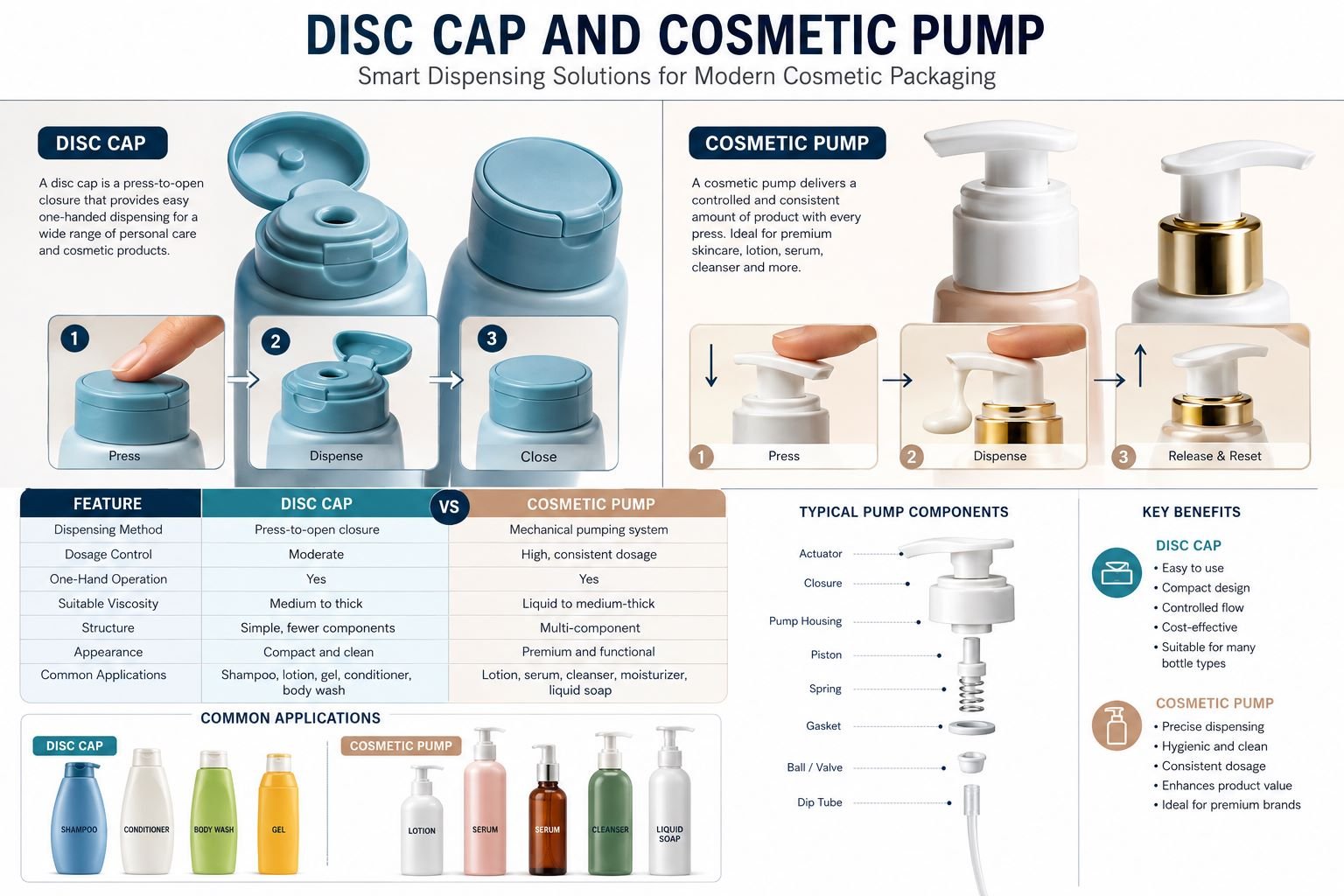
The user presses one part of the top disc. The opposite section rises, revealing the dispensing opening. The product can then be squeezed or poured from the bottle. Pressing the raised section closes it again.
No separate cap needs to be removed.
Where Can a Disc Cap Be Used?
The design makes the disc cap particularly useful for frequently used personal care products.
Typical applications include:
- Shampoo and conditioner
- Shower and bath gel
- Body lotion
- Facial cleansing products
- Hair styling formulations
- Personal care oils
- Hand-care products
- Salon products
However, simply attaching a disc closure to any bottle does not guarantee good dispensing.
The Science Behind Product Flow
A major consideration is viscosity—the resistance of a formulation to flowing.
Water-like products move quickly. Creams and thick conditioners move much more slowly.
Why Orifice Size Matters
The dispensing opening of a disc cap should complement the viscosity of the formulation.
If a thick formulation is paired with a very small opening, users may need excessive squeezing force. If a thin product uses an oversized opening, too much may be released at once.
Bottle Construction Matters Too
Bottle flexibility also affects performance. Many disc closures work with containers designed to be squeezed.
This means formulation, bottle, closure, and dispensing opening should be developed as a complete system rather than treated as unrelated components.
Why Cosmetic Pumps Offer a Different Experience
A cosmetic pump moves beyond simple opening and closing. It actively draws formulation from the bottle and transfers it through a dispensing nozzle.
This makes pumps useful where brands want greater control over application.
Lotions, moisturizers, facial cleansers, hand-care products, body-care formulations, and professional cosmetics frequently use pump packaging.
The familiar press-and-release action may look simple, but several internal components are working together.
What Is Happening Inside the Pump?
A typical cosmetic pump can include a dip tube, chamber, piston, spring, valve, gasket, housing, closure, and actuator.
When the actuator is pressed, movement inside the chamber helps force formulation toward the dispensing outlet.
When pressure is released, the mechanism returns toward its original position and helps draw additional product from the bottle.
Why Pumps Sometimes Need Priming
When a bottle is first opened, the internal pump pathway may contain air.
Several presses can be required before the formulation reaches the actuator. This process is known as priming.
What Happens After Priming?
Once primed, a properly selected pump should provide smooth and repeatable dispensing.
Pump output can also be engineered according to application requirements, making controlled dispensing one of the strongest advantages of a cosmetic pump.
Two Dispensers, Two Different Experiences
The difference becomes clearer when their characteristics are compared.
| Packaging Requirement | Disc Cap | Cosmetic Pump |
| Primary action | Press and squeeze | Press actuator |
| Internal mechanism | Minimal | Multi-component |
| Output control | User dependent | More controlled |
| Ideal container | Often flexible bottle | Rigid/semi-rigid bottle |
| Convenience | High | High |
| Typical positioning | Everyday products | Everyday to premium |
| Common formulation | Shampoo, gel, lotion | Lotion, cleanser, moisturizer |
| Component complexity | Lower | Higher |
| Dispensing experience | Direct | Measured |
| Visual profile | Compact | Distinctive |
Instead of asking which solution is universally better, brands should ask which provides the right experience for their particular formulation.
Why Controlled Dosage Is Becoming More Valuable
Cosmetic consumers increasingly want convenient products that are easy to use without unnecessary waste.
Imagine a moisturizer that releases three times more product than needed. Consumers may finish it faster, create a mess during application, and feel that the packaging lacks refinement.
A cosmetic pump can help solve this problem by providing more predictable output per complete stroke.
With a disc cap, consumers control output themselves through squeezing pressure and duration.
Both approaches are useful, but they serve different consumer behaviors.
Packaging Can Influence Perceived Product Quality
Consumers do not evaluate packaging only visually. They also judge it through touch and operation.
A closure that snaps securely into position can create confidence. Similarly, a pump with smooth actuator movement and consistent output can contribute to a premium experience.
Functionality Becomes Part of Branding
A practical haircare brand might prefer a colorful disc cap that makes products easy to identify in the shower.
A skincare company may choose a minimalist cosmetic pump to communicate controlled application and sophisticated design.
The dispenser should therefore support both technical requirements and brand personality.
What Should Brands Test Before Launch?
Packaging failure is significantly more expensive after thousands of finished products have already been filled.
Testing should happen during development.
Important evaluations can include:
- Closure and neck compatibility
- Leakage resistance
- Product dispensing behavior
- Pump output consistency
- Priming performance
- Drop resistance
- Repeated-use durability
- Chemical compatibility
- Storage stability
- Transportation simulation
Testing the actual formulation is important because different ingredients can behave differently inside packaging systems.
How Material Selection Affects Performance
Plastic materials such as polypropylene are frequently used for cosmetic dispensing components because they can provide durability, manufacturing flexibility, and chemical resistance.
A conventional cosmetic pump, however, may contain multiple materials because different components perform different mechanical functions.
Material selection should consider product compatibility, durability, aesthetics, manufacturing requirements, and end-of-life possibilities.
Can Dispensing Packaging Become More Sustainable?
Sustainability is creating new challenges and opportunities for cosmetic packaging manufacturers.
Brands increasingly want fewer materials, lighter packaging, refillable solutions, improved recyclability, and reduced component complexity.
A disc cap may offer opportunities for simplified construction because its operating mechanism is relatively straightforward.
Pump technology is also changing. New developments are focusing on reducing component complexity and improving recyclability.
Sustainability Requires a Complete-System Approach
A closure cannot be evaluated independently from the bottle.
Brands should consider:
- Total material consumption
- Component compatibility
- Bottle-to-closure ratio
- Refill potential
- Transportation efficiency
- Product waste
- Local recycling infrastructure
Reducing packaging weight while creating significant product waste would not necessarily produce the best environmental outcome.
How Should a Brand Make the Final Choice?
Instead of choosing a dispenser based on trends, begin with the formulation.
Determine its viscosity, required application quantity, consumer usage environment, bottle construction, target price, and brand positioning.
Then evaluate appropriate disc cap and cosmetic pump samples through real-world testing.
Packaging selection should be driven by evidence rather than assumptions.
Frequently Asked Questions
1. What does a disc cap do?
A disc cap provides a press-to-open dispensing system that allows products to be squeezed or poured without removing the closure.
2. Why are disc caps common on shampoo bottles?
Their simple operation makes them convenient for frequently used products, especially when consumers have wet hands.
3. What does a cosmetic pump do?
A cosmetic pump draws formulation from a container and dispenses it through an actuator-operated mechanical system.
4. Which products commonly use pumps?
Moisturizers, lotions, cleansers, hand-care products, body-care formulations, and liquid personal care products frequently use them.
5. Can a disc cap dispense lotion?
Yes. Its suitability depends on lotion viscosity, dispensing-hole dimensions, and bottle flexibility.
6. Why is pump dosage important?
Controlled output can improve application consistency and help reduce unnecessary product dispensing.
7. What is pump priming?
Priming is the process of removing air and drawing formulation into the pump before normal dispensing begins.
8. Can disc caps be customized?
Yes. Manufacturers may offer different colors, finishes, sizes, orifice dimensions, and closure configurations.
9. Should cosmetic packaging be tested with the actual formula?
Yes. Actual-formulation testing provides better insight into dispensing behavior, compatibility, leakage, and long-term performance.
10. Which dispenser is best for premium cosmetics?
A cosmetic pump is frequently used for premium products, although the best solution depends on formulation and brand strategy
https://newsgrow.blogspot.com/2026/08/cream-jar-and-cosmetic-jar.html
https://gosarkarijobs.com/disc-cap-and-cosmetic-pump-a-deep-guide-to-modern-cosmetic-packaging/