
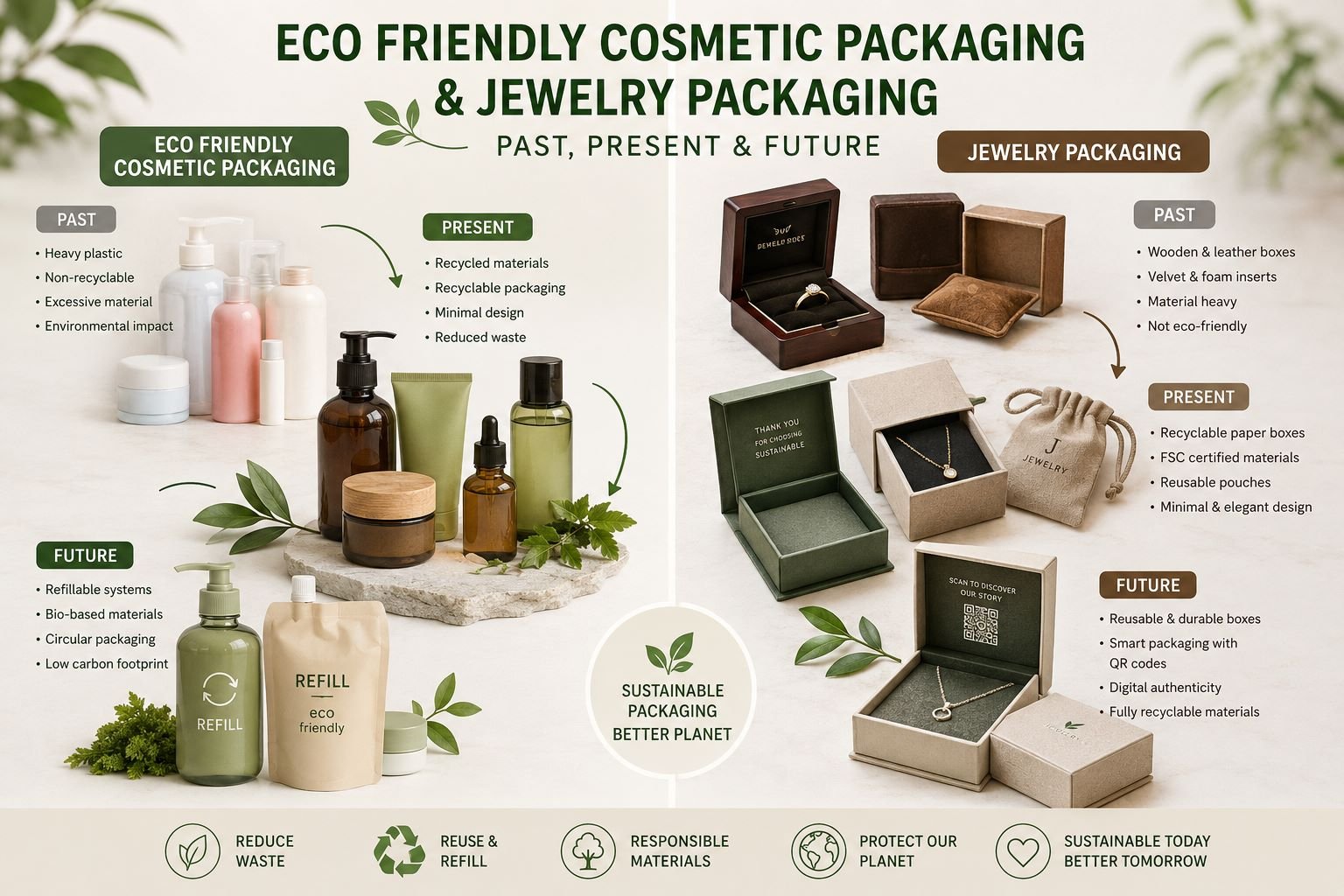
Packaging across the beauty and jewelry industries is entering a new stage of development as businesses move from conventional, material-heavy formats toward smarter and more responsible solutions. The growing focus on eco friendly cosmetic packaging and jewelry packaging reflects a wider transformation in how brands approach product protection, presentation, sustainability, and long-term customer experience.
For decades, packaging success was largely measured by appearance, convenience, and durability. Those priorities remain important, but they are no longer enough. Today’s packaging strategies increasingly consider recyclability, material reduction, refillability, transportation efficiency, responsible sourcing, and reuse.
The result is a changing marketplace where sustainable thinking and premium design are beginning to work together rather than compete.
Packaging Was Once Designed for a Different World
The packaging industry’s past was shaped by availability, manufacturing capabilities, and convenience.
Before industrial production, cosmetics were commonly stored in glass, ceramic, clay, or metal containers. Jewelry was preserved in wooden boxes, textile pouches, leather cases, and handcrafted containers.
Mass manufacturing dramatically expanded packaging possibilities.
Plastic became especially influential in the cosmetics industry because manufacturers could create affordable bottles, jars, tubes, caps, pumps, and applicators at scale. Jewelry businesses similarly gained access to standardized rigid boxes, synthetic linings, foam inserts, laminated papers, and decorative finishes.
These developments made attractive packaging more accessible but also encouraged a predominantly disposable model.
Environmental Priorities Are Changing Cosmetic Packaging
The rise of eco friendly cosmetic packaging represents a shift away from designing exclusively for the point of sale.
Packaging developers increasingly consider what happens before manufacturing and after consumers finish the product.
This lifecycle approach encourages questions such as:
- How much material is actually required?
- Does the package contain recycled content?
- Can customers refill the container?
- Can components be easily separated?
- Is the package unnecessarily heavy?
- Can it be recycled in its target market?
- Does it protect the cosmetic formula effectively?
Answering these questions early in product development can lead to more purposeful packaging decisions.
New Materials Expand Beauty Packaging Possibilities
No single material provides a universal sustainability solution.
Instead, manufacturers are exploring different options according to product requirements, transportation, available infrastructure, manufacturing processes, and intended use.
Materials being considered for eco friendly cosmetic packaging include recycled plastics, aluminum, glass, paperboard, renewable fibers, responsibly sourced paper, and selected bioplastics.
Functionality Remains Essential
Sustainability cannot come at the expense of performance.
Cosmetic containers must protect formulas against contamination, leakage, light, moisture, air exposure, and transportation damage where relevant.
This means future innovation will depend not only on finding different materials but also on engineering better packaging systems.
Jewelry Packaging Moves Beyond Traditional Luxury
The development of jewelry packaging has historically been driven by a different priority: emotional presentation.
Jewelry is closely associated with gifting and important personal occasions. Consequently, presentation boxes became an extension of the product’s perceived value.
Traditional premium packages often featured thick structures, velvet surfaces, ribbons, multiple inserts, metallic decoration, and elaborate outer boxes.
Today, a new interpretation of luxury is emerging.
Modern consumers can appreciate a beautifully designed package without expecting excessive materials. This is encouraging jewelry businesses to explore sophisticated minimalism, reusable cases, compact structures, and responsibly sourced components.
Sustainable Luxury Creates New Design Opportunities
Reducing materials does not necessarily require reducing quality.
A carefully engineered jewelry box can create an impressive presentation through proportion, texture, typography, construction, and finishing.
Modern jewelry packaging may include:
- Recycled paperboard
- Reusable fabric pouches
- Molded fiber inserts
- Compact rigid boxes
- Plastic-free components
- Minimal printed decoration
- Reusable storage cases
This approach changes the meaning of premium packaging from “more materials” to “better design.”
How Packaging Priorities Are Changing
| Consideration | Past Priority | Future Priority |
| Materials | Availability and appearance | Responsible sourcing and performance |
| Cosmetic Packaging | Convenient single-use formats | Refill and reuse opportunities |
| Jewelry Boxes | Elaborate presentation | Functional sustainable luxury |
| Packaging Size | Visual impact | Right-sized efficiency |
| Inserts | Plastic and synthetic foam | Paper and fiber alternatives |
| Consumer Information | Printed materials | Digital access |
| End-of-Life | Disposal | Reuse or recycling |
| Brand Value | Visual differentiation | Purpose plus presentation |
This evolution indicates that sustainability is becoming part of packaging performance rather than a separate feature.
Refill Systems Could Reshape the Beauty Market
Refillable systems are among the most promising directions for eco friendly cosmetic packaging.
Under this model, consumers purchase a durable primary package once and replace only the internal product component when necessary.
A refill model could be suitable for selected:
- Skincare products
- Fragrances
- Makeup products
- Haircare products
- Personal-care products
The concept may reduce the need to manufacture an entirely new decorative container for every repeat purchase.
However, successful refill systems require convenient installation, appropriate hygiene standards, product compatibility, and customer participation.
Tomorrow’s Jewelry Box Could Be Designed to Stay
Future jewelry packaging could increasingly be treated as a useful product rather than temporary packaging.
Instead of designing boxes exclusively for the initial unboxing experience, companies can create structures customers want to retain.
A ring box can become a permanent organizer. A necklace package can double as protective storage. A soft pouch can become a travel accessory.
Extending the useful life of packaging creates an opportunity to reduce disposability while increasing perceived value.
Digital Technology Adds Another Layer of Innovation
Future packaging will not necessarily rely exclusively on printed communication.
QR codes, NFC technology, and connected product systems could make packaging an entry point into a broader digital experience.
A customer scanning eco friendly cosmetic packaging might access recycling instructions, refill guidance, ingredient details, usage tutorials, or information about packaging materials.
Jewelry customers could access authenticity certificates, product registration, care instructions, warranty details, gemstone information, or craftsmanship stories.
Digital connectivity may therefore allow brands to provide more information while keeping physical packaging visually clean.
Transparency Will Become Increasingly Important
As sustainability claims become more common, consumers will need clear information to understand what those claims actually mean.
Terms such as recyclable, recycled, biodegradable, compostable, renewable, and reusable describe different characteristics.
Brands should therefore communicate packaging claims precisely.
For example, stating that a package contains a specific percentage of recycled material can provide more useful information than simply describing it as environmentally conscious.
Transparent communication can strengthen trust and help customers make better disposal decisions.
Key Developments Expected in the Years Ahead
Several developments are likely to influence future beauty and jewelry packaging.
Material efficiency: Brands may reduce package weight and eliminate unnecessary components.
Refillability: Durable containers could support repeat product purchases with smaller replacement units.
Reusable presentation: Premium jewelry boxes may increasingly double as permanent storage.
Recycled content: Manufacturers are expected to continue investigating post-consumer materials.
Smart connectivity: Digital packaging may provide product information without additional printed inserts.
Simplified construction: Reducing complex material combinations may support easier end-of-life management.
Together, these trends suggest a future centered on practical innovation rather than cosmetic sustainability claims.
Frequently Asked Questions
1. What is eco friendly cosmetic packaging?
It refers to packaging designed to reduce environmental impact through material efficiency, recycling, reuse, refillability, or responsible sourcing.
2. Why are beauty brands changing their packaging?
Consumer expectations, sustainability goals, regulations, waste concerns, and material innovation are encouraging new packaging strategies.
3. Which materials are commonly considered sustainable?
Recycled plastics, aluminum, glass, recycled paperboard, renewable fibers, and responsibly sourced paper are common options.
4. What is a refillable cosmetic container?
It is a durable outer container designed to accept replacement product refills after the original formula is finished.
5. Can jewelry packaging be environmentally responsible?
Yes. Material reduction, reusable structures, recyclable components, and responsible sourcing can improve packaging design.
6. Does sustainable jewelry packaging look less luxurious?
Not necessarily. Intelligent construction, textures, typography, and quality finishing can create sophisticated presentation.
7. Why are smaller packages becoming popular?
Right-sized packages can reduce unnecessary materials, shipping volume, storage requirements, and empty space.
8. What is connected packaging?
It uses technologies such as QR codes or NFC to link physical packaging with digital information and services.
9. Are reusable packages better than disposable packages?
They can provide advantages when customers actually reuse them and when their complete lifecycle supports the intended benefits.
10. What is the biggest future packaging trend?
Circular design—combining reduction, reuse, refillability, recycled content, and recyclability—is likely to remain highly influential.
https://newsgrow.blogspot.com/2026/08/cosmetic-packaging-boxes-deep-guide-to.html
https://newsgrow.blogspot.com/2026/08/luxury-cosmetic-packaging-and-perfume.html
https://tandtlawassociates.com/wine-packaging-and-chocolate-boxes-packaging-past-present-and-future/
https://shopnets.com/the-past-and-future-of-wine-packaging-and-chocolate-boxes-packaging/
https://newsgrow.blogspot.com/2026/08/how-wine-packaging-and-chocolate-boxes.html