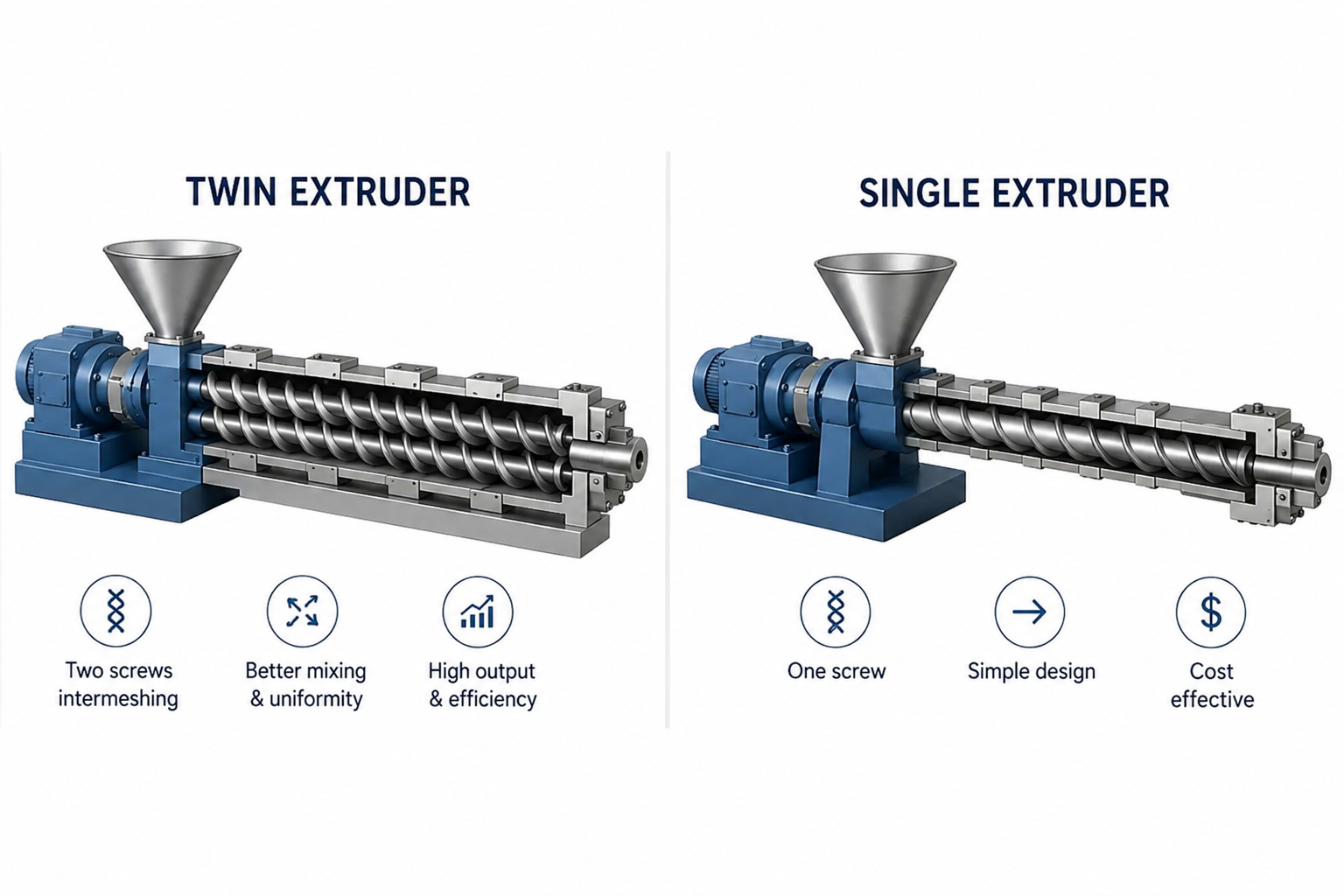
The extrusion industry has evolved significantly with advanced manufacturing technologies designed to improve productivity, material efficiency, and product quality. Among the most widely used extrusion systems, the twin extruder and single extruder are two important machines used across plastic processing, packaging, automotive, construction, medical, and consumer product industries.
Choosing between a twin extruder and a single extruder depends on several factors, including material type, production requirements, mixing capability, output volume, and final product specifications. While both machines perform the basic function of melting and shaping raw materials, their design, performance, and applications are quite different.
This detailed guide explains the differences between twin extruder and single extruder, their advantages, limitations, applications, and future developments in modern manufacturing.
What Is an Extruder?
An extruder is an industrial machine used to process raw materials, mainly plastics and polymers, by heating, melting, mixing, and forcing them through a specially designed die to create continuous shapes.
Extrusion technology is commonly used for producing:
- Plastic pipes
- Sheets and films
- Profiles
- Tubes
- Wires and cables
- Packaging materials
- Automotive components
- Medical products
The main working components of an extrusion machine include:
- Feeding system
- Barrel
- Screw mechanism
- Heating and cooling system
- Die system
- Drive motor
The screw plays a critical role because it controls material conveying, melting, mixing, and pressure generation.
Understanding Single Extruder Technology
A single extruder is an extrusion machine that uses one rotating screw inside the barrel to process polymer materials. It is one of the oldest and most commonly used extrusion technologies because of its simple structure, easy operation, and cost-effective performance.
The single screw system mainly focuses on melting and transporting materials efficiently rather than intensive mixing.
How Does a Single Extruder Work?
The working process of a single extruder includes several stages:
- Raw material enters through the feeding hopper.
- The rotating screw moves the material forward.
- Heat from the barrel and friction melts the polymer.
- The melted material becomes pressurized.
- The material passes through the die to form the required shape.
- The final product is cooled and collected.
Advantages of Single Extruder
A single extruder provides several benefits for manufacturers:
- Simple machine design
- Lower initial investment
- Easy maintenance
- Lower energy consumption
- Reliable operation
- Suitable for continuous production
- Good performance with uniform materials
Applications of Single Extruder
Single screw extrusion is widely used in industries such as:
- Plastic pipe manufacturing
- Film production
- Sheet extrusion
- Cable coating
- Profile extrusion
- Basic polymer processing
Understanding Twin Extruder Technology
A twin extruder uses two rotating screws placed inside the barrel. These screws work together to improve mixing, melting, and material processing performance.
Twin screw extrusion technology is especially useful when manufacturers need better dispersion, higher flexibility, and processing of complex materials.
How Does a Twin Extruder Work?
The operating process of a twin extruder involves:
- Materials are introduced through the feeding system.
- Two screws rotate together to move the material.
- Strong mechanical action improves mixing.
- Heat and shear forces create uniform melting.
- Additives, fillers, and reinforcements are blended effectively.
- The processed material exits through the die.
Types of Twin Extruders
There are two major types of twin screw systems:
1. Co-Rotating Twin Extruder
In this design, both screws rotate in the same direction.
Benefits include:
- Excellent mixing capability
- High production efficiency
- Better compounding performance
- Suitable for polymer blends
2. Counter-Rotating Twin Extruder
In this system, screws rotate in opposite directions.
Benefits include:
- Controlled material movement
- Lower shear processing
- Suitable for sensitive materials
Twin Extruder vs Single Extruder: Key Differences
| Feature | Twin Extruder | Single Extruder |
| Screw Design | Two screws | One screw |
| Mixing Ability | Excellent mixing performance | Limited mixing capability |
| Production Cost | Higher investment | Lower investment |
| Maintenance | More complex | Easier maintenance |
| Energy Consumption | Generally higher | Lower energy usage |
| Material Flexibility | Handles complex materials | Best for simple materials |
| Output Quality | More uniform processing | Suitable for standard applications |
| Additive Processing | Excellent | Limited |
| Processing Speed | High efficiency | Moderate efficiency |
Major Benefits of Twin Extruder Over Single Extruder
A twin extruder offers advanced processing advantages that make it suitable for demanding manufacturing environments.
Better Material Mixing
The two-screw system creates stronger mixing forces, allowing manufacturers to combine:
- Polymers
- Color additives
- Fillers
- Reinforcing materials
- Flame retardants
This results in improved product consistency.
Improved Processing Flexibility
A twin extruder can process various materials, including:
- Engineering plastics
- Recycled polymers
- Polymer blends
- Filled compounds
Higher Production Efficiency
Twin screw technology supports faster processing and improved output quality for large-scale production.
Advantages of Single Extruder in Manufacturing
Although twin screw machines provide advanced features, a single extruder remains valuable for many applications.
Cost-Effective Solution
For manufacturers producing standard plastic products, single extrusion offers an affordable solution with lower operating costs.
Easy Operation
The simple screw structure allows:
- Faster training
- Easier troubleshooting
- Reduced maintenance requirements
Reliable Performance
Single extruders provide consistent results when processing materials with stable characteristics.
Factors to Consider When Choosing Between Twin Extruder and Single Extruder
Selecting the right extrusion system requires careful evaluation.
1. Material Requirements
If the material requires intensive mixing or additives, a twin extruder is usually more suitable.
For standard polymers, a single extruder may provide better cost efficiency.
2. Production Volume
High-volume manufacturing often benefits from advanced twin screw technology.
Small and medium production operations may prefer single extrusion systems.
3. Product Quality Requirements
Industries requiring precise material properties should consider twin extrusion because of better dispersion and uniformity.
4. Investment Budget
A single extruder requires less capital investment, while a twin extruder provides more advanced capabilities at a higher cost.
Industrial Applications Comparison
| Industry | Single Extruder Application | Twin Extruder Application |
| Packaging | Films and sheets | Advanced polymer blends |
| Automotive | Basic plastic components | Reinforced engineering plastics |
| Construction | Pipes and profiles | Modified materials |
| Medical | Tubing products | Specialized compounds |
| Recycling | Basic recycling | High-quality recycled compounds |
Future Trends in Twin Extruder and Single Extruder Technology
The future of extrusion technology is focused on automation, sustainability, and energy efficiency.
Smart Extrusion Systems
Modern extrusion machines are adopting:
- Artificial intelligence monitoring
- Digital controls
- Automated adjustments
- Real-time quality analysis
Sustainable Material Processing
Manufacturers are increasingly using extrusion technology for:
- Recycled plastics
- Bio-based polymers
- Eco-friendly materials
Energy-Efficient Designs
Future machines will focus on:
- Lower power consumption
- Improved heating systems
- Reduced material waste
Advanced Polymer Development
The demand for high-performance materials will continue increasing the use of twin extruder technology for specialized applications.
Frequently Asked Questions About Twin Extruder and Single Extruder
1. What is the main difference between a twin extruder and a single extruder?
The main difference is the screw design. A twin extruder uses two screws for better mixing, while a single extruder uses one screw mainly for melting and transportation.
2. Which extruder provides better mixing performance?
A twin extruder provides better mixing because two screws create stronger mechanical interaction and material dispersion.
3. Is a single extruder cheaper than a twin extruder?
Yes, a single extruder generally has a lower purchase price and maintenance cost compared to a twin screw system.
4. Which extruder is better for plastic recycling?
A twin extruder is often preferred for advanced recycling because it can handle mixed materials and improve material consistency.
5. Can a single extruder process additives?
Yes, but its mixing capability is limited compared with a twin extruder.
6. Which extruder consumes more energy?
Generally, a twin extruder consumes more energy because it performs intensive mixing and processing operations.
7. Which industries use twin extruders?
Twin extruders are commonly used in automotive, electronics, polymer compounding, recycling, and engineering plastics industries.
8. Are single extruders still used today?
Yes, single extruders remain widely used because they are reliable, affordable, and effective for standard extrusion applications.
9. Which extruder has higher production efficiency?
A twin extruder usually provides higher efficiency for complex materials, while a single extruder works efficiently for simple applications.
10. How do I choose between a twin extruder and a single extruder?
The choice depends on material type, production goals, product quality requirements, budget, and processing complexity.