
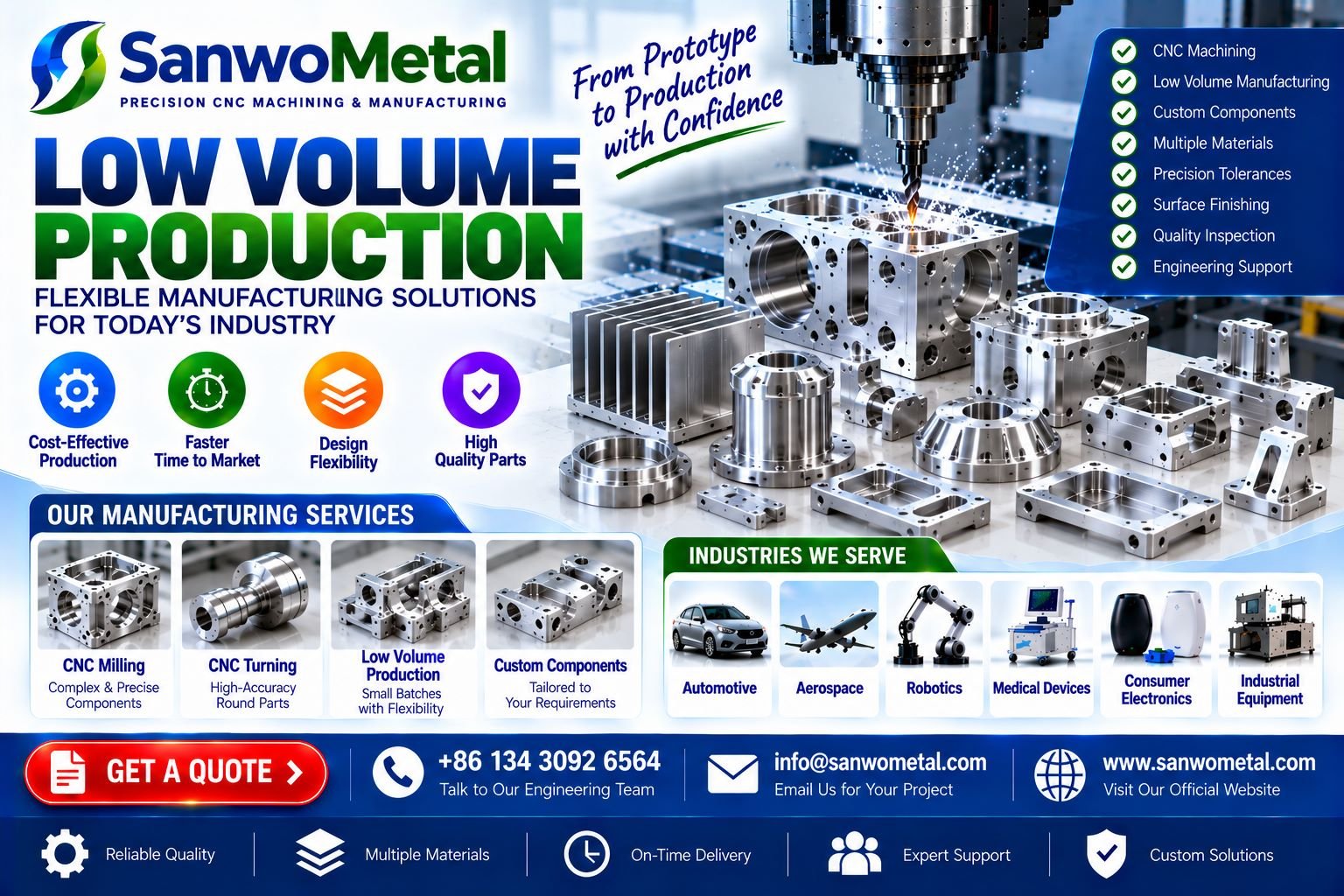
Mass production can provide advantages for products with consistently high demand. However, smaller manufacturing requirements often call for a different approach.
Low volume production enables businesses to manufacture limited quantities of components according to specific engineering requirements without necessarily investing in extensive mass-production tooling.
Similarly, low volume manufacturing can support customised industrial equipment, replacement parts, product variations, and specialised maintenance programmes.
For original equipment manufacturers, industrial distributors, and engineering companies, this approach offers opportunities to manage specialised component requirements while maintaining greater production flexibility.
Why Specialised Equipment Needs Flexible Manufacturing
Industrial machinery often contains components designed for particular operating conditions.
These parts may include custom mounting brackets, machine housings, precision connectors, metal adapters, and mechanical supports.
Some components are required in substantial quantities, while others are needed only for specific installations.
Traditional high-volume manufacturing may not always be economical for these smaller requirements.
Flexible manufacturing arrangements allow businesses to consider smaller quantities without automatically committing to large production orders.
What Is Low Volume Production?
Low volume production refers to manufacturing relatively small quantities of components or finished products according to defined specifications.
Unlike mass production, which focuses on large quantities of standardised products, low-volume operations accommodate smaller manufacturing requirements.
The actual quantity considered low-volume depends on the industry, product complexity, and production method.
Common applications include customised industrial components, replacement parts, specialist equipment, and limited product configurations.
Manufacturing methods may include CNC machining, sheet metal fabrication, casting, or other suitable processes.
The appropriate method depends on material requirements, component geometry, production quantity, and expected quality.
Understanding Low Volume Manufacturing
Low volume manufacturing is a broader production approach that supports smaller quantities through flexible manufacturing processes and carefully managed resources.
Its purpose is not necessarily to produce parts faster or more cheaply in every situation.
Instead, it allows manufacturers to match production methods to specialised demand.
For example, a company producing industrial automation equipment may require custom metal brackets for different customer installations.
Manufacturing these components in smaller batches can accommodate project-specific dimensions.
However, production planning must still consider setup expenses, inspection requirements, and material availability.
Supporting Replacement Parts for Industrial Equipment
Industrial machines may remain operational even when certain replacement components become difficult to obtain.
Equipment manufacturers sometimes discontinue older product configurations, creating challenges for maintenance teams.
Where legal rights, technical documentation, and engineering requirements permit, custom manufacturing can provide a potential replacement-part solution.
For example, a worn mechanical spacer or mounting plate may be reproduced using approved drawings and suitable materials.
However, the replacement must satisfy relevant dimensional, mechanical, and safety requirements.
Reverse engineering should not be treated as a substitute for appropriate design verification.
Critical components require particularly careful technical assessment.
Why Product Customisation Benefits From Smaller Production Runs
Industrial customers frequently request equipment modifications suited to their operating environments.
A standard machine component may need different mounting positions, dimensions, or connection features.
Producing every variation in large quantities can create unnecessary inventory.
Smaller manufacturing runs allow businesses to accommodate approved custom requirements.
However, manufacturers must control design revisions carefully.
A customised part should be manufactured according to approved technical documents rather than informal instructions.
Comparing Manufacturing Approaches
| Manufacturing Factor | Low Volume Manufacturing | High Volume Manufacturing |
| Production Quantity | Smaller batches | Larger quantities |
| Product Variations | Often easier to accommodate | Typically more standardised |
| Tooling Investment | Depends on selected process | May justify dedicated tooling |
| Unit Cost | Can be higher | May decrease with scale |
| Main Applications | Specialised components and custom orders | Established products with substantial demand |
| Planning Priority | Flexibility and specification control | Throughput and process efficiency |
Neither approach is universally superior. The appropriate choice depends on the product and commercial requirements.
Material Selection for Custom Components
Small-batch manufacturing supports a range of engineering materials.
Depending on component requirements, businesses may select aluminium, stainless steel, brass, carbon steel, or suitable engineering plastics.
Each material offers different characteristics involving strength, corrosion resistance, machinability, and thermal behaviour.
For example, stainless steel may be appropriate for selected corrosion-resistant equipment applications.
However, the actual alloy grade and operating environment determine suitability.
Material substitutions should receive appropriate engineering approval before production.
Why Technical Documentation Matters
Clear documentation is essential when manufacturing customised or replacement components.
Engineering drawings should identify relevant dimensions, tolerances, materials, and functional requirements.
Additional instructions may address surface finishing, inspection methods, and assembly considerations.
For replacement parts, designers should confirm that available documentation represents the correct equipment configuration.
Incomplete specifications can lead to components that appear similar but do not function correctly.
Manufacturers should resolve important technical questions before machining or fabrication begins.
Maintaining Quality Across Small Production Batches
Smaller production quantities do not eliminate the need for quality assurance.
Components must still satisfy defined specifications and acceptance criteria.
Depending on the application, inspection may include dimensional measurements, material confirmation, surface examination, and functional testing.
A manufacturer should identify the critical features that influence component performance.
Inspection records can support consistency when similar parts are manufactured again.
Appropriate quality controls help businesses manage manufacturing variation without assuming that every small batch will behave identically.
Cost Considerations in Small-Batch Manufacturing
Manufacturing costs depend on several interconnected factors.
Material prices, machine setup, programming, component complexity, finishing, and inspection requirements can all influence quotations.
Smaller orders may carry higher unit costs because fixed manufacturing expenses are distributed across fewer parts.
However, ordering excessive quantities may also create storage expenses and unused inventory.
Businesses should evaluate total project requirements before determining order quantities.
A technically suitable manufacturing plan considers both immediate component needs and realistic future demand.
Choosing a Reliable Manufacturing Partner
Industrial buyers should evaluate suppliers according to their technical capabilities and ability to handle specialised requirements.
Important considerations include:
- Manufacturing Capabilities: Suitable equipment and production processes.
- Engineering Support: Ability to interpret drawings and identify technical concerns.
- Material Experience: Familiarity with required metals and plastics.
- Customisation: Support for approved component variations.
- Quality Inspection: Appropriate dimensional and material verification.
- Order Flexibility: Clear information about supported quantities and commercial terms.
An effective supplier relationship depends on transparent communication and well-defined technical requirements.
Frequently Asked Questions (FAQs)
1. What is low volume production?
Low volume production involves manufacturing relatively small quantities of components or finished products according to specific technical and commercial requirements.
2. What is low volume manufacturing used for?
It is commonly used for customised equipment components, specialised industrial products, replacement parts, and limited-quantity manufacturing requirements.
3. Can low-volume methods support industrial spare parts?
Yes. Suitable replacement parts can be manufactured when accurate specifications, appropriate materials, and necessary engineering approvals are available.
4. Is low-volume manufacturing more expensive than mass production?
Individual part costs may be higher because setup expenses are distributed across fewer units, but total project costs depend on actual demand and manufacturing requirements.
5. How can businesses choose a low-volume manufacturing supplier?
Businesses should review production capabilities, material expertise, technical communication, quality procedures, and the supplier’s ability to meet specified requirements.
Media Contact
Department: Precision Manufacturing and Custom Metal Component Enquiries
Enquiry Categories: Low Volume Production, Low Volume Manufacturing, Custom Metal Parts, Industrial Components, and Precision CNC Machining.
Phone: +86 (0755) 2717 0914
Email: info@sanwometal.com
Official Website: https://www.sanwometal.com/