
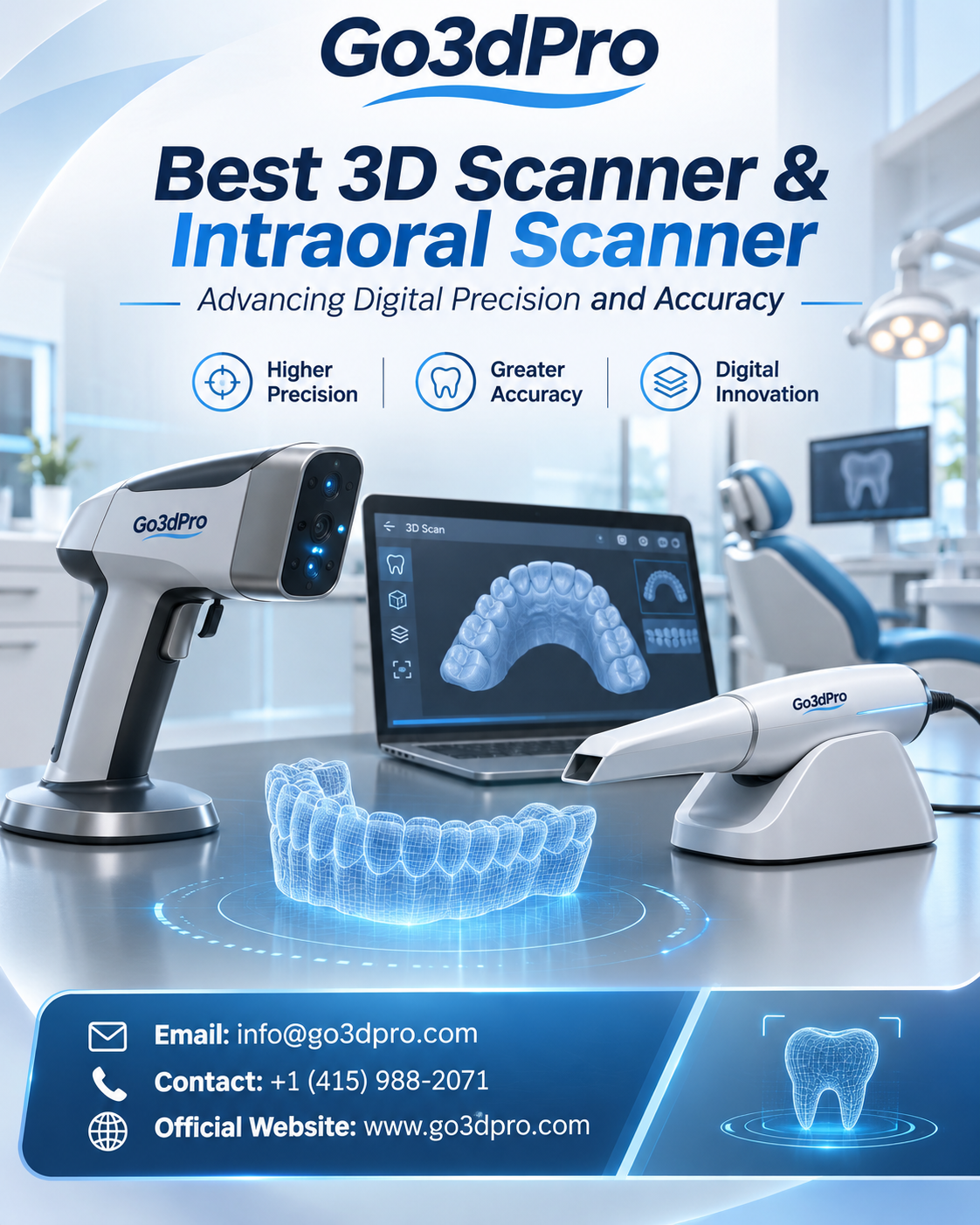
From engineering laboratories to dental clinics, accurate digital representations have become valuable tools for measurement, communication, and professional decision-making.
Choosing the Best 3D Scanner involves more than comparing resolution, scanning speed, or equipment specifications. Buyers must understand whether the captured data can reliably support their intended applications.
Similarly, an intraoral scanner allows dental professionals to create digital impressions of oral structures, supporting suitable clinical and laboratory workflows.
Although these technologies serve different industries, they share an important challenge: capturing three-dimensional data that remains useful, consistent, and appropriately verified.
For engineering companies, manufacturing businesses, dental professionals, and technology buyers, the focus is shifting towards data quality rather than simply producing visually impressive digital models.
Why Digital Accuracy Is Becoming a Business Priority
Three-dimensional scanning converts information about physical surfaces into digital representations.
These representations can support manufacturing inspection, product development, dental restoration design, and other specialised applications.
However, an attractive digital model does not necessarily guarantee accurate measurements.
Scanning conditions, calibration, software processing, and operator technique can influence the final result.
This distinction encourages professional users to evaluate the complete data-capture process.
What Makes the Best 3D Scanner Reliable?
The Best 3D Scanner depends on the measurement requirements, object characteristics, working environment, and intended use.
Industrial scanners may use structured-light technology, laser-based measurement, or other optical techniques.
Suitable applications include reverse engineering, product inspection, prototype evaluation, and digital documentation.
For example, a manufacturing engineer may need a scanner capable of capturing complex mechanical surfaces.
A product designer may prioritise detailed geometry and convenient model processing.
A quality inspection department may require verified measurement performance.
Therefore, one scanning system cannot automatically be considered the best choice for every professional application.
Understanding Intraoral Scanner Technology
An intraoral scanner is a digital dental device used to capture three-dimensional information about teeth and accessible oral structures.
It can support digital impressions for appropriate restorative and orthodontic applications.
During scanning, the device collects surface information that software processes into a digital representation.
Dental professionals can review the scan and, where compatible, use the information in laboratory or design workflows.
However, scanning accuracy may be influenced by moisture, visibility, scanning technique, and the extent of the area being captured.
The technology supports clinical procedures but does not replace professional examination or diagnosis.
Why Data Quality Matters More Than Visual Detail
A highly detailed scan may contain thousands or millions of data points, but information quantity is not the same as measurement accuracy.
Errors can occur during image capture, alignment, or software reconstruction.
For industrial applications, these errors may affect dimensional evaluation or the creation of reference geometry.
For dental applications, inaccurate digital impressions may influence downstream restoration design and fitting.
Professionals should therefore establish appropriate quality checks.
Reliable scanning involves both suitable equipment and consistent operating procedures.
Understanding Accuracy, Resolution, and Repeatability
These terms are frequently used when evaluating scanning equipment, but they describe different characteristics.
| Measurement Factor | Meaning | Why It Matters |
| Accuracy | Closeness to an accepted reference | Supports dependable measurement |
| Resolution | Ability to represent fine detail | Influences surface representation |
| Repeatability | Consistency under repeated conditions | Helps evaluate process stability |
| Scan Coverage | Area or geometry captured | Determines application suitability |
| Data Completeness | Availability of required surface information | Supports downstream processing |
Buyers should review how manufacturers define and test these characteristics.
Specifications obtained under controlled conditions may not fully represent every working environment.
How Scanning Errors Affect Digital Manufacturing
In product development, scanning errors may influence the geometry used for reverse engineering or inspection.
Reflective surfaces, complex shapes, and areas hidden from the scanner can create capture difficulties.
Suitable scanning techniques may require different viewing positions or additional preparation.
Engineers should review the resulting data for missing surfaces, alignment errors, and unwanted artefacts.
Software tools can help process captured information, but excessive smoothing or reconstruction may alter important details.
For critical measurements, suitable independent verification may be necessary.
The purpose is to ensure that digital models are fit for their intended engineering use.
Why Dental Scanning Requires Clinical Evaluation
Dental scanning introduces considerations that differ from industrial measurement.
An intraoral device must operate within a confined clinical environment while capturing accessible oral structures.
Moisture, patient movement, and limited visibility can influence scanning performance.
Dental professionals should examine scans for missing areas, distortions, or incomplete preparation margins where relevant.
An unsuitable scan may need additional capture before proceeding with downstream work.
Clinical suitability also depends on the device’s intended use, regulatory status, and the procedure being performed.
Accurate scanning supports professional decisions but cannot independently guarantee successful treatment outcomes.
The Value of Reliable Data Management
Captured scans often become part of wider digital processes.
Industrial models may be transferred to CAD software, inspection systems, or engineering databases.
Dental scan files may be shared with compatible laboratories for approved restorative workflows.
These processes require appropriate file management and data integrity.
Businesses should establish suitable procedures for naming files, managing versions, and preventing unintended modifications.
For dental applications, patient confidentiality and applicable data-protection requirements are particularly important.
Digital scanning investments should therefore consider information management alongside hardware capabilities.
Evaluating Scanner Performance Before Purchasing
Professional buyers can benefit from testing equipment with representative applications.
Important evaluation steps include:
- Define Requirements: Identify the surfaces, objects, or structures to be scanned.
- Review Accuracy: Examine relevant measurement specifications and validation information.
- Test Real Applications: Evaluate representative scanning tasks.
- Check Software: Confirm compatibility with required downstream systems.
- Assess Usability: Consider equipment handling and operator training.
- Review Support: Evaluate maintenance, updates, and technical assistance.
A practical demonstration can reveal limitations that are not immediately apparent from promotional specifications.
The goal is to select equipment that supports dependable professional results.
Frequently Asked Questions (FAQs)
1. What is the Best 3D Scanner for professional use?
The best scanner depends on the required accuracy, object size, surface characteristics, software compatibility, and intended industrial or technical application.
2. What is an intraoral scanner used for?
An intraoral scanner captures digital impressions of teeth and accessible oral structures for suitable dental procedures and laboratory workflows.
3. Are 3D scanning resolution and accuracy the same?
No. Resolution concerns the representation of detail, while accuracy describes how closely measurements correspond to an accepted reference.
4. Can an industrial 3D scanner replace a dental intraoral scanner?
Generally, no. The devices serve different purposes, and dental scanners must meet relevant clinical, safety, and regulatory requirements.
5. What should buyers check before selecting digital scanning equipment?
Buyers should evaluate measurement performance, application suitability, software integration, operator training, data management, technical support, and overall ownership costs.
Media Contact
Department: 3D Scanning Technology and Dental Equipment Enquiries
Contact: +1 (415) 988-2071
Email: info@go3dpro.com
Official Website: https://www.go3dpro.com/
Read More:-